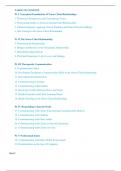
TABLE OF CONTENT
Pt. I Conceptual Foundations of Nurse-Client Relationships
1. Theoretical Perspectives and Contemporary Issues
2. Professional Guides to Action in Interpersonal Relationships
3. Clinical Judgment: Applying Critical Thinking and Ethical Decision Making
4. Self-Concept in the Nurse-Client Relationship
Pt. II The Nurse-Client Relationship
5. Structuring the Relationship
6. Bridges and Barriers in the Therapeutic Relationship
7. Role Relationship Patterns
8. The Grief Experience: Life's Losses and Endings
Pt. III Therapeutic Communication
9. Communication Styles
10. Developing Therapeutic Communication Skills in the Nurse-Client Relationship
11. Intercultural Communication
12. Communicating in Groups
13. Communicating with Families
14. Resolving Conflict Between Nurse and Client
15. Health Promotion and Client Learning Needs
16. Health Teaching in the Nurse-Client Relationship
Pt. IV Responding to Special Needs
17. Communicating with Clients Experiencing Communication Deficits
18. Communicating with Children
19. Communicating with Older Adults
20. Communicating with Clients in Stressful Situations
21. Communicating with Clients in Crisis
Pt. V Professional Issues
22. Communicating with Other Health Professionals
23. Documentation in the Age of Computers
Med C
, Test Bank for Interpersonal Relationships Professional Communication
Skills for Nurses 6th Edition Arnold
Chapter 1: Theoretical Perspectives and Contemporary Issues
MULTIPLE CHOICE
1. Which of the following best describes the role of theory in the nurse-client
relationship?
a. Theory provides a common language.
b. Theory is the essence of the nurse-client relationship.
c. Theory varies with changes in health care delivery.
d. Theory guides nursing practice.
ANS: D
Theory provides nurses with a systematic way to view client situations and a logical way
to organize and interpret data. Incorrect answers: 1. Theory does provide a common
language for nurses, but this question asks what best describes the role of theory in the
nurse-client relationship. 2. Theory acts as a framework or guide; it is not the essence of
the relationship. 3. Theory provides a common framework for describing practice.
DIF: Cognitive Level: Comprehension REF: Text Page Reference: p. 3 TOP:
Step of the Nursing Process: All phases
MSC: Client Needs: Safe, Effective Care Environment: Management of Care
2. Nurse Jones demonstrates the application of modern nursing theory when she:
a. Administers insulin to a client with diabetes
b. Assists a physician with a pelvic examination
c. Teaches a client techniques of self breast examination
d. Makes up a client’s bed
ANS: C
Modern nursing theory has broadened the definition of health with a strong emphasis on
disease prevention and health promotion. Incorrect answers: 1,2,4. These are all nursing
tasks, and modern nursing theory puts less emphasis on tasks and systems.
DIF: Cognitive Level: Application REF: Text Page Reference: p. 22 TOP: Step of
the Nursing Process: Implementation
MSC: Client Needs: Health Promotion and Maintenance
3. Nursing theory originated with which of the following nursing leaders?
Med C
, a. Virginia Henderson
b. Martha Rogers
c. Dorothea Orem
d. Florence Nightingale
ANS: D
Theory development began when Florence Nightingale published her notes on nursing in
1859. Incorrect answers: 1,2,3. These nursing theorists began their theory development
from the 1940s onward.
DIF: Cognitive Level: Knowledge REF: Text Page Reference: p. 3
TOP: Step of the Nursing Process: All phases
MSC: Client Needs: Management of Care
4. Virginia Henderson, Sister Callista Roy, Jean Watson, Dorothea Orem,
and Rosemary Parse are best known for:
a. Developing nursing theories
b. Linking theory to practice
c. Validating existing theory
d. Measuring clinical outcomes
ANS: A
These are some of the nursing leaders who developed the original theories of nursing.
Incorrect answers: 2,3,4. Linking theory to practice, validating existing theory, and
measuring clinical outcomes are modern practice based theories.
DIF: Cognitive Level: Comprehension REF: Text Page Reference: p. 3 TOP:
Step of the Nursing Process: All phases
MSC: Client Needs: Management of Care
5. Nursing’s metaparadigm:
a. Helps bind nursing to other professions
b. Consists of three elements—person, health, and nursing
c. Makes nursing’s functions unique
d. Is a view of the immediate environment
ANS: C
Med C
, Nursing’s metaparadigm is a worldwide view that makes its functions unique. Incorrect
answers: 1. Nursing’s metaparadigm distinguishes nursing from other professions. 2.
Nursing’s metaparadigm consists of four elements: person, environment, health, and
nursing. 4. It is a worldview.
DIF: Cognitive Level: Knowledge REF: Text Page Reference: p. 4
TOP: Step of the Nursing Process: All phases
MSC: Client Needs: Management of Care
6. Nurse Green, when admitting Mr. Brown to the medical-surgical unit, asks him about
cultural issues. By doing this, Nurse Green is demonstrating use of the concept of:
a. Person
b. Environment
c. Health
d. Nursing
ANS: B
The concept of environment includes cultural and religious beliefs. Incorrect answers: 1.
Person is the recipient of care. 3. Health emphasizes well-being. 4. Nursing empowers
clients to achieve health.
DIF: Cognitive Level: Application REF: Text Page Reference: p. 5 TOP: Step of
the Nursing Process: Assessment
MSC: Client Needs: Psychosocial Integrity
7. Mary, a young mother, tells you “I’m worried because my son needs a blood
transfusion. I don’t know what to do, because blood transfusions cause AIDS.” Which
central nursing concept is represented in this situation?
a. Environment
b. Caring
c. Health
d. Person
ANS: D
With the concept of person, nurses provide educational and emotional support to families.
Incorrect answers: 1. Environment refers to the internal and external context of the client.
2. Caring is an essential characteristic of the practice of nursing. 3. Health emphasizes the
equilibrium of all elements.
DIF: Cognitive Level: Application REF: Text Page Reference: p. 4 TOP: Step of
the Nursing Process: Implementation
MSC: Client Needs: Psychosocial Integrity
Med C
Pt. I Conceptual Foundations of Nurse-Client Relationships
1. Theoretical Perspectives and Contemporary Issues
2. Professional Guides to Action in Interpersonal Relationships
3. Clinical Judgment: Applying Critical Thinking and Ethical Decision Making
4. Self-Concept in the Nurse-Client Relationship
Pt. II The Nurse-Client Relationship
5. Structuring the Relationship
6. Bridges and Barriers in the Therapeutic Relationship
7. Role Relationship Patterns
8. The Grief Experience: Life's Losses and Endings
Pt. III Therapeutic Communication
9. Communication Styles
10. Developing Therapeutic Communication Skills in the Nurse-Client Relationship
11. Intercultural Communication
12. Communicating in Groups
13. Communicating with Families
14. Resolving Conflict Between Nurse and Client
15. Health Promotion and Client Learning Needs
16. Health Teaching in the Nurse-Client Relationship
Pt. IV Responding to Special Needs
17. Communicating with Clients Experiencing Communication Deficits
18. Communicating with Children
19. Communicating with Older Adults
20. Communicating with Clients in Stressful Situations
21. Communicating with Clients in Crisis
Pt. V Professional Issues
22. Communicating with Other Health Professionals
23. Documentation in the Age of Computers
Med C
, Test Bank for Interpersonal Relationships Professional Communication
Skills for Nurses 6th Edition Arnold
Chapter 1: Theoretical Perspectives and Contemporary Issues
MULTIPLE CHOICE
1. Which of the following best describes the role of theory in the nurse-client
relationship?
a. Theory provides a common language.
b. Theory is the essence of the nurse-client relationship.
c. Theory varies with changes in health care delivery.
d. Theory guides nursing practice.
ANS: D
Theory provides nurses with a systematic way to view client situations and a logical way
to organize and interpret data. Incorrect answers: 1. Theory does provide a common
language for nurses, but this question asks what best describes the role of theory in the
nurse-client relationship. 2. Theory acts as a framework or guide; it is not the essence of
the relationship. 3. Theory provides a common framework for describing practice.
DIF: Cognitive Level: Comprehension REF: Text Page Reference: p. 3 TOP:
Step of the Nursing Process: All phases
MSC: Client Needs: Safe, Effective Care Environment: Management of Care
2. Nurse Jones demonstrates the application of modern nursing theory when she:
a. Administers insulin to a client with diabetes
b. Assists a physician with a pelvic examination
c. Teaches a client techniques of self breast examination
d. Makes up a client’s bed
ANS: C
Modern nursing theory has broadened the definition of health with a strong emphasis on
disease prevention and health promotion. Incorrect answers: 1,2,4. These are all nursing
tasks, and modern nursing theory puts less emphasis on tasks and systems.
DIF: Cognitive Level: Application REF: Text Page Reference: p. 22 TOP: Step of
the Nursing Process: Implementation
MSC: Client Needs: Health Promotion and Maintenance
3. Nursing theory originated with which of the following nursing leaders?
Med C
, a. Virginia Henderson
b. Martha Rogers
c. Dorothea Orem
d. Florence Nightingale
ANS: D
Theory development began when Florence Nightingale published her notes on nursing in
1859. Incorrect answers: 1,2,3. These nursing theorists began their theory development
from the 1940s onward.
DIF: Cognitive Level: Knowledge REF: Text Page Reference: p. 3
TOP: Step of the Nursing Process: All phases
MSC: Client Needs: Management of Care
4. Virginia Henderson, Sister Callista Roy, Jean Watson, Dorothea Orem,
and Rosemary Parse are best known for:
a. Developing nursing theories
b. Linking theory to practice
c. Validating existing theory
d. Measuring clinical outcomes
ANS: A
These are some of the nursing leaders who developed the original theories of nursing.
Incorrect answers: 2,3,4. Linking theory to practice, validating existing theory, and
measuring clinical outcomes are modern practice based theories.
DIF: Cognitive Level: Comprehension REF: Text Page Reference: p. 3 TOP:
Step of the Nursing Process: All phases
MSC: Client Needs: Management of Care
5. Nursing’s metaparadigm:
a. Helps bind nursing to other professions
b. Consists of three elements—person, health, and nursing
c. Makes nursing’s functions unique
d. Is a view of the immediate environment
ANS: C
Med C
, Nursing’s metaparadigm is a worldwide view that makes its functions unique. Incorrect
answers: 1. Nursing’s metaparadigm distinguishes nursing from other professions. 2.
Nursing’s metaparadigm consists of four elements: person, environment, health, and
nursing. 4. It is a worldview.
DIF: Cognitive Level: Knowledge REF: Text Page Reference: p. 4
TOP: Step of the Nursing Process: All phases
MSC: Client Needs: Management of Care
6. Nurse Green, when admitting Mr. Brown to the medical-surgical unit, asks him about
cultural issues. By doing this, Nurse Green is demonstrating use of the concept of:
a. Person
b. Environment
c. Health
d. Nursing
ANS: B
The concept of environment includes cultural and religious beliefs. Incorrect answers: 1.
Person is the recipient of care. 3. Health emphasizes well-being. 4. Nursing empowers
clients to achieve health.
DIF: Cognitive Level: Application REF: Text Page Reference: p. 5 TOP: Step of
the Nursing Process: Assessment
MSC: Client Needs: Psychosocial Integrity
7. Mary, a young mother, tells you “I’m worried because my son needs a blood
transfusion. I don’t know what to do, because blood transfusions cause AIDS.” Which
central nursing concept is represented in this situation?
a. Environment
b. Caring
c. Health
d. Person
ANS: D
With the concept of person, nurses provide educational and emotional support to families.
Incorrect answers: 1. Environment refers to the internal and external context of the client.
2. Caring is an essential characteristic of the practice of nursing. 3. Health emphasizes the
equilibrium of all elements.
DIF: Cognitive Level: Application REF: Text Page Reference: p. 4 TOP: Step of
the Nursing Process: Implementation
MSC: Client Needs: Psychosocial Integrity
Med C