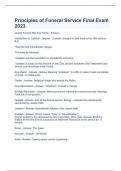
Principles of Funeral Service Final Exam 2023
Jewish Funeral Rite Key Terms - Answer- Introduction to Judaism - Answer- *Judaism, thought to date back to the 16th century B.C. *Was the first monotheistic religion. *Founded by Abraham. *Judaism was the foundation for Christianity and Islam. *Judaism is based on the doctrine of one God, ancient scriptures (Old Testament) and talmud (oral teachings of the Torah). Aron/Aaron - Answer- Hebrew Meaning "container". A coffin or casket made completely of wood- no metal parts. Cantor - Answer- Religious singer who assists the Rabbi Chevrah Kadisha - Answer- "Washers". Trained in Tahara El Molei Rachamin - Answer- Molei sometimes referred to memorial service. Meaning, "God full of compassion." Hesped - Answer- Part of the funeral service. Eulogy - evaluate the individual life sanctioned by Jewish faith. Judaism - Answer- Monotheistic religion of the Jewish faith. Kaddish - Answer- Which means, "Holy" or "Sanctification." Prayer recited for the deceased by direct mourners, Mom, Dad, Spouse, Brothers, Sisters for the first time at conclusion of interment. Recited at every service for 11 months. Kever - Answer- The grave Kevurah - Answer- The Burial Kriah - Answer- Tearing upper corner of garment Levaya - Answer- Funeral cortege Menorah - Answer- A candelabrum with a central stem bearing 7 candles; it is the oldest symbol in Judaism. Minyan - Answer- Quorum of 10 men over the age of 13. Mogen David - Answer- Star of David Rabbi - Answer- Teacher or ordained leader in the Jewish faith. Shabbat - Answer- The Jewish Sabbath begins sundown Friday ends sundown Saturday Shivah - Answer- 7 days of mourning following the burial. The Shiva marks a 7 day period of intense mourning beginning on the day of the burial. During this period of time, the family members are "encouraged to stay away from work or school, to remain at home, and to contemplate the meaning of life and the manner in which adjustment will be made to the death of the beloved." During this 7 day period, the mourners are discouraged from any act which will call attention to themselves, even to the extent of covering all the mirrors in the home. The family will often sit on Shiva stools, which are low to the ground, in order to humble themselves while they contemplate life following the death of a loved one. Services are to be conducted in the morning, afternoon, and evening during this time and a Shiva (7 day) candle burns throughout this period. Shivah Candle - Answer- Special candle burned 7 days of mourning Sholoshism - Answer- Meaning 30 in the Jewish faith; The 30 - day mourning period. Shomer - Answer- Watcher (sitter) Remains with the body until the burial Shroud - Answer- A cloth or garment in which a dead person is wrapped or dressed for burial. Synagogue - Answer- The local organization and place of worship of a Jewish congregation. Tachrichim - Answer- Hand sewn white linen; shroud decedent dressed in Taharah - Answer- Ceremony performed by Chevra Kaddisha, washing the deceased before burial, ritual, purification, cleansing of the body. Tallith - Answer- A prayer shawl worn by men during the morning prayer service. Temple - Answer- Religious building of reform and conservative Jews. Torah - Answer- Book of law, instruction, and learning. Yahrzeit - Answer- Anniversary of the date of death which Kaddish is recited. Yahrzeit Candle - Answer- Candle burned for 24 hours on anniversary of death. Yizkor - Answer- Memorial service recited four times a year. Yamaka/Yarmulke/Kippah - Answer- Skull cap worn by Jewish males. Jews express their religious beliefs at 3 distinct levels - Answer- 1). Orthodox - The most traditional and strict in regards to dress, language, and life-style. 2). Conservative - Moderately strict. Respect and obey some orthodox practices, but live a more contemporary lifestyle. 3). Reform - The least strict and traditional. Respect moral laws, but deemphasize the importance of living in a traditional way. Jewish - Notification of Death - Answer- The Rabbi should be notified immediately if the deceased was an Orthodox Jew. However, if the deceased belonged to the Reformed or Conservative Jewish synagogues, you might find that the Rabbi prefers to be notified after the removal has taken place. The Jewish Sabbath - Answer- Begins at nightfall on Friday to Nightfall on Saturday. For Orthodox Jew this day is strictly observed. No business dealings are to be conducted on this day. No work is allowed, no writing, and even travel is forbidden. Jewish - Making the Removal - Answer- There are no restrictions when making a removal of a deceased Reformed or Conservative Jew. However, if the deceased was an Orthodox Jew and the death occurs on the Sabbath (from sundown Friday to sundown Saturday) the removal should NOT be made until after the sun has set on Saturday, marking the end of the Sabbath. Jewish - Preparation of the Remains - Answer- Reform or Conservative Jew - there are usually no religious restrictions concerning the preparation of the deceased, including embalming. However, since some Reformed and Conservative Jews will follow the Orthodox traditions, it is important that the funeral home staff maintain close communication with the family and Rabbi to prevent unnecessary problems from occurring. Orthodox Jew - If the deceased is an Orthodox Jew, embalming is usually not allowed. The reason for not embalming the body is a religious one. The Orthodox Jews believe that nothing should be done which would delay the return of the body back to the original elements it came from. Jewish - Dressing and Casketing the Remains - Answer- Orthodox Jew - Male It is the responsibility of the Chevrah Kadish to shroud the body. Usually male/male and female/female, but not always. The Tachrichim should be made of white linen without binding, hems, knots or pockets. The Tachrichim for men consists of 7 garments: 1). Mitznefs - Headdress 2). Michnasayim - Trousers with closed feet 3). K'sones - A shirt with sleeves 4). Kittel - A robe with collar and sleeves 5). Avnet, Gartel - A sash 6). Tallis - A prayer shawl 7). Sovev - A small linen bag used as a headrest The Tachrichim for women consists of 8 garments including: 1). Bonnet - Covering for the hair 2). Michnasayim - Pants with closed feet 3). K'sones - A blouse 4). Kittel - A long robe 5). Gartel - A sash 6). Apron 7). Face cover 8). Sovev - A linen sheet The linen bag is filled with straw and Israel earth and is placed in the casket as a headrest. Israel earth is also spread on the floor of the casket. After the body has been carefully placed in the casket, personal articles may be included. Any clothes or jewelry which were on the body at the time of death should also be placed in the casket. Once this is done, the casket is closed and generally will not be reopened again. The casket is then removed from the area of preparation, feet first to the site of the funeralization process. If the decedent is an Orthodox Jew, the role of the funeral director in preparing the deceased is almost non-existent. - Answer- Once the removal has been made to the preparation room, the funeral director will notify the Rabbi. The Rabbi will then notify the Chevrah Kadisha who will come to the funeral home to prepare the remains. The Chevrah, commonly referred to as the "washers" by laymen, are a group of men or women, depending on the sex of the deceased, who have been trained in the Taharah, the ritual of washing and preparing the body for burial. This ritual includes a physical washing, dressing the deceased in Tachrichim, a white burial shroud, and placing the deceased in the casket. During this ritual, prayers are also said and a bag of Israel earth is placed under the deceased head. Jewish - Visitation - Answer- If the deceased was an Orthodox Jew, it is possible that no visitation would be held, or that the time would only be a number of hours. This is due to the tradition of having the burial within 24 hours from the time of death. NO CREMATION! NO EMBALMING! A pall with the star of David may drape the casket, and a Menorah (candelabrum) may be placed at the head of the casket. In some areas, the one or two vigil candles may be substituted for the candelabrum. No flowers or music would normally be present. If the deceased belonged to a reform or Conservative congregation, it is possible that a visitation period would be held. In these cases, the deceased would be embalmed, dressed, and casketed. The visitation, with an open casket, flowers and music, similar to other religions may be held. Jewish - Pre-service Considerations - Answer- Most Orthodox Jewish funeral services are held in the funeral home or at the cemetery. Very few are held in the synagogue. If the funeral is to be held at the funeral home, the Aaron is placed parallel to the front of the chapel or stateroom and covered with a pall. A Menorah (A candelabrum with a central stem bearing 7 candles) is placed near the casket. Flowers are not normally used in an Orthodox funeral. Jewish - The Funeral Service - Answer- At one time funerals for the Orthodox Jew were only held in the funeral home or at the grave site. Today, some funerals are being held in the synagogue, although this is unusual and may depend on the area and the Rabbi. No services are held on the Sabbath. The Rabbi, assisted by the Cantor, leads the funeral service, which is generally very brief and is made up of the reading or chanting of psalms, a memorial prayer, called the El Mole Rachamin, and a he
Written for
- Institution
- Funeral Service
- Course
- Funeral Service
Document information
- Uploaded on
- May 20, 2023
- Number of pages
- 52
- Written in
- 2022/2023
- Type
- Exam (elaborations)
- Contains
- Questions & answers
Subjects
- introduction to judaism
- cantor
-
principles of funeral service
-
principles of funeral service final exam 2023
-
jewish funeral rite key terms
-
aronaaron

Also available in package deal