Exam (elaborations) MSN377
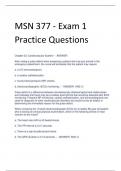
Chapter 32: Cardiovascular System - ANSWER After noting a pulse deficit when assessing a patient who has just arrived in the emergency department, the nurse will anticipate that the patient may require a. a 2-D echocardiogram. b. a cardiac catheterization. c. hourly blood pressure (BP) checks. d. electrocardiographic (ECG) monitoring. - ANSWER ANS: D Pulse deficit is a difference between simultaneously obtained apical and radial pulses and indicates that there may be a cardiac dysrhythmia that would be detected with ECG monitoring. Frequent BP monitoring, cardiac catheterization, and echocardiograms are used for diagnosis of other cardiovascular disorders but would not be as helpful in determining the immediate reason for the pulse deficit. When reviewing the 12-lead electrocardiograph (ECG) for a healthy 86-year-old patient who is having an annual physical examination, which of the following will be of most concern to the nurse? a. The heart rate (HR) is 43 beats/minute. b. The PR interval is 0.21 seconds. c. There is a right bundle-branch block. d. The QRS duration is 0.13 seconds. - ANSWER ANS: A The resting HR does not change with aging, so the decrease in HR requires further investigation. Bundle-branch block and slight increases in PR interval or QRS duration are common in older individuals because of increases in conduction time through the AV node, the bundle of His, and the bundle branches. During a physical examination of a patient, the nurse palpates the point of maximal impulse (PMI) in the sixth intercostal space lateral to the left midclavicular line. The most appropriate action for the nurse to take next will be to a. document that the PMI is in the normal anatomic location. b. ask the patient about risk factors for coronary artery disease. c. auscultate both the carotid arteries for the presence of a bruit. d. assess the patient for symptoms of left ventricular hypertrophy. - ANSWER ANS: D The PMI should be felt at the intersection of the 5th intercostal space and the left midclavicular line. A PMI located outside these landmarks indicates possible cardiac enlargement, such as with left ventricular hypertrophy. Cardiac enlargement is not necessarily associated with coronary or carotid artery disease. To auscultate for S3 or S4 gallops in the mitral area, the nurse listens with the a. bell of the stethoscope with the patient in the left lateral position. b. bell of the stethoscope with the patient sitting and leaning forward.
Document information
- Uploaded on
- May 19, 2023
- Number of pages
- 42
- Written in
- 2022/2023
- Type
- Exam (elaborations)
- Contains
- Questions & answers