

NUR 103 Math for Meds Syllabus-1 Questions with 100% Correct Answers | Verified | Latest Update
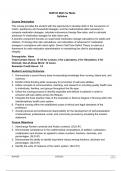
NUR103 Math for Meds Syllabus Course Description This course provides the student with the opportunity to develop skills in the conversion of metric, apothecary and household dosages, and the mathematical skills necessary to compute medication dosages, calculate intravenous therapy flow rates, and to calculate advanced IV medication dosages for safe client care. A practice component focuses on supervised medication dosage calculations for adults and children, IV therapy flow rate calculations, and calculation of advanced IV medication dosages in compliance with client rights. Orem’s Self Care Deficit Theory is used as a framework for safe medication administration in maintaining the client’s physiological integrity. Prerequisite: None Total Contact Hours: 15 (15 for Lecture, 0 for Laboratory, 0 for Simulation, 0 for Clinical); Out-of-Class Work: 72 hours Semester Credit Hours: 1.0 Student Learning Outcomes 1. Demonstrate a sound theory base incorporating knowledge from nursing, liberal arts, and sciences. 2. Exhibit critical thinking skills necessary for promotion of self-care abilities. 3. Utilize concepts of communication, teaching, and research in providing quality health care to individuals, families, and groups throughout the life span. 4. Utilize the nursing process to identify requisites and deficits in patients in order to enhance self-care ability across the lifespan. 5. Integrate the three practice roles of the Associate in Science Degree in Nursing within the interdisciplinary health care system. 6. Practice nursing within the established scope of ethical and legal standards of the profession. 7. Accept personal and professional responsibility for the development of self-actualization of educational, professional, social, and community pursuits by emulating the mission statement. Course Objectives 1. Interchange Roman numerals and Arabic numbers. (SLO #1) 2. Demonstrate competence in the mathematical computations of addition, subtraction, multiplication and division as applied to whole numbers, fractions, decimals, and percentages. (SLO #1) 3. Demonstrate the ability to identify equivalent values among fractions, decimals and percentages. (SLO #1) 4. Identify the units of measure of the metric system. (SLO #1)
Document information
- Uploaded on
- May 17, 2023
- Number of pages
- 10
- Written in
- 2022/2023
- Type
- Exam (elaborations)
- Contains
- Questions & answers


