Saunders Comprehensive Review for the NCLEX-RN® -Pt 1 Questions And Answers. A+ Review 2023
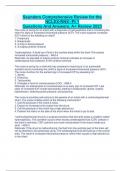
Saunders Comprehensive Review for the NCLEX-RN® -Pt 1 Questions And Answers. A+ Review 2023 The nurse is caring for an infant with a diagnosis of hydrocephalus and is monitoring the infant for signs of increased intracranial pressure (ICP). The nurse suspects increased ICP if which of the following is noted? 1. Proteinuria 2. Bradycardia 3. A drop in blood pressure 4. A bulging anterior fontanel *hydrocephalus :A build-up of fluid in the cavities deep within the brain.This causes increased intracranial pressure. - ANS-4 Rationale: An elevated or bulging anterior fontanel indicates an increase in cerebrospinal fluid collection in the cerebral ventricle. The nurse is caring for a child who has sustained a head injury in an automobile accident and is monitoring the child for signs of increased intracranial pressure (ICP). The nurse monitors for the earliest sign of increased ICP by assessing for: 1. Apnea 2. Posturing 3. Tachycardia 4. Changes in level of consciousness (LOC) - ANS-4 Rationale: An altered level of consciousness is an early sign of increased ICP. Late signs of increased ICP include tachycardia, leading to bradycardia, apnea, systolic hypertension, widening pulse pressure, and posturing. The nurse is providing instructions to the parents of an infant with a ventriculoperitoneal shunt. The nurse includes which of the following instructions? 1. Call the physician if the infant is fussy. 2. Expect an increased urine output from the shunt. 3. Call the physician if the infant has a high-pitched cry. 4. Position the infant on the side of the shunt when the infant is put to bed. *ventriculoperitoneal shunt:is a surgical procedure that primarily treats a condition called hydrocephalus. This condition occurs when excess cerebrospinal fluid (CSF) collects in the brain's ventricles. CSF cushions your brain and protects it from injury inside your skull. - ANS-3 Rationale: If the shunt is malfunctioning, the fluid from the ventricle part of the brain will not be diverted to the peritoneal cavity. The cerebrospinal fluid will build up in the cranial area. The result is increased intracranial pressure, which then causes a high-pitched cry in the infant. Continues...
Written for
- Institution
- Saunders Comprehensive NCLEX-RN® -Pt 1
- Course
- Saunders Comprehensive NCLEX-RN® -Pt 1
Document information
- Uploaded on
- May 17, 2023
- Number of pages
- 3
- Written in
- 2022/2023
- Type
- Exam (elaborations)
- Contains
- Questions & answers
Subjects
- nclex rn® pt 1
- saunders comprehensive
- questions and answers
-
saunders comprehensive review for the nclex rn® pt 1
-
a review 2023
-
the nurse is caring for an infant with a diagnosis of hydrocephalus a

Also available in package deal