

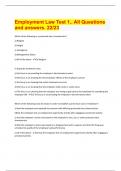
Employment Law Test 1,. All Questions and answers. 22/23
Employment Law Test 1,. All Questions and answers. 22/23 Document Content and Description Below Which of the following is a protected class characteristic? a) Religion b) Height c) Intelligence d) Management Status e) All of the above - a) Religion In disparate treatment cases a) th e focus is on providing the employer's discriminatory intent b) the focus is on showing the discriminatory effects of the employers actions c) the focus is on showing that unfair treatment occurred d) the focus is on showing that the employer holds racist or sexist views e) The focus is on showing that the employer was trying to get back at the employee for something the employee did - a) The focus is on providing the employer's discriminatory intent Which of the following must be shown in order to establish a prima facie case of retaliation? a) that the employee was replaced by someone with differing protected class characteristics b)that the employee lost an employment opportunity shortly after engaging in protected activity c) that the employer's action was based on the employee's race, sex, or other protected class characteristic d) that the employer's action was based on a disagreement with a superior and that the firing was unrelated to quality of the employee's job performance e) all of the above - b) that the employee lost an employment opportunity shortly after engaging in protected activityThree employees working for the same company were found to have stolen company cargo. Two of the employees were white, and one was black. The two white employees were fired, but not the black employee. If the white employees sue, the court will most likely decide: a) for the employer, because the employees were guilty of theft b) for the employer, because the employees were employees at will c) for the employee, because the employer treated him differently based on his race d) for the employee, because his employer was within its discretion to fire some, but not all employees guilty of theft - c) for the employee, because the employer treated him differently based on his race Regarding cases alleging disparate treatment and pretext, it is correct to say: a) disparate treatment is unintentional or accidental b) evidence in a pretext case can be either direct of circumstantial c) the employer has violated the Title VII if it would not have made the same decision absent the discriminatory motive d) they are relatively rare and with current legislation are not likely to be significant in the future - b) evidence in a pretext case can be either direct of circumstantial Which of the following is among the things that a plaintiff must show in order to establish a prima facie case of disparate treatment in a pretext case? a) proof that the employer intended to discriminate b) proof that the employer's stated motive is not credible c) statistical evidence of discriminatory effects d) all of the above e) none of the above - e) none of the above The key element in disparate treatment is discriminatory intent. In this context, that means that: a) the decision-maker made the decision with intent to harm b) the decision-maker made the decision with intent to break the law c) the decision-maker made the decision in whole or in part based on the protected class characteristic of the employeed) all of the above - c) the decision-maker made the decision in whole or in part based on the protected class characteristic of the employee A firm had been sued and found guilty of religious discrimination against people who practiced Judaism, and managers were instructed to be very careful to avoid another similar suit. To that end, Jewish employees, but not others, were given raises. Of the following, what is the most correct assessment of this policy? a) the policy is sound, both legally and ethically b) the policy is sound legally, but not ethically c) the policy is neither legally not ethically sound d) none of the above - c) the policy is neither legally not ethically sound In an adverse impact case, if an employer can show that a challenged employment practice is job related and consistent with business necessity, the plaintiff can still win by showing that: a) there is an alternative practice that would have less discriminatory effects, but the employer declines to use it b) the employer has engaged in a pattern or practice of discrimination c) the difference in selection rates across protected class groups is statistically significant d) the four-fifth's rule has been violated e) there is additional evidence of a discriminatory motive - a) there is an alternative practice that would have less discriminatory effects, but the employer declines to use it Which of the following is a neutral requirement that is likely to result in adverse impact? a) race b) language requirement c) physical strength d) b and c e) all of the above - d) b and c Protected activity on a retaliation claim under Title VII includes: a) peaceful protests opposing an employer's alleged discriminationb) testifying in court about another employee's discrimination claim c) knowingly filing a false discrimination charge against and employer d) all of the above e) none of the above - d) all of the above For a disparate treatment case involving pretext, which is the correct order of proof? a) plaintiff's prima facie case, defendant's lawful motive, plaintiff's additional evidence supporting discriminatory intent b) plaintiff's evidence supporting discriminatory intent, defendant's lawful motive, plaintiff's prima facie case c) plaintiff's primary evidence, defendant's primary evidence, plaintiff's rebuttal showing discriminatory motive d) none of these - a) plaintiff's prima facie case, defendant's lawful motive, plaintiff's additional evidence supporting discriminatory intent Of the elements necessary to prove a case of disparate treatment involving pretext, which of the following is NOT required? a) plaintiff applied for the employment opportunity b) plaintiff was qualified for the employment opportunity c) plaintiff was not hired for the employment opportunity d) plaintiff was as qualified for the employment opportunity as the person hired - d) plaintiff was as qualified for the employment opp
Document information
- Uploaded on
- May 13, 2023
- Number of pages
- 16
- Written in
- 2022/2023
- Type
- Exam (elaborations)
- Contains
- Questions & answers


