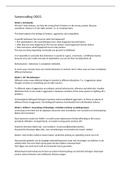
NURSING MSN 571 - Quiz 2 Study Guide.| VERIFIED GUIDE
NURSING MSN 571 - Quiz 2 Study Guide.| VERIFIED GUIDE Antibiotics Review terminology: 1. Selective Toxicity: The ability of a drug to injure a target cell or target organism without injuring other cells or organisms that are in intimate contact with the target. Refers to the ability of an antibiotic to injure only invading microbes and avoiding injuring the host. 2. Culture and Sensitivity test: Is a test done when trying to treat for infection. Culture is to determine the bacteria or fungus causing the infection . Sensitivity checks for what kind of medicine will work best against the bacteria or fungus. Test used to test drug sensitivity is the disk diffusion test, also known as the kirby-bauer test. 3. Mechanisms of Resistance : decreases concentration of a drug at its site of action; alters the structure of a drug target molecules; produces a drug antagonist; causes drug inactivation. Broad spectrum antibiotics promote the emergence of drug resistance. 4. CYP3A4: inhibitor is Drugs used for erectile dysfunction ; it suppresses the metabolism of sildenafil (viagra), thereby increasing its level. Combination should be used with caution. ● Intraconazole (antifungal) inhibits CYP3A4 5. CYP450: Cytochrome P450 Enzyme 17 inhibitor Abiraterone ( Zytiga) indicated for combined use with prednisone to treat metastatic castration-resistant prostate cancer, if castration has not occured it can inhibit androgen production by the testes. Ketoconazole ( Nizoral) used for fungal infections, can be used off label for prostate ● Azoles( antifungal ) has the ability to inhibit CYP450 6. Disulfiram-like effect: Is an unpleasant effect caused by the medication when ingesting alcohol. Manifest as nause, copious vomiting, flushing , palpitations, headache, sweating , thirst, chest pain, weakness, blurred vision and hypotension. 7. Superinfection: A new infection that appears during a course of treatment for a primary infection. When the body's normal flora is decreased the overgrowth of fungi and yeast can occur, an example is yeast infections after the use of antibiotics. They occur most often with broad spectrum antibiotics 8. Cross-sensitivity: is defined as sensitivity to one substance that renders an individual sensitive to other substances of similar chemical structure. B- lactams and sulfonamides are the most common. 9. Cross-resistance: Resistance to all antibiotics belonging to the same class due to a single mechanism. The more active the drug the lower the level of resistance Review labs: WBC- Purpose of white blood cells can detect hidden infections within your body. - Neutrophil- type of WBC, lead the immune system’s response. Neutrophils are 55-70 % of the wbc. !st cell to arrive on the scene of the infection. NORM COUNT
Written for
- Institution
- NURSING MSN 571
- Course
- NURSING MSN 571
Document information
- Uploaded on
- May 11, 2023
- Number of pages
- 75
- Written in
- 2022/2023
- Type
- Exam (elaborations)
- Contains
- Questions & answers
Subjects
-
nursing msn 571 quiz 2 study guide| verified guide antibiotics review terminology 1 selective toxicity the ability of a drug to injure a target cell or target organism without injuring other