

BACE Knowledge Exam 2023
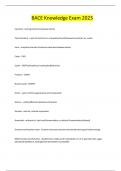
Covalent - sharing electrons between atoms Polar Covalent - a pair of electrons is unequally shared between two atoms; ex. water Ionic - complete transfer of valence electrons between atoms Carbs - CHO Lipids - CHOP (phosphorus in phospholipids only) Proteins - CHON Nucleic acids - CHONP Homo - same uniform appearance and composition Hetero - visibly different substances of phases Aerobic - with air, cellular respiration Anaerobic - without air, lactic acid fermentation, or alcohol fermentation (ethanol) Enzymes and reaction rates - Enzymes increase reaction rates by decreasing activation energy DNA structure and function - double helix; made up of nucleotides, G-C A-T, genetic code, sugar-phosphate backbone, hydrogen bonds between nucleotides Transcription - Turning DNA to RNA, occurs in the nucleus in eukaryotes, occurs in cytoplasm for prokaryotes, DNA copied into RNA by RNA polymerase Protein structure and function - Intercellular joining Enzymatic activity Transport Cell-cell recognition Anchorage Signal transduction Translation and gene expression - (After transcription) mRNA is turned into amino acids which become proteins. In Eukaryotes: mRNA is read through a ribosome in sets of codons, then tRNA brings an anticodon which begins to create an amino acid chain which eventually as it grows creates a protein In prokaryotes: occur in cytoplasm Cell theory - cells are the basic structural/organizational unit of all organisms Physiology of cells - Cell wall: shape and protein Cell membrane: regulates interaction between cell and its environment, selectively permeable Cytoplasm: contains all organelles and cell parts Nuclear Membrane: allows certain substances to go in and out of the nucleus Nucleus: contains DNA Mitochondria: creates ATP, cellular respiration Physiology of cell - Chloroplasts: creates glucose/food for the plant through photosynthesis Golgi: package and transmit cellular material throughout the cell
Document information
- Uploaded on
- May 10, 2023
- Number of pages
- 10
- Written in
- 2022/2023
- Type
- Exam (elaborations)
- Contains
- Questions & answers


