

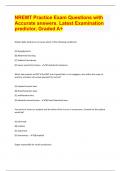
NREMT Practice Exam Questions with Accurate answers. Latest Examination predictor, Graded A+
NREMT Practice Exam Questions with Accurate answers. Latest Examination predictor, Graded A+ Document Content and Description Below Shaken Baby Syndrome can cause which of the following conditions? (A) Hypoglycemia (B) Abdominal bruising (C) Subdural hematoma (D) Lower extremity fracture - (C) Subdural hematoma Whic h law protects an EMT if the EMT acts in good faith, is not negligent, acts within the scope of practice, and does not accept payment for service? (A) implied consent laws. (B) Good Samaritan laws. (C) malfeasance laws. (D) absolute immunity laws. - (B) Good Samaritan laws You arrive at a two car accident and the driver of the 1st car is unconscious. Consent for this patient would be? (A) informed. (B) implied. (C) expressed. (D) involuntary. - (B) implied Organ responsible for insulin production. (A) adrenal (B) pancreas (C) thyroid (D) thymus - (B) pancreas Which federal agency regulates telecommunications in the United States? (A) FBI. (B) FDIC. (C) FCC. (D) FACEP. - (C) FCC. What is the rate of chest compressions for a two-year-old in cardiac arrest? (A) 80/minute. (B) 100/minute. (C) 110/minute. (D) 120/minute. - (B) 100/minute. A BVM with a reservoir and oxygen source (at least 15 LPM) delivers an oxygen concentration of (A) 21%. (B) 40% to 60%. (C) 80%. (D) 100%. - (D) 100%. Beck's triad (associated with pericardial tamponade) includes: distant heart tones, JVD, and... (A) pulse deviation. (B) narrowing pulse pressure. (C) wheezing. (D) delayed capillary refill. - (B) narrowing pulse pressure. What happens during inspiration? (A) the diaphragm contracts and the intercostal muscles relax. (B) the diaphragm relaxes and the intercostal muscles contract. (C) the diaphragm relaxes and the intercostal muscles relax. (D) the diaphragm contracts and the intercostal muscles contract. - (D) the diaphragm contracts and the intercostal muscles contract. When caring for a child in respiratory distress, you hear a harsh high-pitched sound with each breath. What do you suspect? (A) stridor. (B) wheezing. (C) crackles. (D) rhonchi. - (A) stridor. Cushing's reflex includes increased blood pressure, bradycardia, and: (A) irregular respirations. (B) irregular pulse. (C) increased respirations. (D) pupil dilation. - (A) irregular respirations. Cushing's reflex is indicative of a head injury with increased intracranial pressure (ICP). You delivered a full-term baby in the back of your ambulance and the initial APGAR score is 5. What treatment should you do? (A) CPR. (B) effective ventilation. (C) vascular access. (D) administration of epinephrine. - (B) effective ventilation. Most newborns respond favorably to warming, drying, suctioning, and stimulation. All of the following are phases of the stress response EXCEPT: (A) alarm reaction. (B) resistance. (C) exhaustion. (D) acceptance. - (D) acceptance. The 3 phases of the body's response to stress: (1) alarm reaction (fight-or-flight response) (2) resistance: the level of resistance to stress raises (3) exhaustion-as stress continues, coping mechanisms begin to fail Manual maneuvers used to open a patient's airway (A) are contraindicated in most patients. (B) are difficult to perform. (C) include head-tilt/chin-lift and jaw thrust. (D) do not usually work without more extensive intervention. - (C) include head-tilt/chin-lift and jaw thrust. A patient was struck in the head by a large tree branch while trimming a tree. The next day, he complains of dizziness and vomiting. You suspect? (A) an epidural hematoma. (B) a subdural hematoma. (C) a concussion. (D) a contusion. - (a) subdural hematoma. A subdural hematoma is usually due to rupture of small venous vessels. This type of bleeding is slow and the onset of symptoms may take several hours to develop after the injury. Supine hypotensive syndrome occurs from? (A) reduction of cardiac output due to compression of the aorta. (B) reduction of cardiac output due to compression of the inferior vena cava. (C) reduction of cardiac output due to compression of the superior vena cava. (D) the uterus pushing up on the diaphragm. - (B) reduction of cardiac output due to compression of the inferior vena cava. The documentation of a baseline neurological status should NOT include which of the following: (A) Pulse oximetry (B) Response to sensory stimulation (C) Pupillary reaction (D) Motor function - (A) Pulse oximetry The chest wall is lined by a layer of smooth, glistening tissue called: (A) visceral pleura. (B) parietal pleura. (C) visceral peritoneum. (D) parietal peritoneum. - (B) parietal pleura. A dissecting aortic aneurysm may cause the following sign or symptom: (A) a pain sensation on the neck and back of head (B) pain in the lower back and lower quadrants (C) the same blood pressure in each arm (D) respiratory distress - (B) pain in the lower back and lower quadrants The description of pain associated with a dissecting aortic aneurysm is severe back pain because the peritoneum can be rapidly stripped away from the wall of the main abdominal cavity. Your patient is 28 weeks pregnant with complaints of dizziness and blurred vision. Her hands and feet are edematous. Vitals are BP 178/108, HR 104, RR 24. You suspect that she: (A) is emotionally upset. (B) has preeclampsia. (C) has borderline hypotension. (D) has postpartum depression. - (B) has preeclampsia. Common signs and symptoms of preeclampsia include headache, dizziness, blurred vision, nausea, vomiting, hypertension and edema. Treatment for a patient with preeclampsia would include: (A) rapid transport with lights and siren. (B) administering nitroglycerin to lower the blood pressure. (C) transport for psychiatric evaluation. (D) keeping the patient calm; transport without lights and siren. -
Document information
- Uploaded on
- May 9, 2023
- Number of pages
- 19
- Written in
- 2022/2023
- Type
- Exam (elaborations)
- Contains
- Questions & answers


