

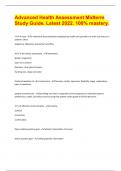
Advanced Health Assessment Midterm Study Guide. Latest 2022. 100% mastery.
Advanced Health Assessment Midterm Study Guide. Latest 2022. 100% mastery. Document Content and Description Below S O A P note - a method of documentation employed by health care providers to write out notes in a patient's chart Subjective, Objective, Assessment and Plan A B C D skin lesion assessment - Asymmetry Border irregularity Color isn't uniform Diameter 6cm (pencil eraser) Evolving size, shape and color Preferred qualities of a first impression - honesty, candor, openness, flexibility, eager, explanatory, open to questions patient centered care - providing care that is respectful of and responsive to individual patient preferences, needs, and values and ensuring that patient values guide all clinical decisions 4 C's of effective communication - courtesy comfort connection confirmation Open ended questions goal - patient's description of answer direct question goal - seeking specific information Leading question goal - Limiting information to one focus / subject Reasons patients avoid the full story of the illness - dementia, alcoholism, illness, sexual uncertainties, domestic violence, child abuse Potential Barriers to Communication - - Curiosity about you - Anxiety - Silence - Depression - Crying and Compassionate Moments - Seduction - Anger - Financial Considerations 2 goals of a patient history - 1. identify what the patient's problem is 2. establish reliability of the patient Why is it important to complete a review of systems after a history? - to identify complementary or symptoms that may seem unrelated Tips when discussing a sensitive topic - provide privacy, direct & firm, no apologies, no judgement, avoid confrontation, no jargon, document carefully 4 steps in approaching the examination of sensitive areas - 1. introduction & why 2. open ended questions to explore pt's feelings 3. repeat what's been said & give feedback 4. take questions from pt TACE questions - Does it *T*ake more than two drinks to get you drunk? Have people *A*nnoyed you by criticizing your drinking? Have you ever felt you ought to *C*ut down on your drinking? Have you ever had a drink first thing in the morning to steady your nerves (*E*ye opener)? Partner Violence Screen - Have you been hit, kicked, punched or otherwise hurt by someone within the past year? Do you feel safe in your current relationship? Is there a partner from a previous relationship who is making you feel unsafe now? HITS tool - Hurt Insult Threaten Scream *for intimate partner violence FICA tool for spiritual assessment - Faith, belief, meaning Importance & influence Community Action in care Sexuality History Goal - identify risk factors for unintentional pregnancy or STIs 5 P's of sexual history - Partners Prevention of pregnancy Protection from STIs Practices Past history of STIs Functional Assessment - screens the safety of independent living and ability to perform ADLs, the need for home health services, and quality of life Functional assessment questions - mobility, upper extremity function, housework, instrumental ADLs pediatric triad - practitioner, parent & child Consent by proxy - process by which people with legal right to consent to a medical treatment for themselves or for a minor/ward delegates that right to another person developmental milestone examples - holds head erect, stands alone, rolls over, walks alone, sits alone, uses words, talks in sentences, dresses self, age of potty training, dentition, pubertal development HEEADSSS TOOL - Home Education and employment Eating Activities Drugs Sexuality Suicide and depression Safety **adolescent screening tool PACES TOOL - parents / peers accidents cigarettes emotional issues school / sexuality **adolescent screening tool fraility - 80 y/o;; ^ loss of physical function & independence, decreased physical reserve diagnostics - tests that need performed or ordered to develop a plan of care PAMI list - Patient's medical problems Allergies with reaction Medications with doses Instructions of how administered / immunizations OLD CARTS - Onset Location Duration Characteristics Aggravating and Alleviating Factors Related Symptoms Temporal factors -- frequency & occurance Severity Sensitive Patient health information - HIV status substance abuse mental health conditions Terms to describe current condition status - stable uncontrolled resovled cranial nerves - 12 pairs of nerves that carry messages to and from the brain Cranial Nerve 1 - Olfactory (smell) Cranial Nerve 2 - Optic nerve (visual acuity) Cranial Nerve 3, 4, 6 - oculomotor, trochlear, abducens - pupillary response and eye movement Cranial Nerve 5 - Trigeminal - corneal reflex, biting Cranial Nerve 7 - facial nerve -- raise eye brows, close eyes, smile, shows teeth Cranial Nerve 8 - Acoustic/ Vestibulocochlear- Hearing and Balance Cranial Nerve 9, 10 - glossopharyngeal and vagus -- swallowing, gag reflex, speech Cranial nerve 11 - Spinal accessory-- shrug shoulders and turn head Cranial nerve 12 - Hypoglossal- stick tongue out Grading Muscle Strength - 0: None; 1: Slight contractility; 2: Full without gravity; 3: Full with gravity; 4: Full with small resisitance; 5: Full with full resistance Grading reflexes - 0: None; 1: Diminished, 2: Normal, 3: H
Document information
- Uploaded on
- May 9, 2023
- Number of pages
- 21
- Written in
- 2022/2023
- Type
- Exam (elaborations)
- Contains
- Questions & answers


