

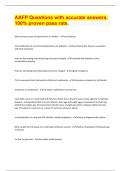
AAFP Questions with accurate answers. 100% proven pass rate.
AAFP Questions with accurate answers. 100% proven pass rate. Most common cause of hypertension in children - renal disease Contraindication of use of thiazolidinediones for diabetes - heart failure (b/c they are associated with fluid retention) How are descending aorta dissecting aneurysms manged - medically with abetalol, unless complications develop How are ascending aorta dissecting aneurysms manged - surgical emergency Tx for supraventricular tachycardia refractory to adenosine - intravenous verapamil or a β-blocker Treatment of claudication - risk factor modification and exercise most likely cause of a small child with failure to thrive that is found to have a bone age that is markedly delayed - Hypothyroidism ( In cystic fibrosis, bone age and height age are equivalent, but both lag behind chronologic age. Chromosomal anomalies have a height age which is delayed relative to bone age. This pattern is also seen as a result of maternal substance abuse) contraindication to using and ACE inhibitor, besides pregnancy - history of Angioneurotic edema Who can get the intranasal, live, attenuated influenza vaccine - healthy, nonpregnant individuals age 5-49 years 1st line for pertussis - macrolides (azithromycin) Treatment of influenza in a 6 year old, and why not the 3 other influenza drugs. - Amantadine and rimantadine are not recommended for the treatment of influenza A because of the development of resistance to these drugs. Resistance is not a problem with neuramidase inhibitors such as oseltamivir in immunocompetent patients. Zanamivir is not recommended for treatment of children under the age of 7. True/False - The first of three rotavirus dose should be given prior to 12 weeks of age - True - The first dose should be given between 6 and 12 weeks of age, with additional doses given at 4 to 10-week intervals. Purpose and major side effect of varenicline (Chantix) - smoking-cessation product, mood changes including suicidal thoughts and aggressive and erratic behavior most common cause of bilateral pleural plaques on chest xray - asbestos Treatment of pneumonia with and without 3 month history of other antibiotic use - with - fluoroquinolone without - azithromycin preferred long-term controller treatment in mild persistent asthma - low-dose inhaled corticosteroid recommendations for # of doses of influenza vaccine - Two doses of influenza vaccine Most common cause of hypertension in children - renal disease Contraindication of use of thiazolidinediones for diabetes - heart failure (b/c they are associated with fluid retention) How are descending aorta dissecting aneurysms manged - medically with abetalol, unless complications develop How are ascending aorta dissecting aneurysms manged - surgical emergency Tx for supraventricular tachycardia refractory to adenosine - intravenous verapamil or a β-blocker Treatment of claudication - risk factor modification and exercise most likely cause of a small child with failure to thrive that is found to have a bone age that is markedly delayed - Hypothyroidism ( In cystic fibrosis, bone age and height age are equivalent, but both lag behind chronologic age. Chromosomal anomalies have a height age which is delayed relative to bone age. This pattern is also seen as a result of maternal substance abuse) contraindication to using and ACE inhibitor, besides pregnancy - history of Angioneurotic edema Who can get the intranasal, live, attenuated influenza vaccine - healthy, nonpregnant individuals age 5-49 years 1st line for pertussis - macrolides (azithromycin) Treatment of influenza in a 6 year old, and why not the 3 other influenza drugs. - Amantadine and rimantadine are not recommended for the treatment of influenza A because of the development of resistance to these drugs. Resistance is not a problem with neuramidase inhibitors such as oseltamivir in immunocompetent patients. Zanamivir is not recommended for treatment of children under the age of 7. True/False - The first of three rotavirus dose should be given prior to 12 weeks of age - True - The first dose should be given between 6 and 12 weeks of age, with additional doses given at 4 to 10-week intervals. Purpose and major side effect of varenicline (Chantix) - smoking-cessation product, mood changes including suicidal thoughts and aggressive and erratic behavior most common cause of bilateral pleural plaques on chest xray - asbestos Treatment of pneumonia with and without 3 month history of other antibiotic use - with - fluoroquinolone without - azithromycin preferred long-term controller treatment in mild persistent asthma - low-dose inhaled corticosteroid recommendations for # of doses of influenza vaccine - Two doses of influenza vaccine Most common cause of hypertension in children - renal disease Contraindication of use of thiazolidinediones for diabetes - heart failure (b/c they are associated with fluid retention) How are descending aorta dissecting aneurysms manged - medically with abetalol, unless complications develop How are ascending aorta dissecting aneurysms manged - surgical emergency Tx for supraventricular tachycardia refractory to adenosine - intravenous verapamil or a β-blocker Treatment of claudication - risk factor modification and exercise most likely cause of a small child with failure to thrive that is found to have a bone age that is markedly delayed - Hypothyroidism ( In cystic fibrosis, bone age and height age are equivalent, but both lag behind chronologic age. Chromosomal anomalies have a height age which is delayed relative to bone age. This pattern is also seen as a result of maternal substance abuse) contraindication to using and ACE inhibitor, besides pregnancy - history of Angioneurotic edema Who can get the intranasal, live, attenuated influenza vaccine - healthy, nonpregnant individuals age 5-49 years 1st line for pertussis - macrolides (azithromycin) Treatment of influenza in a 6 year old, and why not the 3 other influenza drugs. - Amantadine and rimantadine are not recommended for the treatment of influenza A because of the development of resistance to these drugs. Resistance is not a problem with neuramidase inhibitors such as oseltamivir in immunocompetent patients. Zanamivir is not recommended for treatment of children under the age of 7. True/False - The first of three rotavirus dose should be given prior to 12 weeks of age - True - The first dose should be given between 6 and 12 weeks of age, with additional doses given at 4 to 10-week intervals. Purpose and major side effect of varenicline (Chantix) - smoking-cessation product, mood changes including suicidal thoughts and aggressive and erratic behavior most common cause of bilateral pleural plaques on chest xray - asbestos Treatment of pneumonia with and without 3 month history of other antibiotic use - with - fluoroquinolone without - azithromycin preferred long-term controller treatment in mild persistent asthma - low-dose inhaled corticosteroid recommendations for # of doses of influenza vaccine - Two doses of influenza vaccine
Document information
- Uploaded on
- May 8, 2023
- Number of pages
- 6
- Written in
- 2022/2023
- Type
- Exam (elaborations)
- Contains
- Questions & answers


