

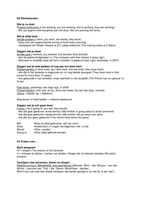
H2 Werkwoorden
Wat je nu doet
Present continuous (I am working, you are working, she is working, they are working)
- We zijn ergens mee bezig/iets aan het doen: We are painting the fence.
Wat je altijd doet
Simple present (I work, you work, she works, they work)
- Gaat over een gewoonte(He arrives at 8.00 every morning)
- Vaststaand feit (Water freezes at 0C) nabije toekomst (The training starts at 3.30pm)
Zeggen wat je deed
Simple past (I worked, you worked, she worked, they worked)
- Iets dat gebeurd/afgelopen is (The company sold their shares 2 years ago)
- Wanneer er duidelijk staat dat het in verleden is gebeurd (last night, yesterday, in 2007)
Zeggen wat je hebt gedaan of nog aan het doen bent
Present perfect (I have lived, you have lived, she has lived, they have lived)
- Iets dat in het verleden is begonnen en nu nog steeds doorgaat (They have lived in that
house for more than 10 years).
- Iets gebeurde in het verleden, maar wanneer is niet duidelijk (The Phone has run gabout 10
times)
Past tense: yesterday, two days ago, in 2006
Present perfect: until now, so far, since last week, the last few days, recently
(Since = tijdstip, for = tijdsduur)
Was/waren of had/hadden + voltooid deelwoord
Zeggen wat je zult gaan doen
Future ( He is going to, you will, they would)
- Iets dat gaat gebeuren (korte termijn) (My brother is going away to study tomorrow)
- Iets dat gaat gebeuren (lange termijn) (My brother will go away next year)
- Iets dat zou gaan gebeuren (You would have done the same)
Will Kan je altijd gebruiken. will not, won’t
Shall Gebruiken in vragen die beginnen met I of we
Would Zou, zouden
Going to Kan altijd gebruikt worden.
H3 Praten over…
Bezit aangeven
Of = dingen (The colours of the rainbow)
‘s = mensen en dieren / namen van landen / dingen die uit mensen bestaan (My dad’s
camera)
Verwijzen naar personen, dieren en dingen
Relative pronoun (Betrekkelijk voornaamwoord) (Mensen: Who – die, Whose – van wie,
Whom – aan/met wie, That – die. Dieren: Which/that – dat/die)
Which kan ook naar een stukje verwijzen dat eerder gezegd is (in het NL is dat ‘wat’).
Wat je nu doet
Present continuous (I am working, you are working, she is working, they are working)
- We zijn ergens mee bezig/iets aan het doen: We are painting the fence.
Wat je altijd doet
Simple present (I work, you work, she works, they work)
- Gaat over een gewoonte(He arrives at 8.00 every morning)
- Vaststaand feit (Water freezes at 0C) nabije toekomst (The training starts at 3.30pm)
Zeggen wat je deed
Simple past (I worked, you worked, she worked, they worked)
- Iets dat gebeurd/afgelopen is (The company sold their shares 2 years ago)
- Wanneer er duidelijk staat dat het in verleden is gebeurd (last night, yesterday, in 2007)
Zeggen wat je hebt gedaan of nog aan het doen bent
Present perfect (I have lived, you have lived, she has lived, they have lived)
- Iets dat in het verleden is begonnen en nu nog steeds doorgaat (They have lived in that
house for more than 10 years).
- Iets gebeurde in het verleden, maar wanneer is niet duidelijk (The Phone has run gabout 10
times)
Past tense: yesterday, two days ago, in 2006
Present perfect: until now, so far, since last week, the last few days, recently
(Since = tijdstip, for = tijdsduur)
Was/waren of had/hadden + voltooid deelwoord
Zeggen wat je zult gaan doen
Future ( He is going to, you will, they would)
- Iets dat gaat gebeuren (korte termijn) (My brother is going away to study tomorrow)
- Iets dat gaat gebeuren (lange termijn) (My brother will go away next year)
- Iets dat zou gaan gebeuren (You would have done the same)
Will Kan je altijd gebruiken. will not, won’t
Shall Gebruiken in vragen die beginnen met I of we
Would Zou, zouden
Going to Kan altijd gebruikt worden.
H3 Praten over…
Bezit aangeven
Of = dingen (The colours of the rainbow)
‘s = mensen en dieren / namen van landen / dingen die uit mensen bestaan (My dad’s
camera)
Verwijzen naar personen, dieren en dingen
Relative pronoun (Betrekkelijk voornaamwoord) (Mensen: Who – die, Whose – van wie,
Whom – aan/met wie, That – die. Dieren: Which/that – dat/die)
Which kan ook naar een stukje verwijzen dat eerder gezegd is (in het NL is dat ‘wat’).


