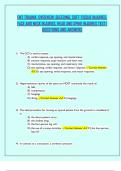
ATLS MCQ-QUESTIONS&ANSWERS BEST FOR 2023.pdf
ATLS MCQQUESTIONS& ANSWERS BEST FOR 2023 APPROVED BY : Q: A 42-year-old man is trapped from the waist down beneath his overtumed tractor for several hours before medical assistance arrives. He is awake and alert until just before arriving in the emergency department. He is now unconscious and responds only to painful stimuli by moaning. His pupils are 3 mm in diameter and symmetrically reactive to light. Prehospital personnel indicate that they have not seen the patient move either of his lower extremities. On examination in the emergency department, no movement of his lower extremities is detected, even in response to painful stimuli. The most likely cause for this fmding is A: an epidural hematoma. a pelvic fracture. central cord syndrome. intracerebral hemorrhage. (E) bilateral compartment syndrome. Q: Twenty-seven patients are seriously injured in an aircraft accident at a local airport. The basic principle of triage should be to A: treat the most severely injured patients first. establish a field triage area directed by a doctor. rapidly transport all patients to the nearest appropriate hospital. treat the greatest number of patients in the shortest period of time. produce the greatest number of survivors based on available resources Q: The response to catecholamines in an injured, hypovolemic pregnant woman can be expected to result in A: This study source was downloaded by from CourseH on :12:28 GMT -05:00 placental abruption. fetal hypoxia and distress. fetal/maternal dysrhythmia. improved uterine blood flow. increased maternal renal blood flow. Q: A 30-year-old man is struck by a car traveling at 56 kph (35 mph). He has obvious fractures of the left tibia near the knee, pain in the pelvic area, and severe dyspnea. His heart rate is 180 beats per minute, and his respiratory rate is 48 breaths per minute with no breath sounds heard in the left chest. A tension pneumothorax is relieved by immediate needle decompression and tube thoracostomy. Subsequently, his heart rate decreases to 140 beats per minute, his respiratory rate decreases to 36 breaths per minute, and his blood pressure is 80/50 inm Hg. Warmed Ringer's lactate is administered intravenously. The next priority should be to: A: perform a urethrogram and cystogram. perform external fixation of the pelvis. obtain abdominal and pelvic CT scans. perform arterial embolization of the pelvic vessels. perform diagnostic peritoneal lavage or abdominal ultrasound. Q: A 32-year-old man is brought to the hospital unconscious with severe facial injuries and noisy respirations after an automobile collision. In the emergency department, he has no apparent injury to the anterior aspect of his neck. He suddenly becomes apneic, and attempted ventilation with a face mask is unsuccessful. Examination of his mouth reveals a large hematoma of the pharynx with loss of normal anatomic landmarks. Initial management of his airway should consist of A: inserting an oropharyngeal airvvay. inserting a nasopharyngeal airway. performing a surgical cricothyroidotomy. performing fiberoptic-guided nasotracheal intubation. performing orotracheal intubation after obtaining a lateral c-spine x-ray Q: Absence of breath sounds and dullness to percussion over the left hemithorax are fmdings best explained by A: left hemothorax. cardiac contusion. left simple pneumothorax. left diaphragmatic rupture. right tension pneumothorax. Q: An electrician is electrocuted by a downed power line after a thunderstorm. He apparently made contact with the wire at the level of the right mid thigh. In the emergency department, his vital signs are normal and no dysrhythmia is noted on ECG. On examination, there is an exit wound on the bottom of the right foot. His urine is positive for blood by dip stick but no RBCs are seen microscopically. Initial management should include A: immediate angiography. aggressive fluid infusion. intravenous pyleography. debridement of necrotic muscle. admission to the intensive care unit for observation. Q: A 22-year-old man is brought to the hospital after crashing his motorcycle into a telephone pole. He is unconscious and in profound shock. He has no open wounds or obvious fractures. The cause of his shock is MOST LIKELY caused by A: a subdural hematoma. an epidural hematoma. a transected lumbar spinal cord. a transected cervical spinal cord. hemorrhage into the chest or abdomen. Q: A 42-year-old man, injured in a motor vehicle crash, suffers a closed head injury, multiple palpable left rib fractures, and bilateral femur fractures. He is intubated orotracheally without difficulty. Initially, his ventilations are easily assisted with a bag¬valve device. It becomes more difficult to ventilate the patient over the next 5 minutes, and his hemoglobin oxygen saturation level decreases from 98% to89 % . The most appropriate next step is to A: obtain a chest x-ray. decrease the tidal volume. auscultate the patient's chest. increase the rate of assisted ventilations. perform needle decompression of the left chest. Q: A 5-year-old boy is struck by an automobile and brought to the emergency department. He is lethargic, but withdraws purposefully from painful stimuli. His blood pressure is 90 mm Hg systolic, heart rate is 140 beats per minute, and his respiratory rate is 36 breaths per minute. The preferred route of venous access in this patient is A: percutaneous femoral vein cannulation cutdown on the saphenous vein at the ankle. intraosseous catheter placement in the proximal tibia. percutaneous peripheral veins in the upper extremities. central venous access via the subclavian or interna1 jugular vein Q: A 17-year-old helmeted motorcyclist is struck broadside by an automobile at an intersection. He is unconscious at the scene with a blood pressure of 140/90 mm Hg, heart rate of 90 beats per minute, and respiratory rate of 22 breaths per minute. His respirations are sonorous and deep. His GCS score is 6. Immobilization of the entire patient may include the use of all the following EXCEPT A: air splints. bolstering devices. a long spine board. a scoop-style stretcher. a semirigid cervical collar. Q: Which one of the following statements is FALSE concerning Rh isoimmunization in the pregnant trauma patient? A: It occurs in blunt or penetrating abdominal trauma. Minor degrees of fetomaternal hemorrhage produce it. A negative Kleihauer-Betke test excludes Rh isoimmunization. This is not a problem in the traumatized Rh-positive pregnant patient. Initiation of Rh immunoglobulin therapy does not require proof of fetomaternal hemorrhage. Q: A 42-year-old man is trapped from the waist down beneath his overtumed tractor for several hours before medical assistance arrives. He is awake and alert until just before arriving in the emergency department. He is now unconscious and responds only to painful stimuli by moaning. His pupils are 3 mm in diameter and symmetrically reactive to light. Prehospital personnel indicate that they have not seen the patient move either of his lower extremities. On examination in the emergency department, no movement of his lower extremities is detected, even in response to painful stimuli. The most likely cause for this fmding is A: an epidural hematoma. a pelvic fracture. central cord syndrome. intracerebral hemorrhage. (E) bilateral compartment syndrome. Q: A crosstable, lateral x-ray of the cervical spine A: must precede endotracheal intubation. excludes serious cervical spine injury. is an essential part of the primary survey. is not necessary for unconscious patients with penetrating cervical injuries. is unacceptable unless 7 cervical vertebrae and the C-7 to T-1 relationship are visualized
Written for
- Institution
- ATLS MCQ
- Course
- ATLS MCQ
Document information
- Uploaded on
- April 28, 2023
- Number of pages
- 6
- Written in
- 2022/2023
- Type
- Exam (elaborations)
- Contains
- Questions & answers
Subjects
-
atls mcq questionsampanswers best for 2023pdf
-
atls mcqquestionsamp answers best for 2023 approved by q a 42 year old man is trapped from the waist down beneath his overtumed tractor for severa