Summary ACQ WS1 - Detailed notes Mergers & Acquisitions
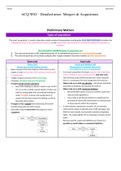
Preliminary Matters The term ‘acquisition’ is used to describe a wide variety of transactions involving the SALE AND PURCHASE of either the underlying assets of an operational business, or the ownership and control of a corporate entity that operates a business. The TWO MOST COMMON types of acquisition are: 1. The sale and purchase of the underlying assets of an operational business (an asset acquisition); and 2. The sale and purchase of a private company (the ‘target company’) by share transfer (a share acquisition). Share sale Asset sale Shares sold Money goes to shareholders directly • Buyer acquires all or the majority of the shares in the target, it is the ownership of the company itself which is transferred • Target company remains in the same shape • Company still owns and runs the business • If target wholly owned subsidiary o Buy of the holding co, doesn’t need to own all of it for a co to be a wholly owned subsid, if halve over half the voting rights then considered holding co under CA 2006, as buyer will usually want to acquire all the shares then the holding co will be joined by other sellers • If target co has a subsid then ownership of that will transfer along with the other assets • Generally, require more work and subject to more regulation Assets and liabilities sold Money goes to company, then to SH (via dividends income or liquidation) • In an asset acquisition the buyer acquires the underlying assets needed to carry on the business (tax does not) • Each of these assets will be transferred in their required form i.e. conveyance for land, assignment for lease etc • Where sale to co with one division – sell assets, distribute proceeds by dividend and dissolve the shell co. • Where sale to co with numerous divisions o Be careful with assets choose to transfer under sale and purchase agreement. o Once sold co will decide whether to distribute the proceeds of sale to the shareholders or reinvest then in new projects within the company. • IF sale of assets represents a transfer ‘of an economic entity which retains its identity then TUPE will apply. See WS6 for more details, but basically maintains employee rights. The responsibility of the employees will pass to the buyer • Because specific assets and liabilities are chosen it is possible to avoid hidden or unwanted liabilitieslOMoAR cPSD| ACQ1 Alice Hick • In certain jurisdictions it is possible to effect an acquisition by way of a legal merger between different corporate entities through the use of a statutory procedure. • Most common in the United States (US) where acquisitions by a corporate entity are often undertaken by way of a statutory merger. 1. Merger by absorption, where the assets and liabilities of one corporate entity are absorbed into another. The transferor company is formally dissolved and on its dissolution it transfers all of its assets and liabilities to the transferee company. 2. Merger by formation, where a new company is formed which absorbs the assets and liabilities of the different companies. Here two or more companies are each dissolved and on dissolution transfer all their assets and liabilities to a transferee company formed for the purpose of the merg
Written for
- Institution
- ACQ WS1 - Detailed notes Mergers & Acquisitions
- Course
- ACQ WS1 - Detailed notes Mergers & Acquisitions
Document information
- Uploaded on
- March 27, 2023
- Number of pages
- 18
- Written in
- 2022/2023
- Type
- Summary
Subjects
-
acq ws1 detailed notes mergers amp acquisitions

Also available in package deal