NURSING MS FNP 590 Health promotion week 1 DB
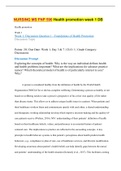
NURSING MS FNP 590 Health promotion week 1 DB Health promotion Week 1 Week 1: Discussion Question 1 - Foundations of Health Promotion Discussion Topic Points: 20 | Due Date: Week 1, Day 3 & 7 | CLO: 1 | Grade Category: Discussions Discussion Prompt Exploring the concepts of health: Why is the way an individual defines health and health problems important? What are the implications for advance practice nurses? Which theoretical model of health is of particularly interest to you? Why? A person is considered healthy from the definition of health by the World Health Organization (WHO) if he or she has complete wellbeing. Determining a person as healthy or not based on wellbeing needs to take a person’s perspective of his or her own quality of life rather than disease status. This allows us to address unique health issues in a patient. When patients and their healthcare workers listen and communicate openly with each other, a shared understanding and therapeutic working relationship develop which improve decision-making and the quality-of- care patients receive (Walters, 2016). NPs’ understanding of their patients’ definition of health based on their healthcare beliefs, values, and preferences is an essential feature of patient- centered care. The implications to practice are reflected in the succeeding concepts. A key principle in health behavior systems is that patient’s perceptions about health predicts health behaviors, e.g., compliance to plan of care, use of healthcare services, and lifestyle modification. Developing awareness about patient’s health beliefs can help identify gaps between the nurses’ and patients’ understanding of the health situation (Kennedy et al., 2017). This facilitates coming up with treatment choices that are more acceptable to patients and are aligned to their needs and expectations. NPs’ skill in perceiving and understanding patient’s definition of health and their related beliefs reflects compassion which equates to effective communication and higher quality of care. Research findings support that shared understanding of health definition, issues, and expectations between patients and their healthcare team leads to better patient satisfaction, commitment to plan of care, active participation in decision-making, and better care outcomes. These concepts pique my interest on the Health Belief Model which posits that interaction with patients will achieve optimal behavior change by targeting the patients’ health concepts where health expectations, perceived barriers, benefits, threats, and self-efficacy are covered. Understanding patients’ perception of health in this model explores the six constructs that predict health behavior: risk susceptibility, risk severity, benefits to action, barriers to action, self-efficacy, and cues to action (Jones et al., 2015). These are integrated in the adoption of health behaviors for health promotion and disease prevention. References Jones, C. L., Jensen, J. D., Scherr, C. L., Brown, N. R., Christy, K., & Weaver, J. (2015). The Health Belief Model as an explanatory framework in communication research: exploring parallel, serial, and moderated mediation. Health communication, 30(6), pp. 566–576. Kennedy, B. M., Rehman, M., Johnson, W. D., Magee, M. B., Leonard, R., & Katzmarzyk, P. T. (2017). Healthcare providers versus patients' understanding of health beliefs and values. Patient experience journal, 4(3), pp. 29–37. Walters, D. (2016). The definition of health – quality of life? The BMJ 2016, 352. doi: Week 1 discussion 2 There remains a significant number of the population who hold concerns about vaccination safety which is often reinforced by misinformation from online sources, books, and other nonmedical resources. There are parents who refuse or delay the vaccination of their children which makes their children at risk of diseases that are almost 100% preventable with immunization. Around 10% to 15% of parents request physicians to space out the schedule of vaccination (Glanz, Kraus, & Daley, 2015). Such posts tension between the exercise of personal liberty and public health, as parents and individuals fight for their decisions that impact their own health or the health of children while public health teams strive to achieve high immunization rates to prevent the spike of vaccine-preventable infections. This has been an on-going issue in public health for decades, which is more pronounced now with the issue on COVID-19 vaccine. Health workers need to understand the issue on vaccine hesitancy in order to address the gap and encourage more people to avail for vaccination services, whether for themselves, their elder family members, or for their children. Many of the angles related to vaccine hesitancy are related to the delicate balance between personal liberty and public health. Parents for instance, want to maintain control over the decisions affecting their children (Glanz, Kraus, & Daley, 2015). They need to be armed with information to come up with objective decisions in weighing the benefits and risks of vaccination. Some may argue against the scientific information presented to them, and they have the right to refuse vaccinations for their children. Strong political and cultural beliefs are added factors that keep some groups close-minded about vaccinations in general or about certain vaccine. An example of this is highlighted among the anti-vaxxers against the recent mandate on COVID-19 vaccination, where a mass vaccination site was shut down in Los Angeles last January (Malcom, 2021). “The overwhelming whiteness of the anti-vaccine movement is worth noting,” as mentioned by Dr. Anna Kirkland, director of the Institute for Research on Women and Gender (IRWG). Some of the doubts of the vaccine hesitant population can be traced back to their difficulty in assessing personal risks. Effective information, education, and communication (IEC) campaigns need to be strengthened to combat vaccination hesitancy in this post-truth era, where emotions prevail over facts (Arede et al., 2019). We need strategies that can target the emotions and conflicting belief system of the anti-vaxxers. Some perceive public policy on vaccination as political means that suppresses freedom of decision making. Communicating public health policy on vaccination can be effective by utilizing already existing communication tools in smart ways. Utilizing mixture of all available types of communication channels to reach out to public and individual patients include interpersonal, community-based, and mass media channels, and has higher chance of changing mindsets compared to using single channel approach. Interpersonal communication by healthcare frontliners can make communication with each client more personalized, where doctors and nurses can address misinformation about certain vaccines with their expertise while respecting the concerns expressed by the clients. Being sensitive to the different stages of cognitive development, cultural backgrounds, and race are important in developing information and education materials. Adolescents for instance can be influenced greatly through social media considering that they spend an average of 4.3 hours on facebook, twitter, Instagram, youtube, and other applications. Neutral approach needs to be used in terms of gender, social status, political views, and race in order to minimize related barriers in the campaigns for vaccination (Larson et al., 2018). Emphasis must be given to the benefits of vaccination, use of testimonies from clients who benefited from the vaccines, highlighting the casualties and dangers of the diseases being addressed by vaccination, and how these greatly outweigh the risks or real side effects and adverse effects of the vaccines. Developing long-term good impression about vaccination through the educational system and reaching out to the younger generations will have a long- lasting beneficial effects to the population (Arede et al., 2019). References Arede, M., Bravo-Araya, M., Bouchard, É., Singh Gill, G., Plajer, V., Shehraj, A., & Adam Shuaib, Y. (2019). Combating vaccine hesitancy: Teaching the next generation to navigate through the post truth era. Frontiers in public health, 6, 381. Glanz, J. M., Kraus, C. R., & Daley, M. F. (2015). Addressing parental vaccine concerns: Engagement, balance, and timing. PLoS biology, 13(8), e.
Written for
- Institution
- NURSING MS FNP 590
- Course
- NURSING MS FNP 590
Document information
- Uploaded on
- March 21, 2023
- Number of pages
- 12
- Written in
- 2022/2023
- Type
- Exam (elaborations)
- Contains
- Questions & answers
Subjects
-
nursing ms fnp 590 health promotion week 1 db health promotion week 1 week 1 discussion question 1 foundations of health promotion discussion topic points 20 | due date week 1
-
day 3 amp 7

Also available in package deal