

HAP Exam 1 questions & answers latest 2023
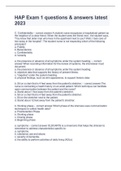
HAP Exam 1 questions & answers latest 2023C. Confidentiality A student nurse recognizes a hospitalized patient as the neighbor of a close friend. When the student sees the friend next , the student says, "You know that older man who lives in the apartment next to you? Well, I took care of him today in the hospital". The student nurse is not respecting which of the following principles? a. Fidelity b. Benevolence c. Confidentiality d. Veracity a. the presence or absence of all symptoms under the system heading. When recording information for the review of systems, the interviewer must document: a. the presence or absence of all symptoms under the system heading. b. objective data that supports the history of present illness. c. "negative" under the system heading. d. physical findings, such as skin appearance, to support historic data. b. Sit on a chair that is 4 feet away from the patient's stretcher. The nurse is conducting a heath history on an adult patient. Which technique can facilitate open communication between the patient and the nurse? a. Stand about 1 foot away from the patient's stretcher. b. Sit on a chair that is 4 feet away from the patient's stretcher. c. Sit on the stretcher next to the patient. d. Stand about 12 feet away from the patient's stretcher. b. Working phase Which phase of the interview uses communication techniques to collect health data? a. Preinteraction Phase b. Working phase c. Closing phase d. Beginning phase a. symptoms OLDCARTS is a mnemonic that helps the clinician to remember to address characteristics specific to: a. symptoms. b. substance use and abuse. c. severity of dementia. d. the ability to perform activities of daily living (ADLs). c. "Mr. Jones, I am going to ask you some questions about your health so that we can plan your care." The most appropriate introduction to use to start an interview with an adult patient is: a. "David, I am here to ask you questions about your illness; we want to determine what is wrong." b. "Because so many people have already asked you questions, I will just get the information from the chart." c. "Mr. Jones, I am going to ask you some questions about your health so that we can plan your care." d. "Mr. Jones, is it okay if I ask you some quick questions this morning about your health?" c. "Tell me how you feel about having surgery." The nurse is caring for a patient who is scheduled for surgery. The nurse observes that the patient appears anxious. Which of the following responses from the nurse is appropriate? a. "Why did you wait so long to make an appointment?" b. "That is exactly how I would feel." c. "Tell me how you feel about having surgery." d. "If I were you, I would have the surgery." c. aggravating factors A patient seeks care for "debilitating headaches that cause excessive absences at work." On further exploration, the nurse asks, "What makes the headaches worse?" With this question, the nurse is seeking information about: a. relieving (alleviating) factors. b. the patient's perception of pain. c. aggravating factors. d. the nature or character of the headache. d. a personal effort to find meaning and purpose in life Spirituality is defined as: a. participating in religious services on a regular basis. b. a social group that claims to possess variable traits. c. the process of being raised within a culture. d. a personal effort to find meaning and purpose in life. b. Critical thinking helps nurses work through the analysis, develop alternatives, and implement the best interventions. What is one way nurses use critical thinking in regard to the nursing process? a. Nurses do not need to think critically; they just need to follow orders b. Critical thinking helps nurses work through the analysis, develop alternatives, and implement the best interventions. c. Critical thinking helps nurses decide which parts of the nursing process are not needed in regard to a particular patient. d. Critical thinking allows nurses to make decisions regarding patient care without involving the patient in decisions. a. Count the radial pulse for 30 seconds, if the pulse is regular, and multiply by two. b. If irregular, count the radial pulse for 1 full minute To perform an accurate assessment of heart rate, the examiner can do which of the following? Select all that apply: a. Count the radial pulse for 30 seconds, if the pulse is regular, and multiply by two. b. If irregular, count the radial pulse for 1 full minute. c. Count the radial pulse for 2 full minutes if the pulse is irregular. d. Count the radial pulse for 15 seconds, if the pulse is regular, and multiple by 4. b. Heart rate 56 beats per minute The nurse is conducting an exam on a five year-old child. Which finding would require immediate follow up by the nurse? a. Blood pressure 90/58 mmHG b. Heart rate 56 beats per minute c. Axillary temperature of 97.2 F (36.2 C) d. Respiratory rate 24 c. Patient's hygiene and dress, speech, posture, and mobility. The nurse knows that elements of the general survey include: a. Patient's level of consciousness, personal hygiene, vital signs, and physical condition. b. Patient's gait, behavior, physical appearance and duration of their of pain. c. Patient's hygiene and dress, speech, posture, and mobility. d. Patient's overall appearance, facial expression, vital signs, and gait. b. Inspection When performing a physical assessment, the technique the nurse will always use first is: a. palpation b. inspection c. auscultation d. percussion a. patient self-report When working with a patient in acute pain, the nurse knows that the most reliable indicator of pain is: a. Patient self-report b. Magnetic resonance imaging (MRI) results c. Tissue enzyme levels d. Blood drug levels b. systolic pressure The nurse knows that the first Korotkoff sound when taking a patient's blood pressure indicates: a. Diastolic pressure b. Systolic pressure c. Brachial pressure d. Cuff malfunction a. 12-20 When conducting a respiratory assessment with an adult patient, which of the following would the nurse consider as a normal respiratory rate range? a. 12-20 b. 18-30 c. 24-40 d. 30-60 a. wear gloves when in contact with patient's mucous membrane When examining a patient, the nurse remembers to follow which principle of Standard Precautions? a. Wear gloves when in contact with patient's mucous membranes b. Wear gloves throughout the entire examination of patients c. Wear eye protection and gown during the examination of the patient d. Wear gloves to reduce the need for hand washing a. temperature The dorsa of the hands are used to determine: a. temperature b. texture c. an organ's location d. vibration c. waiting less than 15 seconds before repeating the reading on the same arm A common error in blood pressure measurement includes: a. taking the blood pressure in an arm that is at the level of the heart. b. deflating the cuff about 2 mm Hg per heart beat. c. waiting less than 15 seconds before repeating the reading on the same arm. d. palpating the brachial artery before placing the blood pressure cuff. a. allergic reaction When taking the health history, the patient complains of pruritus. What is a common cause of this symptom? a. Allergic response b. Cancer c. Hyperpigmentation d. Excessive bruising d. zosteriform What term refers to a linear skin lesion that runs along a nerve route? a. Annular b. Dermatome c. Shingles d. Zosteriform
Document information
- Uploaded on
- March 10, 2023
- Number of pages
- 10
- Written in
- 2022/2023
- Type
- Exam (elaborations)
- Contains
- Questions & answers


