

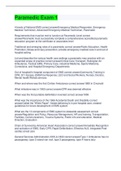
Paramedic Exam 1(A+ graded 100% latest update)
4 levels of National EMS correct answerEmergency Medical Responder, Emergency Medical Technician, Advanced Emergency Medical Technician, Paramedic Requirements that must be met to function at Paramedic Level correct answerParamedic must successfully complete a comprehensive accredited paramedic education program at the certificate or associates level Traditional and emerging roles of a paramedic correct answerPublic Education, Health Promotion, Illness and injury prevention, provide emergency medical care in and out of hospital setting List and describe the various health care settings a paramedic may practice with an expanded scope of practice correct answerCritical Care Transport, Helicopter Air Ambulance, Tactical EMS, Primary Care, industrial Medicine, Sports Medicine, Corrections, and Hospital Emergency Departments Out of hospital/In-hospital component of EMS correct answerCommunity Training in CPR, 911 Access, EMS/Fire Response, LEO and Social Workers, Nurses, Doctors, Mental health/Rehab services When and where was the first Civilian Ambulance correct answer1860 in Cincinatti What milestone was in 1960 correct answerCPR was deemed effective When was the first portable defibrillator invented correct answer1959 What was the importance of the 1966 Accidental Death and Disability correct answerCalled the "White Paper", Noted deficiency's in pre-hospital care, created guidelines for future development of EMS system What are the 10 components of EMS system to statewide assessment correct answerRegulation and Policy, Resource Management, HR and training, Transportation, Facilities, Communications, Trauma Systems, Public info and education, Medical Direction, Evaluation Chain of Survival by American Heart Association correct answerImmediate Recognition and activation of EMS, Early CPR, Rapid Defibrillation, Effective ALS, integrated Post-cardiac arrest care General Services Administration-KKK-A-1822 correct answerType 1 Ambulance has no passageway, type 2 raised van roof, type 3 passageway, type 4 heavy duty Level 1 Trauma correct answer24/7 University Based, Comprehensive Stroke Center Level 2 trauma correct answerPrimary stroke Center, 30 mins - 2 hour surgeon response time Level 3 Trauma correct answerEmergency Room Primary Responsibilities of a Paramedic correct answerPreparation, Response, Size-Up, Patient Assessment, Treatment & management, disposition & transfer, documentation, Clean up, Maintenance, Review Additional Responsibilities of a paramedic correct answerCommunity involvement, Support for primary care, citizen involvement, personal and professional development Professional Attributes of a paramedic correct answerLeadership, Integrity, Empathy, Self-Motivation, Professional Appearance/Hygiene, Self-confidence, Communication Skills, Time Management Skills, Diplomacy in Teamwork, Respect, Patient Advocacy, Careful Delivery of Service Basics of Physical Fitness correct answerCardiovascular, Flexibility & Strength, Nutrition & Weight Control, Freedom from addiction, Back Safety Dietary Guidelines correct answerEnjoy your food but eat less, eat more fruits, vegetables, eat less sodium and sugar, avoid junk foods Standard Precautions correct answerPPE, Gloves, Goggles, Mask, N-95, Gown Most important infection control practice correct answerHand-Washing, scrub for 15 seconds Stages of Grief correct answerDABDA, Denial, Anger, Bargaining, Depression, Acceptance What are the responses to stress correct answerAlarm, Resistance, Exhaustion Good stress correct answerEustress Bad Stress correct answerDistress Infectious disease caused how correct answerBy Pathogens Greatest hazard to EMS correct answerMotor Vehicle Collisions Steps for Scientific Method correct answerObserve, Data Collection, Construct Hypothesis, Test Hypothesis, Analyze Results, Revise Hypothesis, Report Results Quantitative Study correct answerUses Numbers Qualitative Study correct answerUses Words Mixed Study correct answerUses Quantitative and Qualitative Independent Variable correct answerAffects the Dependent Dependent Variable correct answerIs the outcome or being affected Retrospective correct answerUses existing Data Prospective correct answerPredicts future outcomes. Has greater validity Control Group correct answerDoes not receive intervention Treatment correct answerDoes Receive intervention Single Blind Study correct answerSubject is blind Double Blind Study correct answerBoth groups are blind. No one knows who is being tested Institutional Review Board/IRB correct answerApproves, Monitors and reviews human research Cohort Study correct answerAn observational Study in which subjects with condition are followed over time EMS roles in public correct answerDisease Prevention, Disease Surveillance, Disaster Management, Injury Prevention Public Health Laws correct answerIllness & Prevention, Police Powers for public health agencies, Epidemiological Tools Epidemiology 6 roles in public health correct answerPublic Health Surveillance, Field investigation, Analytic Studies, Evaluation, Linkage, Policy Development Areas where EMS can be active in prevention correct answerInfants & Children, Motor Vehicle Collisions, Geriatric Patients, Work and Recreation hazards, Medications, Early Discharge Prevention Strategies for EMS personnel correct answerPreserve Team Safety, Recognize Scene Hazards, Document findings, conduct on scene education, know community resources, assess community needs Morals correct answerPersonal/religious standards of right and wrong Ethics correct answerA set of rules or guidelines for a professional group Laws correct answerFrequently describe what is wrong in eyes of society Religion correct answerEnhances ones ethical & moral principles and values What was published in 1978 correct answerEMT Code of Ethics Beneficence correct answerActually Doing Good Maleficence correct answerDoing Harm Non-maleficence correct answerNot doing harm Autonomy correct answerCompetent adult has the right to decide will for his own body Justice correct answerTreating all patients equally Impartiality Test correct answerGolden Rule Test, Reduces Bias Universalizability correct answerWould you want action performed in similar instance Interpersonal correct answerCan you defend your actions Parties that EMS communicate with correct answerEmergency Medical Dispatcher, Patient, Patient Family, Other responding agencies, health care staff, Medical director Pre-Hospital Care Report/PCR correct answerWritten or electronic, Record of events, Legal document NEMSIS National Emergency Medical Services Information system correct answerData dictionary and collector UHF/ Ultra High Frequency correct answerUsed in urban areas. Goes through concrete and steel VHF/ Very High Frequency correct answerUsed in rural area for long distance Simplex correct answerTransmit & Receive on same frequency Duplex correct answerSimultaneous 2 way communications Multiplex correct answerTransmits Voice & Data at the same time Trunked correct answerPulls all frequency to avoid searching Digital correct answerFaster & more accurate. Becoming more popular FCC/Federal Communications Commission correct answerRegulates all Non-governmental frequencies What was published in 2009 correct answerNational Emergency Communications Plan Pre-Hospital Care Report correct answerReflects professionalism, provides info to health care professionals, Provides info for proper billing, Provides Legal Record of the call, Well Written PCR suggests efficient assessment and quality care Narrative of PCR correct answerProvides Subjective, Objective and Assessment/Management Plan SOAP PCR format correct answerSubjective, Objective, Assessment, Plan CHART PCR Format correct answerChief Complaint, History, Assessment, RX (Treatment), Transport First 3 hours of life correct answerNewborn First 3 hours - 28 days correct answerNeonate Infant correct answer28 days - 1 year Toddler correct answer12 months - 36 months Pre-school correct answer3-5 Years old Adolescence correct answer13-18 years old Early Adult correct answer19-40 years old Middle Adult correct answer41-60 Years old Late Adult correct answer60 + years old Infant birth weight correct answer3.3-3.5KG Infant head weight correct answer25% of body weight First breath taken by an infant correct answerForceful First 4 weeks correct answerNose breather Infant airway correct answerNarrower, Shorter, Easily Obstructed Moro Reflex correct answerStartled infant throws arms out Rooting correct answerTouch of cheek turns head towards Sucking Reflex correct answerStroking lips causes sucking infant Posterior Fontanelle correct answercloses in 2-3 months Anterior Fontanelle correct answerSinks when dehydrated. Closes in 9-18 months Authoritarian Parenting correct answerDemanding - wants instant obedience Authoritative Parenting correct answerNot as demanding. Wants Kids to do well make own decisions Permissive Parenting correct answerLet's kids do what they want 3 parenting styles correct answerAuthoritarian, Authoritative, Permissive 3 types of bonds correct answerCovalent (Strongest), Ionic and Hydrogen 4 major elements of living systems correct answerCarbon, Hydrogen, Oxygen and Nitrogen Chemicals that do not contain carbon correct answerInorganic Chemicals that contain carbon correct answerOrganic 2 major systems involved in acid-base balance correct answerRespiratory and Renal Systems 4 major classes of biological/compounds correct answerProteins, Carbs, Lipids, Nucleic Acids Scale that measures Hydrogen by factors of 10 correct answerPH Scale Less than 7 on scale is what correct answerAcid More than 7 is what correct answerBasic 2 Standard IV Fluids correct answerCrystalloids and Colloids Any chemical reaction that results in the transfer of protons is referred to as correct answerAcid-Base Reaction Substance that give up protons during chemical reaction correct answerAcid Substance that acquire protons during chemical reaction correct answerBases Biologic PH Scale correct answer7.35 - 7.45 3 components of Circulatory System correct answerHeart (Pump) Blood (Fluid) Blood Vessels (Container) Study of Disease Causes correct answerEtiology 4 general categories of tissue correct answerEpithelial, Connective, Muscle, Nervous 3 categories of muscle correct answerSmooth, Skeletal, Cardiac Physical Agents correct answerHeat, Cold, Radiation What determines degree of injury correct answerStrength of agent and Length of exposure Who's total body water is 60-70% correct answerAdult Who's total body water is 70-80% correct answerInfants who's total body water is 50% correct answerElderly Location of 40% of Total body water correct answerIntracellular Location of 20% of total body water correct answerInterstitial 2 types of cells correct answerEukaryotic and Prokaryotic Smallest unit of life? correct answerCells Apoptosis correct answerCell death that is programmed to destroy itself. Normal Necrosis correct answerPathological and Uncontrollable Wide-Spread cell death Phospholipids correct answerForm the membrane that surround the cells Nucleic Acids correct answerDeoxyribonucleic Acid (DNA) Ribonucleic Acid (RNA) RNA plays major role in protein synthesis Plasma correct answerMakes up approximately 55% of Blood It is composed of 91-92% water and 6-7 or 9% Protein Hydrostatic Pressure correct answerPressure from the heart Universal Solvent correct answerWater 2 Structures important in Cell movement correct answerCilia (Hairlike) Flagella The smallest building block correct answerAtom Atoms consist of 3 parts correct answerProtons, Neutrons and Electrons The number of Protons in an atom's nucleus is referred to as correct answerAtomic Number The number of Protons and Neutrons in an atom is correct answerThe mass number Valence Shell correct answerThe outermost shell of an atom An atom that is missing electrons and has a net positive is what correct answerCation (I.e Sodium and Calcium) An atom with a negative charge correct answerAnion Has a capsule that protects it from phagocytes correct answerBacteria How many Chromosomes do humans have correct answer46 (23 Pairs) a substance disolved in water that counteracts changes in PH correct answerA Buffer 3 major buffer systems correct answerCarbonic Acid-Bicarbonate Buffer System, Protein Buffer system, Phosphate Buffer System Carbonic Acid-Bicarbonate correct answermost rapidly acting & most important Protein Buffer System correct answerPlays major role in PH Regulation in ECF & ICF compartments Phosphate Buffer System correct answerPlays role in buffering the PH of the ICF and Urine Simple Diffusion correct answersubstances move across membrane from lower to higher to balance. A passive process called simple diffusion Osmosis correct answermovement of water molecules from area of high concentration to low. Facilitated Diffusion correct answerFacilitated by integral proteins in the plasma membrane called carrier/transporter proteins. Active Transport correct answerUses Carrier protein and ATP for Energy Endocytosis correct answerPlasma membrane circles the substance to be ingested Exocytosis correct answerSubstance fuses with Cell membrane and it's contents are released outside the cell There are 5 of these correct answerTypes of shock Cardiogenic Shock correct answerAn inability of the heart to pump enough blood to supply all body parts Hypovelemic Shock correct answerShock due to loss of intravascular fluid volume Neurogenic Shock correct answerResults from injury to either the brain or spinal cord Anaphylactic shock correct answerWhen a foreign substance enters the body, the immune system responds to rid the body of the invader Septic Shock correct answerBegins with Septicemia (Sepsis), an infection that travels throughout the bloodstream MODS correct answerMultiple Organ Dysfunction Syndrome Progressive impairment of more than 2 organ systems, Most common cause sepsis and septic shock, 60-90% mortality rate correct answerMODS Primary Mods correct answerDirect result of insult Secondary Mods correct answerProgressive organ dysfunction Common Poisons correct answerCyanide and Pesticides 3 lines of defense correct answerAnatomic barriers, Immune response, Inflammatory Response What makes up the Lymphatic System correct answerNetwork of Capillaries, Vessels, Ducts and nodes, and organs What is Lymph correct answerThin watery fluid that bathes tissues Inflammatory Response correct answerReaction of the body to irritation or injury Oncotic Force correct answerOsmotic Pressure created by large proteins inside vascular system pulling water from interstitial space More hydrogen causes correct answerLower PH Level Calorie correct answerThe energy needed to heat 1g of water 1 degree celsius How is Body Heat generated correct answerfrom Oxidation, Digestion, and Movement What controls the body temperature correct answerHypothalamus Has oxygen to grow correct answerAerobic Does not need oxygen to grow correct answerAnaerobic Isotonic correct answerWhen both sides are equal Where is sodium correct answerOutside of the cells Where is potassium correct answerInside the cells What cells are the chief activators of the inflammatory system correct answerMast Calcium works with what correct answerMuscle Sodium works with what correct answerNerves Potassium works with what correct answerHeart Maximum Life span? correct answer120 years old What system works with Prostaglandins to cause pain correct answerKinin System What would you use to clean blood in ambulance correct answerChemical Sterilizing agent quality improvement correct answerBased on the whole EMS system Quality Assurance correct answerLooks at results and identifies individuals Physiological Response in metabolic acidosis correct answerIncreased rate of respiration and depth Hypertrophy correct answerIncreased Cell size due to workload Key hormone released from adrenal gland during fight or flight correct answerCortisol Postive charge on the outside, negative charge on the inside correct answerDepolarized What is a hypotonic Solution? correct answerD5W solvent and solute combined correct answerSolution Mechanism Responsible for potassium being able to enter cardiac cells correct answerActive transport Digestive enzymes that protect against disease and produce nutrients are found in correct answerMitochondria Co2 levels correct answer35-45 is normal Greater than 45 is acidic HCO3(Bi-Carbonate) levels correct answer22-26 normal Greater than 26 basic When breathing fast what happens correct answerPH increases and CO2 decreases Respiratory alkalosis symptoms correct answerTachypnea, increase Heart rate Metabolic alkalosis symptoms correct answerBradypnea, hypokalemia, caused by losing hydrogen ions
Document information
- Uploaded on
- March 6, 2023
- Number of pages
- 11
- Written in
- 2022/2023
- Type
- Exam (elaborations)
- Contains
- Questions & answers


