CRITICAL CARE TESTBANK EXAM 2
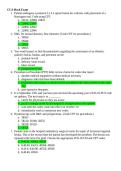
CRITICAL CARE TESTBANK EXAM 2Chapter 08: Hemodynamic Monitoring 1. The nurse is caring for a 100-kg patient being monitored with a pulmonary artery catheter. The nurse assesses a blood pressure of 90/60 mm Hg, heart rate 110 beats/min, respirations 36/min, oxygen saturation of 89% on 3 L of oxygen via nasal cannula. Bilateral crackles are audible upon auscultation. Which hemodynamic value requires immediate action by the nurse? a. Cardiac index (CI) of 1.2 L/min/m3 b. Cardiac output (CO) of 4 L/min c. Pulmonary vascular resistance (PVR) of 80 dynes/sec/cm–5 d. Systemic vascular resistance (SVR) of 1400 dynes/sec/cm–5 A cardiac index of 1.2 L/min/m3 combined with the identified clinical assessment findings indicate a low cardiac output with fluid overload (bilateral crackles), requiring intervention. The remaining hemodynamic values are within normal limits: cardiac output of 4 L/min; pulmonary vascular resistance of 80 dynes/sec/cm–5; and the systemic vascular resistance of 1400 dynes/sec/cm–5. 2. While caring for a patient with a small bowel obstruction, the nurse assesses a pulmonary artery occlusion pressure (PAOP) of 1 mm Hg and hourly urine output of 5 mL. The nurse anticipates which therapeutic intervention? Low pulmonary artery occlusion pressures usually indicate volume depletion, so intravenous fluids would be indicated. A normal hourly urine output is 1 mL/kg or at least 30 mL/hour, so this is another indication that the patient is volume depleted. Administration of diuretics would worsen the patient’s volume status. Negative inotropes would not improve the patient’s volume status. Vasopressors will increase blood pressure but are contraindicated in a low volume state. 3. The nurse is caring for a patient who has had an arterial line inserted. To reduce the risk of complications, what is the priority nursing intervention? Loose connections in hemodynamic monitoring tubing can lead to hemorrhage, a major complication of arterial pressure monitoring. Application of a pressure dressing is required only upon arterial line removal. Blood return is adequate confirmation of arterial line placement; radiography is not performed to confirm arterial line placement. Neutral positioning of the extremity and use of an arm board, without limb restraint, is the standard of care. 4. While caring for a patient with a pulmonary artery catheter, the nurse notes the pulmonary artery occlusion pressure (PAOP) to be significantly higher than previously recorded values. The nurse assesses respirations to be unlabored at 16 breaths/min, oxygen saturation of 98% on 3 L of oxygen via nasal cannula, and lungs clear to auscultation bilaterally. What is the priority nursing action? A hemodynamic value not supported by clinical assessment should be treated as questionable. To ensure the accuracy of hemodynamic readings, the catheter transducer system must be leveled at the phlebostatic axis and zero referenced. In this example, the catheter transducer system may be lower than the phlebostatic axis, resulting in erroneously higher pressures. Clinical manifestations do not support increasing supplemental oxygen. Clinical manifestations do not warrant provider intervention; aberrant values should be investigated further. An aberrant value warrants further investigation, which includes zero referencing and checking the level as an initial measure. A chest x-ray study is not warranted at this time. 5. A patient is admitted to the hospital with multiple trauma and extensive blood loss. The nurse assesses vital signs to be BP 80/50 mm Hg, heart rate 135 beats/min, respirations 36 breaths/min, cardiac output (CO) of 2 L/min, systemic vascular resistance of 3000 dynes/sec/cm–5, and a hematocrit of 20%. The nurse anticipates administration of which the following therapies or medications? Both hemodynamic parameters and the reported hematocrit value indicate hypovolemia and blood loss requiring volume resuscitation with blood products. Furosemide administration will worsen fluid volume status. Inotropic agents will not correct the underlying fluid volume deficit and anemia. Vasoconstrictors are contraindicated in a volume-depleted state. 6. After pulmonary artery catheter insertion, the nurse assesses a pulmonary artery pressure of 45/25 mm Hg, a pulmonary artery occlusion pressure (PAOP) of 20 mm Hg, a cardiac output of 2.6 L/min and
Written for
- Institution
- Case 13 Coronary Artery Disease and Coronary Arter
- Course
- Case 13 Coronary Artery Disease and Coronary Arter
Document information
- Uploaded on
- March 2, 2023
- Number of pages
- 6
- Written in
- 2022/2023
- Type
- Exam (elaborations)
- Contains
- Questions & answers
Subjects
-
critical care testbank exam 2 chapter 08 hemodynamic monitoring 1 the nurse is caring for a 100 kg patient being monitored with a pulmonary artery catheter the nurse assesses a blood pressure of 90