Chamberlain College of Nursing CHEM 120 Chem Lab Week 2.
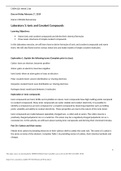
Learning Objectives: Name ionic and covalent compounds and derive their chemical formulas Draw Lewis structures of simple covalent compounds In this laboratory exercise, we will learn how to derive formulas of ionic and covalent compounds and name them. We will also flame test for various metal ions and make models of simple covalent molecules. Exploration 1: Explain the following terms (Complete prior to class). Cation: loses an electron, becomes positive Anion: gains an electron, becomes negative Ionic bond: when an atom gains or loses an electron Polar covalent bond: uneven distribution w/ sharing electrons Nonpolar covalent bond: even distribution w/ sharing electrons Hydrogen bond: weak bond between 2 molecules Exploration 2: Ionic compounds Ionic compounds are hard, brittle and crystalline in nature. Ionic compounds have high melting points compared to covalent compounds. Many Ionic compounds are water soluble and conduct electricity. It is possible to identify a compound as an ionic compound or a covalent compound by observing properties such as melting point, solubility and ability to conduct electricity. These properties are due to the nature of the ionic bond. Ionic compounds are made between oppositely charged ions- a cation and an anion. The cation may be a positively charged polyatomic ion or a metal ion. The anion may be a negatively charged polyatomic ion or a nonmetal ion. In this activity, we will learn about naming ionic compounds and deriving their chemical formulas. Part 2A: Cations and their names Metals form cations by donat
Written for
- Institution
-
Chamberlain College Of Nursing
- Course
-
CHEM 120
Document information
- Uploaded on
- February 24, 2023
- Number of pages
- 8
- Written in
- 2022/2023
- Type
- Exam (elaborations)
- Contains
- Unknown
Subjects
- chem 120
-
laboratory 3 ionic and covalent compounds

Also available in package deal