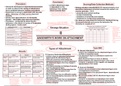
Conclusion
Procedure Scoring/Data Collection Methods
• a child’s attachment style
• Ainsworth developed an experimental procedure is dependent on the • Strange situation classifications are based primarily on 4
in order to observe the variety of attachment behaviour their mother interaction behaviours directed onwards the mother in 2
forms exhibited between mothers and infants shows towards them reunion episodes - 5 & 8
• Experiment is set up in small room with one way - proximity and contact seeking
glass - behaviour of infant can be observed - contact maintaining
covertly - avoidance of proximity and contact
• Infants were aged between 12-18 months - resistance to contact and comforting
• Sample - 100 middle class American families • the observer notes down the behaviour displayed during
• Procedure - conducted by observing the 15-second intervals and scores the behaviour for
behaviour o the infant in a series of 8 episodes intensity on a scale of 1-7.
lasting approx. 3 mins each
Strange Situation
Episodes (3 minute duration) Behaviour Assessed
1. Parent and infant play. /
2. Parent sits while infant plays. Use of parent as secure base.
3. Stranger enters and talks to parent. Stranger anxiety.
4. Parent leaves, infant plays, stranger offers Separation anxiety.
comfort if needed.
AINSOWRTH’S WORK ON ATTACHMENT
5. Parent returns, greets infant, offers comfort if Reunion behaviour.
needed; stranger leaves.
6. Parent leaves, infant alone. Separation anxiety.
7. Stranger enters and offers comfort. Stranger anxiety.
8. Parent returns, greets and comforts infant. Reunion behaviour.
Types of Attachment Type BAC
B: Secure Attachment
Results • children feel confident that the attachment figure will be
C: Insecure Ambivalent/Resistant available to meet their needs
Secure Resistant Avoidant
• children adopt an ambivalent behavioural • Use attachment figure as safe base to explore the
Separation Distressed when mother
Anxiety leaves
Intense distress when the
mother leaves
No sign of distress when
the mother leaves style towards the attachment figure environment
• Child will commonly exhibit clingy and • Seek attachment figure in times of distress
Stranger
Anxiety
Avoidant of stranger when The infant avoids the The infant is okay with the dependent behaviour, but will be rejecting of • Easily soothed by the attachment figure when upset
alone, but friendly when the
mother is present
stranger - shows fear of the
stranger
stranger and plays normally
when the stranger is the attachment figure when they engage in • Caregiver is sensitive to their signals, and responds
present.
interaction appropriately to their needs
Reunion
behaviour
Positive and happy when
mother returns
The infant approaches the
mother, but resists contact,
The infant shows little • Child fails to develop any feelings of security
may even push her away
interest when the mother
returns from the attachment figure A: Insecure Avoidant
• They exhibit difficulty moving away from the • children do not orientate to their attachment figure while
Other Uses the mother as a safe
base to explore their
The infant cries more and
explores less than the other
The mother and stranger
are able to comfort the attachment figure to explore novel investigating the environment
environment two types infant equally well surroundings • Very independent of the attachment figure - physically and
• When distressed, they are difficult to soothe emotionally
% of infants 70% 15% 15% and are not comforted by interaction with the • Do not seek contact with the attachment figure when
attachment figure distressed
• This behaviour results from an inconsistent • Caregiver is insensitive and rejecting to their needs
level of response to their needs from the • attachment figure may withdraw from helping during
primary caregiver difficult tasks and is often unavailable during times of
emotional distress
Procedure Scoring/Data Collection Methods
• a child’s attachment style
• Ainsworth developed an experimental procedure is dependent on the • Strange situation classifications are based primarily on 4
in order to observe the variety of attachment behaviour their mother interaction behaviours directed onwards the mother in 2
forms exhibited between mothers and infants shows towards them reunion episodes - 5 & 8
• Experiment is set up in small room with one way - proximity and contact seeking
glass - behaviour of infant can be observed - contact maintaining
covertly - avoidance of proximity and contact
• Infants were aged between 12-18 months - resistance to contact and comforting
• Sample - 100 middle class American families • the observer notes down the behaviour displayed during
• Procedure - conducted by observing the 15-second intervals and scores the behaviour for
behaviour o the infant in a series of 8 episodes intensity on a scale of 1-7.
lasting approx. 3 mins each
Strange Situation
Episodes (3 minute duration) Behaviour Assessed
1. Parent and infant play. /
2. Parent sits while infant plays. Use of parent as secure base.
3. Stranger enters and talks to parent. Stranger anxiety.
4. Parent leaves, infant plays, stranger offers Separation anxiety.
comfort if needed.
AINSOWRTH’S WORK ON ATTACHMENT
5. Parent returns, greets infant, offers comfort if Reunion behaviour.
needed; stranger leaves.
6. Parent leaves, infant alone. Separation anxiety.
7. Stranger enters and offers comfort. Stranger anxiety.
8. Parent returns, greets and comforts infant. Reunion behaviour.
Types of Attachment Type BAC
B: Secure Attachment
Results • children feel confident that the attachment figure will be
C: Insecure Ambivalent/Resistant available to meet their needs
Secure Resistant Avoidant
• children adopt an ambivalent behavioural • Use attachment figure as safe base to explore the
Separation Distressed when mother
Anxiety leaves
Intense distress when the
mother leaves
No sign of distress when
the mother leaves style towards the attachment figure environment
• Child will commonly exhibit clingy and • Seek attachment figure in times of distress
Stranger
Anxiety
Avoidant of stranger when The infant avoids the The infant is okay with the dependent behaviour, but will be rejecting of • Easily soothed by the attachment figure when upset
alone, but friendly when the
mother is present
stranger - shows fear of the
stranger
stranger and plays normally
when the stranger is the attachment figure when they engage in • Caregiver is sensitive to their signals, and responds
present.
interaction appropriately to their needs
Reunion
behaviour
Positive and happy when
mother returns
The infant approaches the
mother, but resists contact,
The infant shows little • Child fails to develop any feelings of security
may even push her away
interest when the mother
returns from the attachment figure A: Insecure Avoidant
• They exhibit difficulty moving away from the • children do not orientate to their attachment figure while
Other Uses the mother as a safe
base to explore their
The infant cries more and
explores less than the other
The mother and stranger
are able to comfort the attachment figure to explore novel investigating the environment
environment two types infant equally well surroundings • Very independent of the attachment figure - physically and
• When distressed, they are difficult to soothe emotionally
% of infants 70% 15% 15% and are not comforted by interaction with the • Do not seek contact with the attachment figure when
attachment figure distressed
• This behaviour results from an inconsistent • Caregiver is insensitive and rejecting to their needs
level of response to their needs from the • attachment figure may withdraw from helping during
primary caregiver difficult tasks and is often unavailable during times of
emotional distress