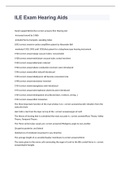
ILE Exam Hearing Aids WITH CORRECT ANSWERS 2023
Hand Cupped Behind Ear -first Hearing Aid -increased sound by 5-8db -included horns,trumpets, speaking tubes 1892 -carbon amplifiers patent by Alexander Bell -marketed until 1930;first patent for a telephone type hearing instrument 1920 large vacuum tubes; not portable 1938 miniature vacuum tube ;crystal receivers 1930 diameter reduced 1940 bone conduction receivers were introduced 1946 first telecoil introduced 1950 bodyworn HA became convenient size 1948 transistor invented 1954 eyeglasses aids introduced 1974 microphones electrets were introduced 1964 intergrated circuit(transistors, resistors, wiring...) 1952 first transistors The Most Important function of the oval window is to : transfer vibration from the ossicular chain Hair Cells a rise from the layer on top of the : organ of corti The theory of hearing that is considered the most accurate is : Place Theory, Volley Theory, Temporal Theory The Three semicircular canals are: 1)90degress angle to one another 2)superior,posterior, and lateral 3)detectors of rotational movement in any direction The average length of an uncoiled basilar membrane is 35mm The name given to the nerve cells connecting the organ of corti to the 8th cranial Nerve is : Spiral Ganglia The Theory of hearing that describes the cochlea as consisting of nerve ending with hair cells that respond to specific frequencies: The Place Theory The basilar membrane is located: In the scala media Sounds appear to be louder when both ears hear together because of: binaural summation Collectively the semi circular canals are called the vestibular system The inability of the brain to accurately process auditory stimuli is called a Central Hearing Loss A Congential hearing loss : is always present @ or near birth Tinnitus is most common in : SNHL sensorineural hearing loss A small increase in intensity that results in a large increase in perceived loudness is call: recruitment A central hearing loss involves the : cochlea& auditory nerve Common symptoms of Meniere's syndrome include: tinnitus, vertigo, hearing loss Acoustic trauma is caused by : sudden impact noise Noise in the head such as roaring, hissing, buzzing or ringing is called: tinnitus Hearing loss from noise exposure is usually due to: cochlear hair cell damage
Document information
- Uploaded on
- February 15, 2023
- Number of pages
- 4
- Written in
- 2022/2023
- Type
- Exam (elaborations)
- Contains
- Questions & answers