100% satisfaction guarantee Immediately available after payment Both online and in PDF No strings attached 4.2 TrustPilot
logo-home
Exam (elaborations)

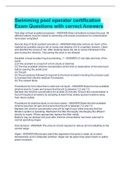
Swimming pool operator certification Exam Questions with correct Answers

Rating
4.7
(3)
Sold
1
Pages
9
Grade
A+
Uploaded on
12-02-2023
Written in
2022/2023

First step of fecal accident procedure - ANSWER-Direct all bathers to leave the pool. All affected waters must be closed to swimming until proper procedures for contamination have been completed Second step of fecal accident procedure - ANSWER-Manually remove as much of the material as possible using a net or scoop and dispose of it in a sanitary manner. Clean and disinfect the scoop or net. After cleaning leave the net or scoop immersed in the pool during this infection. Vacuuming the stool is not allowed. Establish a fecal accident log documenting...? - ANSWER-(1) the date and time of the event (2) if the accident is a result of a form stools or diarrhea (3) The free available chlorine concentration at the time or observation of the event and before opening the public pool (4) The pH (5) The procedures followed to respond to the fecal accident including the process used to increase free chlorine residual if necessary (6) The contact times Procedures for form stool that is solid and not liquid - ANSWER-Raise the free available chlorine level to 2 ppm and ensure that the pH is between 7.2 and 7.5 Maintain the chlorine concentration for at least 25 minutes. Ensure this concentration is found throughout all waters by sampling at least three widely spaced locations away from return outlets Procedures for diarrhea liquid or non-form stools - ANSWER-Raise the free available chlorine level two 20 ppm and ensure that the pH is between 7.2 and 7.5 Maintain the chlorine concentration and pH for eight hours while ensuring that the filtration system is operating. Backwash the filter thoroughly discharging the effluent directly to waste. Where appropriate replace the filter media Bathers may be allowed into pool after chlorine concentration has been returned to normal operating ranges Acid demand - ANSWER-The amount of acid required to reduce pH and alkalinity to the correct range Algae - ANSWER-Microscopic plant like organisms that grow in water do to warm temperatures and in adequate sanitizer. Algae can be green blue green black or yellow green (mustard). Alkalinity - ANSWER-A measure of the ability of pool water to resist changes in pH. Buffering capacity of water. Balanced water - ANSWER-The correct ratio of hardness, alkalinity, temperature, dissolved solids, and pH that prevent pool water from being either corrosive or scale forming Bromine - ANSWER-A chemical element that exists as a liquid in its elemental form or as part of a chemical compound that is an oxidant and a biocidal agent used to disinfect pool, spa and hot tub water. Bromamine - ANSWER-Bromine-ammonia compounds formed when the bromine in the water combines with ammonia, nitrogen or swimmer or bather waste. Unlike Chloramines they do not smell or irritate the body. They are active sanitizers. Calcium hardness - ANSWER-The amount of dissolved calcium in the pool. High levels promote scale and cloudy water. Low levels promote corrosion of the pool or spa equipment. Cavitation - ANSWER-Formation of partial vacuums when the pump exceeds the water supply Chlorine - ANSWER-A chemical element that exists as a gas in its elemental form or as a part of a chemical compound that is an oxidant and a biocidal agent used in pool, spa, and hot tub disinfection Chlorine demand - ANSWER-The amount of chlorine necessary to destroy the germs, algae, and other impurities in the water. Demand refers to the amount required before chlorine can be made available to continue sanitizing the pool, spa, or hot tub water. Chloramines - ANSWER-A compound formed when chlorine combines with ammonia, nitrogen, or swimmer or bather wastes. They cause eye and skin irritation, and they have a strong objectionable odor. Chlorine residual - ANSWER-The amount of measurable chlorine remaining after treating water with chlorine to disinfect and oxidize contaminants. It may also be explained as the amount of chlorine left after satisfying the chlorine demand. Free available chlorine (FAC) - ANSWER-The portion of total chlorine remaining in chlorinated water that is not combined with ammonia or nitrogen compounds and will react chemically with undesirable or disease causing organisms Conditioner - ANSWER-Also called cyanuric acid, stabilizer, Isocyanuric acid and Triazinetrione-A chemical that helps reduce the excessive loss of chlorine in water due to ultraviolet rays of the sun. Copper - ANSWER-Metallic element that forms compounds causing green or blue green water, green or blue green stains in pool or spa surfaces and green hair or blue fingernails on swimmers and bathers. Cross connection - ANSWER-An unprotected connection between a domestic water supply and the pool. Protective devices must be used to eliminate possible contamination. DPD - ANSWER-(Diethel-P-Phenylene Diamine) A reagent and test method that specifically measures the free available chlorine and total chlorine. It produces a series of colors from pink to red. Flow meter - ANSWER-A device that measures pressure differential across a calibrated orifice and indicates a rate of flow at that point usually given in gallons per minutes Hard water - ANSWER-Water that has a high level of calcium and magnesium dissolved in it Iron - ANSWER-A metallic element that forms compounds causing orange or brown colored water and orange or brown colored stains on pool or spa walls Oxidation reduction potential - ANSWER-A method of measuring the potential, which often relates to the concentration of an oxidizer in the pool water. ORP probes send signals to electrical controllers that can control valves on chemical feeders to dissolve and release disinfectants. Pathogen - ANSWER-Micro organism that causes disease in humans. pH - ANSWER-Value expressing the relative acidity or alkalinity Of pool or spa water as indicated by hydrogen ion concentration. It is expressed as a number between zero and 14. Low pH values cause corrosion of equipment and pool or spa surfaces. High pH values cause scale and reduce the effectiveness of sanitizers. ppm - ANSWER-Parts per million Phenol red - ANSWER-A red chemical reagent that reacts with the hydrogen ion in pool or spa water to indicate the pH value Residual - ANSWER-The concentration of a chemical (typically the disinfectant) in water. Scale - ANSWER-The hard mineral deposits that forms on surfaces in contact with water when the calcium hardness, pH or total alkalinity levels are too high Shock - ANSWER-The practice of adding significant amounts of oxidizing chemical to water to destroy ammonia and nitrogen compounds and swimmer or bather contaminants Super chlorination - ANSWER-The practice of adding enough chlorinating compound to water to attain 5 to 10 ppm free available chlorine as measured with a DPD test kit Total chlorine - ANSWER-Total of all free available chlorine and combined chlorine in the water Total dissolved solids - ANSWER-The sum total of all dissolved material in the water Ounces to pounds conversion - ANSWER-# oz / 16 = lbs Fluid ounces to gallons conversion - ANSWER-# fl oz / 128 = gal Yards to feet conversion - ANSWER-# yards * 3 = ft Meters to feet conversion - ANSWER-# meters * 3.28 = ft Surface area of a square or rectangle calculation - ANSWER-Length * width = sq ft Surface area of a round or circular pool calculation - ANSWER-Diameter / 2 = radius (3.14 or Pi)(radius * radius) = sq ft Surface area of a triangle calculation - ANSWER-(Length * width) / 2 = sq ft Bathing load or pool capacity calculation - ANSWER-Surface area / 25 or 10 Subtract 300 sq ft for each diving board Average depth calculation - ANSWER-Sum of the depths / # of depths Volume of a rectangle in # gallons - ANSWER-Length * with * average depth * 7.48 Volume of a circle in # gallons - ANSWER-Pi * radius * radius * average depth * 7.48 Volume of an oval in # gallons - ANSWER-Length * with * average depth * 6.7 Volume of a kidney in # gallons - ANSWER-Length * average width * average depth * 7.0 Turnover rate in # of hours - ANSWER-Volume (gal) / flow rate (GPM) / 60 Flow rate in gallons per minute (GPM) - ANSWER-Volume (gal) / turnover rate (hrs) / 60 Filter rate (Media) - ANSWER-Sand - 12 gpm/sq ft Diatomaceous Earth (D.E.) - 2 gpm/sq ft Cartridge - 0.375 gpm/sq ft Filter surface area (sq ft) - ANSWER-Flow rate / filter rate How much? - ANSWER-Test reading - desired reading = calculated change Amount of chemical from chart * pool volume/10,000 * calculated change = quantity needed Parameters of Free chlorine residual - ANSWER-Pool - 1 to 5 ppm Spa - 2 to 5 ppm Wade - 1 to 5 ppm Spray pad - 2 to 5 ppm Parameters of Max combined chlorine - ANSWER-0.5 ppm but recommended 0.2 ppm Parameters of total available bromine - ANSWER-Pool - 2 to 6 ppm Spa - 2 to 6 ppm Wade - 2 to 6 ppm Spray pad - 4 to 6 ppm Parameters of pH - ANSWER-7.2 to 7.8 but recommended 7.4 to 7.6 Parameters of Cyanuric acid (stabilizer) - ANSWER-100 ppm max but recommended 30 to 50 ppm Parameters of temperature - ANSWER-104°F max but recommended less than this Parameters of total alkalinity - ANSWER-Recommended between 80 ppm and 120 ppm Parameters of calcium hardness - ANSWER-Recommended between 200 ppm and 400 ppm Parameters of total dissolved solids - ANSWER-Less than 1500 ppm Turnover rates parameters - ANSWER-Pool - 6 hours Spa - 1/2 hour Wade - 1 hour Spray pad - 1/2 hour Old grandfathered rates Pool - 6 hours Spa - 1 hour Wade - 2 hour Pool capacity or bathing capacity per person - ANSWER-Pool - 25 sq ft Spa - 10 sq ft Wade - 25 sq ft Opening a seasonal pool - ANSWER-Be sure all components of your pool are functioning properly and water chemistry is correct Schedule a pre-opening inspection 3 to 5 days in advance Alb EDH 768-2600 or 311 Bernalillo county 314-0310 State of an NM-Contact local Env. Dept. for invoice and make checks payable to Water Rec Facilities Fund Plans and specifications are required for any plan changes to existing approved facilities The certified operator on staff or by contract must be present Filters, chlorinators, brominators, VGB compliant drain covers must have...? - ANSWER-ANSI accreditation and have a national sanitation foundation (NSF), UL, or ETL seal of approval. Test for chlorine and bromine is by...? - ANSWER-DPD method When do you test pH and disinfectant? - ANSWER-Prior to opening and one more time during operational, Minimum How do you pools using unstabilized chlorine are to be tested...? All other testing frequencies are...? - ANSWER-Hourly for chlorine and every four hours for other testing frequencies All pools using bro mine shall be tested...? - ANSWER-Every four hours. Disinfectants/sanitizers residuals required - ANSWER-Chlorine - 1 to 5 ppm for pools 2 to 5 ppm for spas and spray pads Bromine - 2 to 6 ppm for pools, spas and 4 to 6 ppm for spray pads Super chlorination is required when combined chlorine is...? - ANSWER-0.5 ppm or more pH operating range?range? pH ideal range? - ANSWER-Operating range 7.2-7.8 Ideal range 7.4-7.6 Cyanuric acid maximum and minimum recommended ppm and how often should it be tested? - ANSWER-100 ppm maximum 30 - 50 ppm minimum recommended Tested weekly Flow rate meter is...? - ANSWER-Required VGB compliant anti-entrapment drain grate and safety device (SVRS) is ...? - ANSWER-Required No cross connections between pool and water supply parameters - ANSWER-(1) 6 inch air gap for over the rim fill sprouts. (2) anti-siphon device protected for other means of adding water to the pool Oh spas in wading pools are to be equipped did with...? - ANSWER-Oxidation - reduction potential(ORP) automatic disinfection and pH controllers Pools so equipted with ORP still need to be tested...? - ANSWER-Prior to daily opening and one additional time halfway through the period of operation Maximum ____ minute timer for spas located a minimum of ____ feet horizontally - ANSWER-15 minutes 6 feet Shatterproof thermometers...? - ANSWER-Required Records - ANSWER-Pool operator certification MSDS for all chemicals used Accidents and fecal accidents Date name of certified operator and lifeguard if required Disinfectant residuals and pH Filter pressure and backwash time when necessary Water clarity, flow rate, and number of bathers Daily temp of spa Werkly cyanuric acid levels Testing or calibration of automatic equipment Close pool when...? - ANSWER-Main drain is not visible Drena gate is not secure Recirculation equipment fails Addition of chemicals is necessary to correct water chemistry Any electrical hazard is present Water temperature exceeds 140° Fahrenheit Chemical safety - ANSWER-Read and follow label instructions Always add chemicals to water Protect yourself at all times Never mix chemicals are interchange scoops and dippers Store chemicals right. Store chemicals tight. Right to entry - ANSWER-The enforcement authority, upon presentation of credentials shall - have right of entry to premises where a permitted or unpermitted pool is located - on any promises were records that are required to be maintained are kept He or she may at reasonable times inspect facilities, copy records, and obtain any sample required Responsibility - ANSWER-Th

Show more Read less
Institution
Swimming Pool Operator Certification
Course
Swimming pool operator certification


Whoops! We can’t load your doc right now. Try again or contact support.

Written for

Institution
Swimming pool operator certification
Course
Swimming pool operator certification

Document information

Uploaded on
February 12, 2023
Number of pages
9
Written in
2022/2023
Type
Exam (elaborations)
Contains
Questions & answers

Subjects

  • establish a

Content preview

Swimming pool operator certification Exam Questions with correct Answers
First step of fecal accident procedure - ANSWER-Direct all bathers to leave the pool. All
affected waters must be closed to swimming until proper procedures for contamination have been completed
Second step of fecal accident procedure - ANSWER-Manually remove as much of the material as possible using a net or scoop and dispose of it in a sanitary manner. Clean and disinfect the scoop or net. After cleaning leave the net or scoop immersed in the pool during this infection. Vacuuming the stool is not allowed.
Establish a fecal accident log documenting...? - ANSWER-(1) the date and time of the event (2) if the accident is a result of a form stools or diarrhea
(3) The free available chlorine concentration at the time or observation of the event and before opening the public pool
(4) The pH
(5) The procedures followed to respond to the fecal accident including the process used
to increase free chlorine residual if necessary
(6) The contact times
Procedures for form stool that is solid and not liquid - ANSWER-Raise the free available
chlorine level to 2 ppm and ensure that the pH is between 7.2 and 7.5
Maintain the chlorine concentration for at least 25 minutes. Ensure this concentration is found throughout all waters by sampling at least three widely spaced locations away from return outlets
Procedures for diarrhea liquid or non-form stools - ANSWER-Raise the free available chlorine level two 20 ppm and ensure that the pH is between 7.2 and 7.5
Maintain the chlorine concentration and pH for eight hours while ensuring that the filtration system is operating. Backwash the filter thoroughly discharging the effluent directly to waste. Where appropriate replace the filter media
Bathers may be allowed into pool after chlorine concentration has been returned to normal operating ranges
Acid demand - ANSWER-The amount of acid required to reduce pH and alkalinity to the
correct range
Algae - ANSWER-Microscopic plant like organisms that grow in water do to warm temperatures and in adequate sanitizer. Algae can be green blue green black or yellow green (mustard). Alkalinity - ANSWER-A measure of the ability of pool water to resist changes in pH. Buffering capacity of water.
Balanced water - ANSWER-The correct ratio of hardness, alkalinity, temperature, dissolved solids, and pH that prevent pool water from being either corrosive or scale forming
Bromine - ANSWER-A chemical element that exists as a liquid in its elemental form or as part of a chemical compound that is an oxidant and a biocidal agent used to disinfect
pool, spa and hot tub water.
Bromamine - ANSWER-Bromine-ammonia compounds formed when the bromine in the water combines with ammonia, nitrogen or swimmer or bather waste. Unlike Chloramines they do not smell or irritate the body. They are active sanitizers.
Calcium hardness - ANSWER-The amount of dissolved calcium in the pool. High levels promote scale and cloudy water. Low levels promote corrosion of the pool or spa equipment.
Cavitation - ANSWER-Formation of partial vacuums when the pump exceeds the water supply
Chlorine - ANSWER-A chemical element that exists as a gas in its elemental form or as a part of a chemical compound that is an oxidant and a biocidal agent used in pool, spa,
and hot tub disinfection
Chlorine demand - ANSWER-The amount of chlorine necessary to destroy the germs, algae, and other impurities in the water. Demand refers to the amount required before chlorine can be made available to continue sanitizing the pool, spa, or hot tub water.
Chloramines - ANSWER-A compound formed when chlorine combines with ammonia, nitrogen, or swimmer or bather wastes. They cause eye and skin irritation, and they have a strong objectionable odor.
Chlorine residual - ANSWER-The amount of measurable chlorine remaining after treating water with chlorine to disinfect and oxidize contaminants. It may also be explained as the amount of chlorine left after satisfying the chlorine demand.
Free available chlorine (FAC) - ANSWER-The portion of total chlorine remaining in chlorinated water that is not combined with ammonia or nitrogen compounds and will react chemically with undesirable or disease causing organisms
Conditioner - ANSWER-Also called cyanuric acid, stabilizer, Isocyanuric acid and Triazinetrione-A chemical that helps reduce the excessive loss of chlorine in water due to ultraviolet rays of the sun.

Reviews from verified buyers

Showing all 3 reviews
2 year ago

2 year ago

2 year ago

4.7

3 reviews

5
2
4
1
3
0
2
0
1
0
Trustworthy reviews on Stuvia

All reviews are made by real Stuvia users after verified purchases.

Get to know the seller

Seller avatar
Reputation scores are based on the amount of documents a seller has sold for a fee and the reviews they have received for those documents. There are three levels: Bronze, Silver and Gold. The better the reputation, the more your can rely on the quality of the sellers work.
Gordones22 Yala university
View profile
Follow You need to be logged in order to follow users or courses
Sold
492
Member since
3 year
Number of followers
351
Documents
9477
Last sold
3 weeks ago

4.1

107 reviews

5
63
4
16
3
13
2
4
1
11

Recently viewed by you

Why students choose Stuvia

Created by fellow students, verified by reviews

Quality you can trust: written by students who passed their tests and reviewed by others who've used these notes.

Didn't get what you expected? Choose another document

No worries! You can instantly pick a different document that better fits what you're looking for.

Pay as you like, start learning right away

No subscription, no commitments. Pay the way you're used to via credit card and download your PDF document instantly.

Student with book image

“Bought, downloaded, and aced it. It really can be that simple.”

Alisha Student

Frequently asked questions