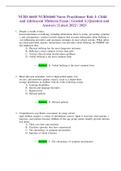
NURS 6660/ NURS6660 Nurse Practitioner Role I: Child and Adolescent Midterm Exam | Graded A| Question and Answers | Latest 2022 / 2023
NURS 6660/ NURS6660 Nurse Practitioner Role I: Child and Adolescent Midterm Exam | Graded A| Question and Answers | Latest 2022 / 2023 1. Despite a wealth of data-based information on bullying, including information about its forms, presenting symptoms, and consequences, current research suggests that accurate information about bullying is not influencing preventive and awareness strategies in most school systems. When advising school personnel, parents, and primary care providers about bullying, the PMHNP should emphasize that: A. Physical bullying has the most dangerous outcomes B. Bullying is more common in boys than girls C. Victims often develop alcohol abuse problems D. Verbal bullying is the most common form ~ Answer: D. Verbal bullying is the most common form 2. Minor physical anomalies, such as high-arched palate, low-set ears, and transverse palmar creases, occur in a higher-than-average distribution in children with all of the following except: A. Learning disabilities B. Speech and language disorders C. Hyperactivity D. Delayed puberty ~ Answer: D. Delayed puberty 3. Comprehensive psychiatric assessment of young school-aged children requires a variety of information sources. Input is necessary from parents, caregivers, and teachers because children of this age group cannot reliably provide information about: A. Their own fears and anxieties B. Psychotic episodes they have experienced C. The chronology of symptom presentation D. Episodes of mood extremes ~ Answer: C. The chronology of symptom presentation 4. Mark is a 5-year-old boy brought in for evaluation because his behavior at school has become so disruptive. According to the parents, Mark's teacher says he just refuses to follow the rules of the classroom, openly defies her, and actually seems to try and upset his classmates. The teacher says Mark gets frustrated very easily when he cannot complete a task and is resistant to any effort to help him. This happens almost every day, and the teacher has indicated that she will not be able to keep him in the classroom if things do not change. Mark's parents admit that he has always been "willful" and difficult to manage, but as he is an only child with a stay-at-home mom, the family overlooked his disruptive tendencies and accommodated Mark. The parents report that they often skip social events and family outings because they don't know how Mark will behave. While counseling Mark's parents about the theories of causation of oppositional defiant disorder (ODD), the PMHNP tells the parents that psychiatric theories include all of the following except: A. Unresolved conflict as a fuel for aggressive behavior targeting authority figures B. The concept that oppositionality is a reinforced, learned behavior in which the child exerts control over authority figures C. A maladaptive response to parents' modeling of conflict avoidance as manifested by even-tempered responses to parent-toddler struggles D. That the behavior is reinforced by increased parental attention in response to the undesirable behavior ~ Answer: C. A maladaptive response to parents' modeling of conflict avoidance as manifested by even-tempered responses to parent-toddler struggles 5. Having child and adolescent patients rate their feelings and moods on a scale of 1-10 is most effective in which age group? A. 18-months to 3 years B. 3 to 5 years C. 5 to 11 years D. 12 to 17 years ~ Answer: C. 5 to 11 years 6. Which of the following is a true statement with respect to conduct disorder? A. The diagnosis is distributed equally between boys and girls. B. Boys with conduct disorder are more likely to develop somatic symptoms later in life. C. About 80% of children with conduct disorder were previously diagnosed with oppositional defiant disorder (ODD). D. The later the age of onset of conduct disorder, the greater the risk of antisocial personality disorder (ASPDD) ~ Answer: D. The later the age of onset of conduct disorder, the greater the risk of antisocial personality disorder (ASPDD) 7. Being Brave: A Program for Coping With Anxiety for Young Children and Their Parents is a manualized intervention for anxiety disorders in young children between the ages of 4 and 7years old. It uses a combination of parent-only and parent-child sessions and demonstrates significant improvement in children with all forms of anxiety disorders except: A. Separation anxiety B. Social anxiety C. Generalized anxiety D. Specific phobia ~ Answer: B. Social anxiety
Document information
- Uploaded on
- February 11, 2023
- Number of pages
- 29
- Written in
- 2022/2023
- Type
- Exam (elaborations)
- Contains
- Questions & answers