

Laura Heijnen – Working Man
Problem 2. Selective Selection
Arnold & Randall (2010) – Work psychology. Understanding human behaviour in the workplace –
Chapter 4: The foundations of personnel selection: analysing jobs, competencies and selection
effectiveness.
Arnold & Randall (2010) – Work psychology. Understanding human behaviour in the workplace –
Chapter 5: Personal selection and assessment methods: what works?
Judge, Higgins & Cable (2000) – The employment interview: A review of recent research and
recommendations for future research.
Summary of Hough, Oswald & Ployhart (2001) – Determinants, detection and amelioration of adverse
impact in personnel selection procedures: Issues, evidence and lessons learned.
How do employers select employees?
Main principles
- Individual differences procedures for matching people can be beneficial.
- Future behaviour at least partly predictable future job performance.
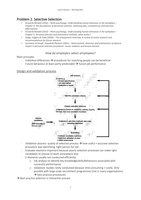
Design and validation process
- Validation process: quality of selection process how useful + accurate selection
procedure was identifying ‘right person for job’.
- Evaluate reactions important because poorly selection processes can make right
candidates to choose to work somewhere else.
- 2 elements usually not conducted efficiently:
o Job analysis to identify key knowledge/skills/behaviours associated with
successful performance.
o Validation studies rarely conducted because time-consuming + costly. Only
possible with large-scale recruitment programmes (not in many organisations)
best practice procedures.
Best practice selection is interactive process
1
Problem 2. Selective Selection
Arnold & Randall (2010) – Work psychology. Understanding human behaviour in the workplace –
Chapter 4: The foundations of personnel selection: analysing jobs, competencies and selection
effectiveness.
Arnold & Randall (2010) – Work psychology. Understanding human behaviour in the workplace –
Chapter 5: Personal selection and assessment methods: what works?
Judge, Higgins & Cable (2000) – The employment interview: A review of recent research and
recommendations for future research.
Summary of Hough, Oswald & Ployhart (2001) – Determinants, detection and amelioration of adverse
impact in personnel selection procedures: Issues, evidence and lessons learned.
How do employers select employees?
Main principles
- Individual differences procedures for matching people can be beneficial.
- Future behaviour at least partly predictable future job performance.
Design and validation process
- Validation process: quality of selection process how useful + accurate selection
procedure was identifying ‘right person for job’.
- Evaluate reactions important because poorly selection processes can make right
candidates to choose to work somewhere else.
- 2 elements usually not conducted efficiently:
o Job analysis to identify key knowledge/skills/behaviours associated with
successful performance.
o Validation studies rarely conducted because time-consuming + costly. Only
possible with large-scale recruitment programmes (not in many organisations)
best practice procedures.
Best practice selection is interactive process
1


