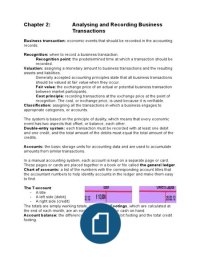
Chapter 2: Analysing and Recording Business
Transactions
Business transaction: economic events that should be recorded in the accounting
records.
Recognition: when to record a business transaction.
Recognition point: the predetermined time at which a transaction should be
recorded.
Valuation: assigning a monetary amount to business transactions and the resulting
assets and liabilities.
Generally accepted accounting principles state that all business transactions
should be valued at fair value when they occur.
Fair value: the exchange price of an actual or potential business transaction
between market participants.
Cost principle: recording transactions at the exchange price at the point of
recognition. The cost, or exchange price, is used because it is verifiable.
Classification: assigning all the transactions in which a business engages to
appropriate categories, or accounts.
The system is based on the principle of duality, which means that every economic
event has two aspects that offset, or balance, each other.
Double-entry system: each transaction must be recorded with at least one debit
and one credit, and the total amount of the debits must equal the total amount of the
credits.
Accounts: the basic storage units for accounting data and are used to accumulate
amounts from similar transactions.
In a manual accounting system, each account is kept on a separate page or card.
These pages or cards are placed together in a book or file called the general ledger.
Chart of accounts: a list of the numbers with the corresponding account titles that
the accountant numbers to help identify accounts in the ledger and make them easy
to find.
The T-account
- A title
- A left side (debit)
- A right side (credit)
The totals are simply working totals, or footings. Footings, which are calculated at
the end of each month, are an easy way to determine cash on hand.
Account balance: the difference between the total debit footing and the total credit
footing.
, The double-entry system follows two rules:
- Every transaction affects at least two accounts
- Total debits must equal total credits
Normal balance: the usual balance of an account and is the side that increases the
amount.
To increase Debit Credit
Assets X
Liability X
Owner’s equity X
Revenues X
Expenses X
Accounting cycle: a series of steps that measure and communicate useful
information to decision makers.
1. Analyse business transactions from source
documents
2. Record the transactions by entering them in the
general journal
3. Post the journal entries to the ledger, and
prepare a trial balance
4. Adjust the accounts, and prepare an adjusted
trial balance
5. Prepare financial statements
6. Close the
accounts, and prepare a post-closing trial
balance
Source documents: support the detail of a
transaction.
Journal entry: a notation that records a single
transaction in the chronological accounting record
known as a journal.
Compound entry: a journal entry in which more than
two accounts are involved.
Transactions
Business transaction: economic events that should be recorded in the accounting
records.
Recognition: when to record a business transaction.
Recognition point: the predetermined time at which a transaction should be
recorded.
Valuation: assigning a monetary amount to business transactions and the resulting
assets and liabilities.
Generally accepted accounting principles state that all business transactions
should be valued at fair value when they occur.
Fair value: the exchange price of an actual or potential business transaction
between market participants.
Cost principle: recording transactions at the exchange price at the point of
recognition. The cost, or exchange price, is used because it is verifiable.
Classification: assigning all the transactions in which a business engages to
appropriate categories, or accounts.
The system is based on the principle of duality, which means that every economic
event has two aspects that offset, or balance, each other.
Double-entry system: each transaction must be recorded with at least one debit
and one credit, and the total amount of the debits must equal the total amount of the
credits.
Accounts: the basic storage units for accounting data and are used to accumulate
amounts from similar transactions.
In a manual accounting system, each account is kept on a separate page or card.
These pages or cards are placed together in a book or file called the general ledger.
Chart of accounts: a list of the numbers with the corresponding account titles that
the accountant numbers to help identify accounts in the ledger and make them easy
to find.
The T-account
- A title
- A left side (debit)
- A right side (credit)
The totals are simply working totals, or footings. Footings, which are calculated at
the end of each month, are an easy way to determine cash on hand.
Account balance: the difference between the total debit footing and the total credit
footing.
, The double-entry system follows two rules:
- Every transaction affects at least two accounts
- Total debits must equal total credits
Normal balance: the usual balance of an account and is the side that increases the
amount.
To increase Debit Credit
Assets X
Liability X
Owner’s equity X
Revenues X
Expenses X
Accounting cycle: a series of steps that measure and communicate useful
information to decision makers.
1. Analyse business transactions from source
documents
2. Record the transactions by entering them in the
general journal
3. Post the journal entries to the ledger, and
prepare a trial balance
4. Adjust the accounts, and prepare an adjusted
trial balance
5. Prepare financial statements
6. Close the
accounts, and prepare a post-closing trial
balance
Source documents: support the detail of a
transaction.
Journal entry: a notation that records a single
transaction in the chronological accounting record
known as a journal.
Compound entry: a journal entry in which more than
two accounts are involved.