AMLS Post Test Questions and Answers, 2022.
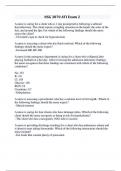
AMLS Post Test Questions and Answers, 2022. 1. A 45-year-old patient is found supine on the floor. Healthcare providers note pinpoint pupils, shallow respirations, and vomitus in and around the mouth. What course of action should be taken next? - b. Supplemental oxygen and suction 2. Patients with a history of COPD that present with an acute onset of shortness of breath are likely to have what condition? - a. Pulmonary embolism 3. During compensatory shock, the renin-angiotensin-aldosterone system is activated to cause a/an: - a. Increase in preload, afterload, and re-absorption of sodium 4. What clinical findings are most commonly associated with a pulmonary embolus? - a. Clear breath sounds with tachypnea 5. What condition is most likely to cause respiratory acidosis? - b. Narcotic overdose 6. A 55-year-old complains of an 'aching' chest discomfort that persists over several days. The patient has a temperature of 101F (38.3C). Which finding will help narrow the diagnosis to pericarditis? - d. ST-segment elevation in all leads 7. Anaphylaxis is most associated with which physiological event? - b. Vasodilation 8. Acute Respiratory Distress Syndrome (ARDS) is characterized by what pathological change? - c. Breakdown of the alveolar-capillary membrane 9. Continuous positive airway pressure would be most beneficial in treating which patient? - b. A 22yo with severe asthma who is not responding to nebulizer treatments 10. What is the initial treatment for a patient experiencing hyperosmolar hyperglycemic nonketotic coma (HHNC)? - a. Crystalloid IV fluid administration 11. Your patient has had a seizure secondary to a nerve agent exposure. What medication would be best to diminish the seizure? - c. Midazolam 12. Respiratory alkalosis may occur as a result of: - a. Fever and anxiety 13. An age-related change that increases the risk of respiratory compromise is: - c. Decrease in lung compliance 14. Paroxysmal nocturnal dyspnea is most common in patients with a history of: - a. Left-sided heart failure (?) 15. The patient presents with a history of fever and an upper respiratory infection. Historical information reveals increasing water intake, orthostatic hypotension, and an increase in urination. You suspect these symptoms are caused by: - a. Hyperglycemia 16. You are dispatched to the home of a 32yo patient with a history of Graves' disease. The patient was in the ER earlier today for some "tests for my ulcers." He received contrast and was discharged. He is now complaining of not feeling well, chest pain, and palpitations. You note an anxious patient with fine tremors. He is diaphoretic and has a temperature of 101.5F, BP 100/62, P 156 (sinus tach), R 30, glucose level 133. Which of the following are management considerations for this patient? - d. Beta Blockers.
Written for
- Institution
-
Saint Xavier University
- Course
-
AMLS (AMLS)
Document information
- Uploaded on
- January 10, 2023
- Number of pages
- 8
- Written in
- 2022/2023
- Type
- Exam (elaborations)
- Contains
- Questions & answers
Subjects
- 2022
- amls post test 2022
- 2022
-
amls post test questions and answers
-
amls post test questions and answers
-
amls questions and answers
-
amls questions and answers
-
amls test questions and answers
-
2

Also available in package deal