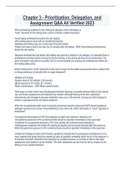
Chapter 3 - Prioritization, Delegation, and Assignment Q&A All Verified 2023
Chapter 3 - Prioritization, Delegation, and Assignment Q&A All Verified 2023 When scheduling a patient for skin testing for allergies, which information is *most* important for the allergy clinic nurse to include in patient teaching? •Avoid taking antihistamines before the skin testing •Skin testing may be done with an intradermal injection •Swelling and itching may occur at the site of the skin testing •Patient will need to wait in the clinic for 20 minutes after the testing - ANS-•Avoid taking antihistamines before the skin testing •Because antihistamine use before skin testing may prevent a reaction to an allergen, it is important that no antihistamine be taken before arriving for the skin testing, or the testing will have to be rescheduled. The other information may also be included, but it is not as important as avoiding any antihistamine before the skin testing takes place. Which finding will be *most* important for the nurse to report to the health care provider about a patient who is taking prednisone chronically after an organ transplant? •Multiple arm bruises •Sodium level of 146 mEq/dL (146 mmol/L) •Blood glucose of 110 mg/dL (6.1 mmol/L) •Black-colored stools - ANS-•Black-colored stools •Dark green or black stools may indicate gastrointestinal bleeding, a possible adverse effect of oral steroid use, and further assessment and treatment are needed. Although thinning of the skin, electrolyte disturbances, and changes in glucose metabolism also occur with steroids, bruising and mild changes in sodium or glucose level do not require treatment. When the occupational health nurse is teaching unlicensed assistive personnel (UAP) about bloodborne pathogen exposure and human immunodeficiency virus (HIV) risk, which information is *most* important to emphasize? •Occupational transmission of HIV from patients to health care workers is relatively rare •Occupational exposure to HIV-containing fluids should be reported immediately to the supervisor •Treatment for occupational exposure to HIV may include use of antiretroviral medications •Postexposure treatment will include HIV testing at baseline and at several intervals after the exposure - ANS-•Occupational exposure to HIV-containing fluids should be reported immediately to the supervisor •Centers for Disease Control and Prevention guidelines indicate that if postexposure prophylaxis is to be used, antiretroviral drugs should be started as soon as possible, preferably within hours of the exposure. It is important that staff understand that reporting the possible exposure is a priority so that so that rapid assessment and treatment can be initiated. The other statements are also true but will not impact on the efficacy of any needed treatment. A patient in the allergy clinic who has a rash has received diphenhydramine 50 mg PO. Which patient information is *most* indicative of a need for action by the nurse?...
Written for
- Institution
- Chapter 3 - Prioritization, Delegation, and Assig
- Course
- Chapter 3 - Prioritization, Delegation, and Assig
Document information
- Uploaded on
- January 6, 2023
- Number of pages
- 9
- Written in
- 2022/2023
- Type
- Exam (elaborations)
- Contains
- Questions & answers
Subjects
- delegation
-
chapter 3 prioritization
-
and assignment qampa all verified 2023
-
when scheduling a patient for skin testing for allergies
-
which information is most important for the allergy clini

Also available in package deal