PORTAGE LEARNING NURS 231: Pathophysiology 2022 Module
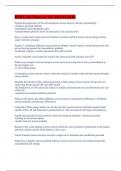
PORTAGE LEARNING NURS 231: Pathophysiology 2022 Module 1 exam Question 1 0 / 0 pts What is the definition of “pathophysiology”? Your Answer: The study of the body's responses to changes caused by a disease Pathophysiology is defined as not only the cellular and organ changes that occur with disease, but also the effects that these changes have on total body function. Question 2 0 / 0 pts Name the 5 etiologic factors and give an example if listed. Your Answer: Biologic agents -- bacteria, viruses Physical forces -- trauma, burns Genetic inheritance Chemical agents -- alcohol, drug toxicities Nutritional excesses or deficiencies Biologic agents (bacteria, viruses), physical forces (trauma, burns, radiation), chemical agents (poisons, alcohol), one’s genetic inheritance, and nutritional excesses or deficiencies. Question 3 0 / 0 pts What are the 2 types of risk factors? Your Answer: Congenital conditions -- present at birth Acquired defects -- after birth Risk factors can be categorized as congenital conditions (present at birth) or acquired defects (occurring after birth). Question 4 0 / 0 pts What is the difference between morphology and histology? Your Answer: Morphology is the structure or form of cells and tissues Histology is the study of the cells and extracellular matrix of body tissues Morphology is defined as the fundamental structure or form of cells or tissues. Histology is the study of the cells and extracellular matrix of body tissues. Question 5 0 / 0 pts Describe the difference between signs and symptoms and give an example of each. Your Answer: Sign is an objective manifestation -- temperature or changes in pupil size Symptoms is a subjective complaint -- pain, dizziness or troubled breathing A symptom is a subjective complaint, for example pain, trouble breathing, or dizziness. A sign is an objective manifestation, for example an elevated temperature, a swollen extremity, or changes in pupil size. Question 6 0 / 0 pts What are 3 important processes when coming to a diagnosis? Your Answer: Family history, physical examination, diagnostic tests The diagnostic process requires a careful history, physical examination (PE), and sometimes diagnostic tests. Question 7 0 / 0 pts Explain validity, reliability, sensitivity, and specificity. Your Answer: Validity is how a tool measures what it is intended to measure Reliability is how likely the same result will occur if repeated Sensitivity is the proportion of people with a disease who are positive for that disease Specificity is when people without the disease are tested negative on a given test Validity is how a tool measures what it is intended to measure. Reliability is how likely the same result will occur if repeated. Sensitivity is the proportion of people with a disease who are positive for that disease. Specificity are people without the disease who are negative on a given test. Question 8 0 / 0 pts Define epidemiology and name some things that it tracks. Your Answer: The study of disease occurrence in human populations Epidemiology tracks age, race, and dietary habits Epidemiology is the study of disease occurrence in human populations. It tracks age, race, dietary habits, lifestyle, or geographic location. Question 9 0 / 0 pts What is the difference between incidence and prevalence? Your Answer: Incidence is the number of new cases in a population at risk during a specific time Prevalence is the number of people with the disease in a population in a given time Incidence is the number of new cases in a population at risk during a specified time. Prevalence is the number of people with the disease in a population in a given time. Question 10 0 / 0 pts Define mortality and morbidity. Your Answer: Mortality refers to death Morbidity refers to an illness or disease Morbidity is the effect of an illness on one’s life. Mortality statistics deal with the cause of death in a population. Question 11 0 / 0 pts Define primary, secondary, and tertiary prevention and give an example of each. Your Answer: Primary prevention is to remove the risk factors to prevent disease from occurring -- vaccinating children to prevent communicable disease Secondary prevention detects and treat disease early -- checking blood pressure and cholesterol Tertiary prevention occurs after a disease has been diagnosed and clinical intervention is needed to reduce complications or deterioration -- specific medications taken after a heart attack to help reduce the risk of a future event or death Primary prevention is to remove risk factors to prevent disease from occurring- taking folic acid while pregnant to prevent neural tube defects, vaccinating children to prevent communicable disease, eating healthy and exercising to prevent heart disease, and wearing seatbelts or helmets. Secondary prevention aims to detect and treat disease early, usually while the disease is asymptomatic and curable- annual Pap smears to detect early cervical cancer, encouraging smoking cessation, checking blood pressure and cholesterol, and colonoscopy screening. Tertiary prevention occurs after a disease has been diagnosed and clinical intervention is needed to reduce complications or deterioration- certain medications one must take after a heart attack to help reduce the risk of a future event or death. Question 12 0 / 0 pts Why is evidence-based practice important? Your Answer: Evidence-based practice is the con
Written for
- Institution
- PORTAGE LEARNING NURS 231: Pathophysiology
- Course
- PORTAGE LEARNING NURS 231: Pathophysiology
Document information
- Uploaded on
- January 5, 2023
- Number of pages
- 14
- Written in
- 2022/2023
- Type
- Exam (elaborations)
- Contains
- Questions & answers
Subjects
- portage learning nurs 231
- portage learning nurs 2
-
portage learning nurs 231 pathophysiology 2022 module
-
portage learning nurs 231pathophysiology 2022 module
-
portage learning nurs 231 pathophysiology

Also available in package deal