MS I Lab Health Assessment in class quiz
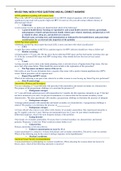
MS I Lab Health Assessment in class quiz MS I Lab Health Assessment in class quiz Name: _Pamela Wright Date: November 15th, 2022 1. A nurse performs a general survey on a client who is being admitted to the health care facility. What will the nurse include in this type of assessment? Select all that apply. A) Vital signs B) Gait C) Laboratory tests D) Behavior E) Body mass index (BMI) F) Percussion of abdomen 2. A nurse calculates the BMI of a client during a general survey as 28. How should the nurse best interpret this assessment finding? A) The nurse should identify a nursing diagnosis of Imbalanced Nutrition: Less Than Body Requirements. B) The nurse should document the client's normal BMI. C) Further assessments and interventions are necessary because the client is overweight. D) The nurse should identify the client as a potential candidate for bariatric surgery. 3. During a general survey, the nurse documents the waist circumference of a female client as 36 in. The nurse should educate the client about what? A) Her increased risk of type 2 diabetes B) Improvements to her coping strategies C) Techniques for reducing her risk of osteoporosis D) Ways of reducing fat intake 4. The nurse is caring for a client diagnosed with coronary artery disease after a cardiac angiogram. The client has a sandbag on the right femoral artery. Which assessments should the nurse choose? Select all that apply. A) Vital signs B) Comprehensive assessment C) Emergency assessment D) Focused peripheral vascular assessment E) General physical assessment 5. During a health history, a client complains to the nurse about severe allergies that he is reporting for the first time. What assessment question should the nurse ask to address the “P” component of the mnemonic “PQRST?” A) “Do you know what triggers your allergies?” B) “Do you ever experience any pain when your symptoms get worse?” C) “How would you describe your symptoms?” D) “Have you taken any over-the-counter or prescription medications for this?” 6. A nurse is performing a physical assessment of a client who has a history of heart disease. In what position should the nurse place this client to assess her cardiovascular status? A) Dorsal recumbent B) Sims' C) Supine D) Left side-lying 7. A nurse uses a bed scale to perform a client's daily weight. The nurse notes that today's weight is 3 kg less than the previous day's. What is the nurse's most appropriate action? A) Encourage the client to increase food and fluid intake. B) Ensure that the scale is correctly calibrated and repeat the assessment. C) Report this finding promptly to the client's primary care provider. D) Increase the frequency of the client's weight assessments. 8. A nurse is assessing the skin, hair, and nails of a client who has dark skin tone. How should the nurse best assess the client for cyanosis? A) Inspect the palms of the client's hands. B) Inspect the skin between the client's fingers. C) Inspect the client's skin under a bright light. D) Inspect the client's lips and oral mucosa. 9. A nurse performs an integumentary assessment of a client and documents the following: 5/27/14: Williams. Client is a White, 56-year-old man who reports a history of emphysema. Skin coloring is bluish gray. What conclusion can the nurse draw from these data? A) The client may have liver disease. B) The client has hyperpigmented extremities. C) The client is experiencing localized inflammation. D) The client has inadequate oxygenation. 10. The nurse pinches the skin under the clavicle and it tents longer than 3 seconds. What conclusion should the nurse determine from this assessment? A) The skin is less elastic with aging. B) The client is dehydrated. C) The skin has normal turgor. D) The client is overhydrated. 11. A nurse is documenting the assessment of a client's nails. Which finding would be interpreted as normal? A) Concave nails B) Skin-toned cuticles C) 160-degree angle of nail attachment D) Capillary refill of 5 seconds 12. A nurse is teaching a student nurse how to conduct an integumentary assessment of a client. Which statement accurately describes cultural considerations related to this assessment? A) Pallor is manifested by a yellowish-brown color in clients with darker skin tones. B) Cyanosis can be assessed by observing the sclera of the eyes of darker skinned clients. C) Mongolian spot is a common variation of hyperpigmentation in newborns of African American descent. D) Asian clients may exhibit normal variations in physical features, such as an increase in body hair and thin head hair. 13. Which action best allows the nurse to assess a client's pupillary accommodation? A) Using an ophthalmoscope, check the client's red reflex. B) Ask the client to focus on a finger and move the client's eyes through the six cardinal positions of gaze. C) Ask the client to focus on an object as it is brought closer to the nose. D) Ask the client to read the smallest possible line of letters on the Snellen chart. 14. A nurse is performing a head and neck assessment of a client who is experiencing signs and symptoms of a viral illness. How should the nurse assess for the enlarged lymph nodes that are commonly associated with this disease? A) Palpate the sides of the client's thyroid gland. B) Inspect the client's ability to move his or her neck through the full range of motion. C) Inspect and palpate the left and then the right carotid arteries. D) Inspect and palpate the sides of the client's neck. 15. The nurse is performing an assessment of the lungs of a client with pneumonia. After preparing the room and the client for this assessment, what action should the nurse first perform? A) Palpate the client's anterior thorax. B) Inspect the client's posterior thorax. C) Palpate over the client's spine and posterior thorax. D) Auscultate the client's anterior thorax. 16. The nurse inspects the client's thorax. Which assessments should the nurse determine to be normal findings? Select all that apply. A) Accessory muscle use is noted at rest. B) The anteroposterior (AP) to transverse diameter is 1:1. C) Respirations easy, even, nonlabored. D) The skin is natural tone without lesions. E) Chest expansion is equal and symmetrical. 17. The nurse is interpreting the results of a cardiac assessment. Which statement accurately represents a characteristic of the third or fourth heart sound? A) S3 is considered normal in children and young adults and abnormal in middle-aged and older adults. B) S3 is best heard with the stethoscope bell at the mitral area, with the client lying on the right side. C) S4 is the fourth heart sound, represented by “lub-dub-dee.” D) S4 is considered normal in children, youths, and adults, but abnormal in older adults. 18. Following auscultation of a client's heart, the nurse documents the presence of a murmur. How should the nurse best interpret this assessment finding? A) There is inadequate blood flow to the heart.
Written for
- Institution
- MS I Lab Health
- Course
- MS I Lab Health
Document information
- Uploaded on
- December 28, 2022
- Number of pages
- 6
- Written in
- 2022/2023
- Type
- Exam (elaborations)
- Contains
- Questions & answers
Subjects
- ms i lab health
-
ms i lab health assessment in class quiz
-
ms i lab health assessment