NUR 266 Week 6 Quiz
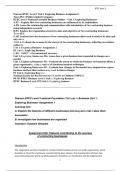
NUR 266 Week 6 Quiz NUR 266 Week 6 Quiz 1. The nurse is assessing the client's cardiovascular system. The client asks the nurse why she presses on his toenails. Which is the best reply by the nurse? a. "I can see how quickly the blood returns when I press and release your toenail. This tells me how well your peripheral blood is flowing." b. "I can tell a lot about your respiratory rate from pressing on your toes." c. "Pressing on your toenail gives me an idea about how well you have been eating." d. "I can learn things about your blood coagulation by pressing on your toenail." Rationale: the nurse is checking perfusion when looking at capillary refill 2. The client asks the nurse what his urine output has to do with his cardiac function. The best reply by the nurse is which of the following? a. "The urine output is an important indicator of cardiac function; poor urine output may b. "Poor urine output indicates a need for a blood transfusion." c. "Too much urine output indicates a need for a blood transfusion." d. "High urine output indicates poor cardiac function." Rationale: when there is a problem with renal perfusion it is usually indicative of a cardiac problem; this can be assessed by looking at urine output 3. The nurse auscultates the apex beat at which of the following anatomical locations? a. Midsternum b. 2 inch to the left of the lower end of the sternum c. 1 inch to the left of the xiphoid process d. Fifth intercostal space, midclavicular line Rationale: this is where the apex is located Reference: nursing a concept based approach (pg 1064, figure 16-19) 4. A 79-year-old client with a history of right-sided heart failure lives in the long-term care facility where you practice nursing. In your daily assessment, you are required to record the level of this client’s peripheral edema. Which of the following would be the main area for examination? a. Feet and ankles b. Over the sacrum c. Lips and earlobes d. Knees and elbows Rationale: the edema affects the feet ankles the most; there is poor venous flow which is why TED hose are usually used in treatment of these patients Reference: nursing a concept based approach (pg 1148) 5. The nurse is caring for a client who has just returned from the cardiac catheterization laboratory following a coronary angioplasty. Which of the following assessments will the nurse do immediately? a. Check the temperature, color, and capillary refill of the affected extremity. b. Check the client's tolerance to ambulation to the bathroom. c. Assess when the client last had a bowel movement. d. Assess for PERRLA. Rationale: the nurse is checking the client for proper perfusion Reference: nursing a concept based approach (pg. 1126) 6. A nursing student working today on the cardiac unit asks the instructor why loss of the "atrial kick" causes a decrease in cardiac output, because ventricles are still contracting. The instructor's best answer is which of the following? a. "The atrial contraction fills the ventricles and accounts for nearly one third of the volume ejected during ventricular contraction." b. "Loss of the atrial kick does not affect cardiac output; cardiac output remains the same, with or without it." c. "The atrial kick is only helpful if the ventricles are failing." d. "The atrial kick is never lost; there is always some atrial kick present." Rationale: this is the definition of atrial kick Reference: nursing a concept based approach (pg. 1178) 7. A nurse is developing a nursing care plan for a client with peripheral arterial disease. Which of the following will be the priority nursing diagnosis? a. Ineffective peripheral tissue perfusion b. Impaired tissue integrity c. Ineffective thermoregulation d. Ineffective self-health management Rationale: the other nursing diagnoses do not really apply in this case Reference: nursing a concept based approach (pg. 1202) 8. How should the nurse best position a patient who has leg ulcers that are venous in origin? a. Keep the patient's legs flat and straight. b. Keep the patient's knees bent to 45-degree angle and supported with pillows. c. Elevate the patient's lower extremities.
Written for
- Institution
- NUR 266
- Course
- NUR 266
Document information
- Uploaded on
- December 28, 2022
- Number of pages
- 7
- Written in
- 2022/2023
- Type
- Exam (elaborations)
- Contains
- Questions & answers