Fundamentals RN Exit Hesi 2 (Q&A )
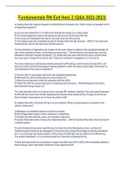
Fundamentals RN Exit Hesi 2 (Q&A ) An elderly client who requires frequent monitoring fell and fractured a hip. Which nurse is at greatest risk for a malpractice judgment? A) A nurse who worked the 7 to 3 shift at the hospital and wrote poor nursing notes. B) The nurse assigned to care for the client who was at lunch at the time of the fall. C) The nurse who transferred the client to the chair when the fall occurred. D) The charge nurse who completed rounds 30 minutes before the fall occurred. - ANS-C) The nurse who transferred the client to the chair when the fall occurred The four elements of malpractice are: breach of duty owed, failure to adhere to the recognized standard of care, direct causation of injury, and evidence of actual injury. The hip fracture is the actual injury and the standard of care was "frequent monitoring." (C) implies that duty was owed and the injury occurred while the nurse was in charge of the client's care. There is no evidence of negligence in (A, B, and D) The nurse observes an unlicensed assistive personnel (UAP) taking a client's blood pressure with a cuff that is too small, but the blood pressure reading obtained is within the client's usual range. What action is most important for the nurse to implement? A) Tell the UAP to use a larger cuff at the next scheduled assessment. B) Reassess the client's blood pressure using a larger cuff. C) Have the unit educator review this procedure with the UAPs. D) Teach the UAP the correct technique for assessing blood pressure. - ANS-B) Reassess the client's blood pressure using a larger cuff The most important action is to ensure that an accurate BP reading is obtained. The nurse should reassess the BP with the correct size cuff (B). Reassessment should not be postponed (A). Though (C and D) are likely indicated, these actions do not have the priority of (B). An elderly client with a fractured left hip is on strict bedrest. Which nursing measure is essential to the client's nursing care? A) Massage any reddened areas for at least five minutes. B) Encourage active range of motion exercises on extremities. C) Position the client laterally, prone, and dorsally in sequence. D) Gently lift the client when moving into a desired position. - ANS-D) Gently lift the client when moving into a desired position To avoid shearing forces when repositioning, the client should be lifted gently across a surface (D). Reddened areas should not be massaged (A) since this may increase the damage to already traumatized skin. To control pain and muscle spasms, active range of motion (B) may be limited on the affected leg. The position described in (C) is contraindicated for a client with a fractured left hip. A client with pneumonia has a decrease in oxygen saturation from 94% to 88% while ambulating. Based on these findings, which intervention should the nurse implement first?...
Written for
- Institution
- Fundamentals RN Exit Hesi 2
- Course
- Fundamentals RN Exit Hesi 2
Document information
- Uploaded on
- December 19, 2022
- Number of pages
- 9
- Written in
- 2022/2023
- Type
- Exam (elaborations)
- Contains
- Questions & answers
Subjects
-
fundamentals rn exit hesi 2
-
fundamentals rn exit hesi 2 qampa 2022 2023
-
an elderly client who requires frequent monitoring fell and fractured a hip which nurse is at greatest risk for a malpract

Also available in package deal