Chapter 1 Health Assessment Nclex Question well answered 2022/2023
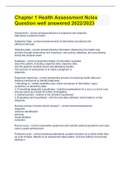
Chapter 1 Health Assessment Nclex Question well answered 2022/2023Assessment collection of subjective and objective data about a patient's health. Subjective Data consist of information provided by the affected individual. Objective data Include information obtained by the health care provider through observation and inspection, percussing, palpating, and auscultating during the physical exam. Database the totality of information available about the patient, including subjective data, objective data, and the patient's medical record and laboratory studies. The purpose of assessment is to make a judgment or diagnosis. Diagnostic reasoning the process of analyzing health data and drawing conclusions to identify diagnoses. 1.Attending to - initially available cues, which are pieces of information, signs, symptoms, or laboratory data 2. Formulating diagnostic hypotheses - tentative explanations for a cue or a set of cues and can serve as a basis for further investigation 3. Gathering Data - relative to the tentative hypotheses 4. Evaluating each hypothesis - with the new data collected, which leads to a final diagnosis. Nursing process includes what 6 phases? Assessment diagnosis outcome identification planning implementation evaluation Novice nurse No experience with specific patient populations and uses rules to guide performance Proficient nurse understands a patient situation as a whole rather than as a list of tasks, attends to an assessment data pattern, and acts without consciously labeling it Expert nurse intuitive grasp of a clinical situation and zeroes in on the accurate solution Critical thinking multidimensional thinking process needed for sound diagnostic reasoning and clinical judgement. The process includes identifying relevant information, gathering clinical cues, completing an assessment, and setting priorities First-level priority problems in critical thinking Emergent, life-threatening, and immediate, such as establishing and airway or supporting breathing Second-level priority problems in critical thinking next in urgency. They require prompt intervention to prevent further deterioration and may include a mental status change, acute pain, or abnormal laboratory values Third-level priority problems in critical thinking important to the patient's health but can be addressed after more urgent problems. Examples include lack of knowledge or family coping. Collaborative problems in critical thinking certain physiologic conditions in which the approach to treatment involves multiple disciplines Evidence-based practice Systemic approach to practice that uses best evidence, the clinician's experience, and the patient's preferences and values to make decisions about care and treatment Complete database Complete health history and a full physical examination, yielding the first diagnoses. Focused (or problem-centered) database Used for a limited or short-term problem. It is smaller in scope and more targeted than the complete database. Follow-up database Evaluates the status of any identified problem at regular intervals to follow up on short-term or chronic health problems Emergency database Calls for rapid collection of crucial data, which often occurs while performing life-saving measures Concept of health expanded and is based on the practice model use Holistic health model Assesses the whole person because it views the mind, body, and spirit as interdependent and functioning as a whole within the environment. Health depends on all these factors working together. Health promotion and disease prevention Involve changing people's unhealthy behaviors through a set of positive acts. The focus is on teaching and helping the consumer choose a healthier lifestyle. Health assessment Should consider the cultural beliefs and practices of different people. Obtaining a heritage assessment helps gather data that are accurate and meaningful and can guide culturally sensitive and appropriate care. According to the holistic model, a narrow definition of holistic health includes: the absence of disease. From a biomedical perspective, health is defined as the absence of disease or elimination of symptoms and signs of disease, whereas a holistic model approach examines mind, body, and spirit working interdependently within the environment to maintain health and well-being. Nursing has an expanded concept of health; holistic health includes the mind, body, and spirit as interdependent and functioning as a whole within the environment. Nursing diagnoses are clinical judgments about a person's response to an actual or potential health state. In a holistic model approach to health, both the internal and the external environment affect a patient's health and well-being. What type of database is most appropriate when rapid collection of data is required and often compiled concurrently with lifesaving measures? Emergency An emergency database includes rapid collection of data often obtained concurrently with lifesaving measures. An episodic database is for a limited or short-term problem; this database concerns mainly one problem, one cue complex, or one body system. A follow-up database is used to follow up short-term or chronic health problems; the statuses of identified problems are evaluated at regular and appropriate intervals. A complete database includes a complete health history and a full physical examination; it describes the current and past health state and forms a baseline against which all future changes can be measured. A medical diagnosis is used to evaluate the cause of disease Medical diagnoses are used to evaluate the cause or etiology of disease. Nursing diagnoses are clinical judgments about a person's response to an actual or potential health state. Nursing diagnoses are used to evaluate the response of the whole person to actual or potential health problems. The holistic model of health care is used in nursing, and culture is an important factor to consider in a nursing assessment. An example of subjective data is: left knee has been swollen and hot for the past 3 days. Subjective data is what the patient says about himself or herself during history taking. Objective data is what the health professional observes by inspecting, percussing, palpating, and auscultating during the physical examination. Range of motion is assessed by inspection. Objective data is what the health professional observes by inspecting, percussing, palpating, and auscultating during the physical examination. Crepitation is assessed by palpating. Arthritis is a medical diagnosis. What type of database is most appropriate for an individual who is admitted to a long-term care facility? Complete Which of the following is an example of objective data? Alert and oriented An example of objective data is: crepitation in the left knee joint. A nursing diagnosis is best described as: a concise statement of actual or potential health concerns or level of wellness. A complete database is: used to perform a thorough or comprehensive health history and physical examination A patient admitted to the hospital with asthma has the following problems identified based on an admission health history and physical assessment. Which problem is a first-level priority? Impaired gas exchange
Written for
- Institution
- Health Assessment Nclex
- Course
- Health Assessment Nclex
Document information
- Uploaded on
- November 24, 2022
- Number of pages
- 4
- Written in
- 2022/2023
- Type
- Exam (elaborations)
- Contains
- Questions & answers
Subjects
-
chapter 1 health assessment nclex question well answered 20222023
-
assessment collection of subjective and objective data about a patients health
-
objective data include information obtained by th

Also available in package deal