

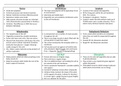
Cells
Nucleus Cell Membrane Cytoplasm
• Inside the cytoplasm. • Thin layer enclosing the cell & separating it from • Consists of the cytosol and organelles.
• Controls processes and chemical reactions. its environment. • All the living parts within the cell membrane
• Nuclear membrane encloses DNA (Has pores) • Selectively permeable layer. EXCL. The nucleus.
• Nucleolus is darker area inside • Organelles are surrounded by membranes same • Protoplasm: Cytoplasm + Nucleus
• DNA contains info that encodes our inherited as the cell membrane. • Cytosol is water-like jelly medium made up of
traits (Characteristics passed down in families.) 70-90% water and is usually colourless. This is
• Variation: The difference in DNA that occurs where many chemical reactions take place.
between individuals.
Mitochondria Vacuole Endoplasmic Reticulum
• The ‘powerhouse of the cell’ • In animals there are a number of small vacuoles • Forms canals where proteins are completed
• Organelles enclosed by a double membrane. throughout the cell. when they are made & transported throughout
• Active cells have more mito. than non-active. • There is one large vacuole in plants filled with the the cell.
• Glucose from food enters cells & pass into mito. cell sap which is made from water. • Smooth ER: No ribosomes attached.
and are used in cellular respiration (Combine • This is then enclosed by the tonoplast which is a • Rough ER: Has Ribosomes attached.
molecules from glucose + oxygen releasing membrane.
usable energy for the cell.) • Full vacuoles push out against cell wall & make
• CO2 , Water, waste materials are By-products of cells and plants ridged (Turgid: stem and leaves
cellular respiration. firm) -> Opposite: Flaccid: Drooping/wilting)
Ribosomes Cell Wall Chloroplasts
• Make proteins which are what everything in the • Animal cells have an irregular shape. • These are the only cell organelles that are able
body consists of. • Plant cells have a regular shape. to photosynthesise.
• Make the proteins which builds the rest of the • This is an additional layer surrounding the cell on • They contain a very important green pigment
body’s organs & functions. the outside of the cell membrane. called chlorophyll.
• Forms a protective framework + provides stability • Chlorophyll converts radiant energy to glucose
and support. which plants and animals use as energy.
• Formed of cellulose/ various other compounds.
• Cellulose helps maintain the shape of the plant
cell & supports the plant. It allows for the plant
to remain rigid + upright & grow to great heights.
• Acts as a skeleton for the plant.
Nucleus Cell Membrane Cytoplasm
• Inside the cytoplasm. • Thin layer enclosing the cell & separating it from • Consists of the cytosol and organelles.
• Controls processes and chemical reactions. its environment. • All the living parts within the cell membrane
• Nuclear membrane encloses DNA (Has pores) • Selectively permeable layer. EXCL. The nucleus.
• Nucleolus is darker area inside • Organelles are surrounded by membranes same • Protoplasm: Cytoplasm + Nucleus
• DNA contains info that encodes our inherited as the cell membrane. • Cytosol is water-like jelly medium made up of
traits (Characteristics passed down in families.) 70-90% water and is usually colourless. This is
• Variation: The difference in DNA that occurs where many chemical reactions take place.
between individuals.
Mitochondria Vacuole Endoplasmic Reticulum
• The ‘powerhouse of the cell’ • In animals there are a number of small vacuoles • Forms canals where proteins are completed
• Organelles enclosed by a double membrane. throughout the cell. when they are made & transported throughout
• Active cells have more mito. than non-active. • There is one large vacuole in plants filled with the the cell.
• Glucose from food enters cells & pass into mito. cell sap which is made from water. • Smooth ER: No ribosomes attached.
and are used in cellular respiration (Combine • This is then enclosed by the tonoplast which is a • Rough ER: Has Ribosomes attached.
molecules from glucose + oxygen releasing membrane.
usable energy for the cell.) • Full vacuoles push out against cell wall & make
• CO2 , Water, waste materials are By-products of cells and plants ridged (Turgid: stem and leaves
cellular respiration. firm) -> Opposite: Flaccid: Drooping/wilting)
Ribosomes Cell Wall Chloroplasts
• Make proteins which are what everything in the • Animal cells have an irregular shape. • These are the only cell organelles that are able
body consists of. • Plant cells have a regular shape. to photosynthesise.
• Make the proteins which builds the rest of the • This is an additional layer surrounding the cell on • They contain a very important green pigment
body’s organs & functions. the outside of the cell membrane. called chlorophyll.
• Forms a protective framework + provides stability • Chlorophyll converts radiant energy to glucose
and support. which plants and animals use as energy.
• Formed of cellulose/ various other compounds.
• Cellulose helps maintain the shape of the plant
cell & supports the plant. It allows for the plant
to remain rigid + upright & grow to great heights.
• Acts as a skeleton for the plant.


