

PMHNP Board Prep 1 – 12 with complete solution
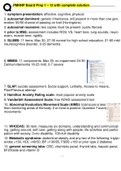
PMHNP Board Prep 1 – 12 with complete solution 1. symptom presentation: affective, cognitive, physical 2. autosomal dominant: genetic inheritance. will present in more than one gen- eration. 50/50 chance of passing on trait (Huningtons) 3. autosomal recessive: two copies must be present (cystic fibrosis 4. prior to MSE: assessment includes ROS, VS, heart tone, lung sounds, neuro exam, muscle tone, rigidity 5. SLUMS: 11 items. Max 30, 27-30 normal for high school education, 21-60 mild neurocognitive disorder, 0-20 dementia 6. MMSE: 11 components. Max 30, no impairment 24-30 Delirium/dementia 18-23 mild, 0-7 severe 7. SLAP: suicide assessment. Social support, Lethality, Access to means, Plan/Previous attempt 8. Hamilton Anxiety Rating scale: most popular anxiety scale 9. Vanderbilt Assessment Scale: free ADHD assessment tool 10. Abnormal Involuntary Movement Scale (AIMS): total score is less than monitoring areas of the body. 2 or more is positive. Question 7 exa movements 11. WHODAS: 36 item, measures six domains, understanding and communicat- ing, getting around, self care, getting along with people, life activities and partici- pation with society. 0=no disability, 100=full disability 12. Metabolic syndrome: abdominal obesity and any two of the following: triglyc- erides 150, HDL 40/50, BP 130/85, FSBS 100 or prior type 2 diabetes 13. general screening labs: CBC, chemistry panel, thyroid labs, hepatic panel, B12/folate and vitamin D 14. PET scan: localizes mental activities, primarily as experimental basis and is very expensive 15. cranial nerves: olfactory=smell, sensory optic=vision, sensory oculomotor=most EOM, motor trochlear=downward and inward eye movement, motor trigeminal=mastication muscles, sensation of face, both abducens=lateral eye movmement, motor facial=move face, close eyes, taste, saliva, tears, both acoustic=hearing and balance, sensory glossopharyngeal=phonation, gag, carotid, swallowing, taste, both vagus=talk, swallow, carotid, both spinal accessory=shrug shoulders, motor hypoglossal=moves the tounge, motor 16. tender lymph node: classic sign of infection 17. rubbery lymph node: classic sign of lymphoma 18. soft lymph node: insignificant 19. nontender lymph node: classic sign of potential malignancy 20. lymph node size: insignificant if less than 2cm, 3cm in axilla and inguinal. but if supraclavicular fossa, 1cm is significant 21. lasts longest in the urine: cannabis. 3 days to 4 weeks 22. pneumococcal vaccine: give to 19-64 year old smoker or if have asthma 23. Pap smear: every 3 years, HPV every 5 years. discontinue at age 65-70 if have 3 consecutive negative and no abnormal tests in 10 years 24. prostate exam: digital begin at age 40 and PSA at age 40 if have family history of prostate cancer or AA. ALL males 50 years and older should get screening 25. colorectal screening: starting at 50 years old, annual fecal occult blood test, flex sig every 5 years and colonoscopy every 10 years 26. Medicare B screening coverage: for cervical, breast, prostate, colorectal cancer
Document information
- Uploaded on
- November 12, 2022
- Number of pages
- 31
- Written in
- 2022/2023
- Type
- Exam (elaborations)
- Contains
- Questions & answers


