
neuron
Neuron Function
How does a signal travel across and between neurons?
Why?
Just as the coaxial cables that run down your street or through your house carry television and Internet
signals, the job of a neuron is to move an electrical signal from one place to another in order to send sen-
sory messages throughout the body. In a previous activity you saw how a membrane potential is formed
both at rest and during an inflow of ions. In this activity you will explore how changes in membrane
potentials can propagate a signal down the axon of a neuron.
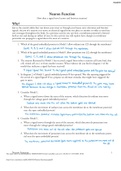
1. Which of the gated embedded proteins in Model 1 allow sodium ions ( ) through the membrane?
Gates A B D andFallowsodiumionsthroughthemembrane
2. Which of the gated embedded proteins in Model 1 allow potassium ions ( ) through the membrane?
Gates C E andGallowpotassiumionsthroughthemembrane
3. The neuron illustrated in Model 1 has received a signal from either a sensory cell (taste bud, skin
cell, retinal cell, etc.) or from another neuron. What evidence do you find in diagram 1 of the
model that indicates a signal has been received?
Asignalligandhasboundtotheligandgatedembeddedproteinandthegatehasopened
4. In diagram 2 of Model 1, gated embedded protein B has opened. Was this opening triggered by
the arrival of a signal ligand? If no, propose an alternate stimulus that might have triggered the
gate to open.
Nodiagram 2doesnotshow aligandboundto embeddedproteinB Thegatemayhave
openedbecause ofthechangeinmembranepotentialfromthefloodofionsnearby
5. Consider Model 1.
a. When a signal moves down the axon of the neuron, which direction do sodium ions move
through the voltage-gated embedded proteins?
Sodiumionsmoveintothecellwhenthesodiumgatesareopened
b. What does the movement of sodium ions across the membrane do to the membrane potential
near the open embedded protein?
Themembranepotentialincreasesgetsmorepositiveasthesodiumionsmoveintothecell
6. Consider Model 1.
a. When a signal moves through the axon of the neuron, which direction do potassium ions
move through the voltage-gated embedded proteins?
Potassiumionsmoveoutofthecellwhenthepotassiumgatesareopened
b. What does the movement of potassium ions across the membrane do to the membrane poten-
tial near the open embedded protein?
Themembranepotentialdecreasesgetsmorenegative asthepotassiumionsmoveoutof
thecell
Neuron Function
This study source was downloaded by 100000852290574 from CourseHero.com on 11-08-2022 13:15:30 GMT -06:00
1
https://www.coursehero.com/file/36809393/Neuron-Function-pogilpdf/
, G
G
G
+30 mV
–55 mV
+35 mV
F
F
F
E
E
E
–80 mV
+35 mV
+30 mV
D
D
D
C
C
C
+35 mV
–70 mV
–80 mV
B
B
B
A
A
A
4
5
6
G
G
G
–70 mV
–70 mV
–60 mV
F
F
F
E
E
E
–70 mV
–60 mV
–55 mV
Model 1 – An Action Potential
D
D
D
C
C
C
–60 mV
–55 mV
+30 mV
B
B
B
A
A
A
Outside
of cell
of cell
Inside
1
2
3
2 POGIL™ Activities for AP* Biology
This study source was downloaded by 100000852290574 from CourseHero.com on 11-08-2022 13:15:30 GMT -06:00
https://www.coursehero.com/file/36809393/Neuron-Function-pogilpdf/
Neuron Function
How does a signal travel across and between neurons?
Why?
Just as the coaxial cables that run down your street or through your house carry television and Internet
signals, the job of a neuron is to move an electrical signal from one place to another in order to send sen-
sory messages throughout the body. In a previous activity you saw how a membrane potential is formed
both at rest and during an inflow of ions. In this activity you will explore how changes in membrane
potentials can propagate a signal down the axon of a neuron.
1. Which of the gated embedded proteins in Model 1 allow sodium ions ( ) through the membrane?
Gates A B D andFallowsodiumionsthroughthemembrane
2. Which of the gated embedded proteins in Model 1 allow potassium ions ( ) through the membrane?
Gates C E andGallowpotassiumionsthroughthemembrane
3. The neuron illustrated in Model 1 has received a signal from either a sensory cell (taste bud, skin
cell, retinal cell, etc.) or from another neuron. What evidence do you find in diagram 1 of the
model that indicates a signal has been received?
Asignalligandhasboundtotheligandgatedembeddedproteinandthegatehasopened
4. In diagram 2 of Model 1, gated embedded protein B has opened. Was this opening triggered by
the arrival of a signal ligand? If no, propose an alternate stimulus that might have triggered the
gate to open.
Nodiagram 2doesnotshow aligandboundto embeddedproteinB Thegatemayhave
openedbecause ofthechangeinmembranepotentialfromthefloodofionsnearby
5. Consider Model 1.
a. When a signal moves down the axon of the neuron, which direction do sodium ions move
through the voltage-gated embedded proteins?
Sodiumionsmoveintothecellwhenthesodiumgatesareopened
b. What does the movement of sodium ions across the membrane do to the membrane potential
near the open embedded protein?
Themembranepotentialincreasesgetsmorepositiveasthesodiumionsmoveintothecell
6. Consider Model 1.
a. When a signal moves through the axon of the neuron, which direction do potassium ions
move through the voltage-gated embedded proteins?
Potassiumionsmoveoutofthecellwhenthepotassiumgatesareopened
b. What does the movement of potassium ions across the membrane do to the membrane poten-
tial near the open embedded protein?
Themembranepotentialdecreasesgetsmorenegative asthepotassiumionsmoveoutof
thecell
Neuron Function
This study source was downloaded by 100000852290574 from CourseHero.com on 11-08-2022 13:15:30 GMT -06:00
1
https://www.coursehero.com/file/36809393/Neuron-Function-pogilpdf/
, G
G
G
+30 mV
–55 mV
+35 mV
F
F
F
E
E
E
–80 mV
+35 mV
+30 mV
D
D
D
C
C
C
+35 mV
–70 mV
–80 mV
B
B
B
A
A
A
4
5
6
G
G
G
–70 mV
–70 mV
–60 mV
F
F
F
E
E
E
–70 mV
–60 mV
–55 mV
Model 1 – An Action Potential
D
D
D
C
C
C
–60 mV
–55 mV
+30 mV
B
B
B
A
A
A
Outside
of cell
of cell
Inside
1
2
3
2 POGIL™ Activities for AP* Biology
This study source was downloaded by 100000852290574 from CourseHero.com on 11-08-2022 13:15:30 GMT -06:00
https://www.coursehero.com/file/36809393/Neuron-Function-pogilpdf/


