Government and Market Failure
Chapter 16
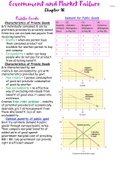
Public Goods Demand for Public Goods
Characteristics of Private Goods
G/s individually consumed & can be
profitably provided by privately owned
firms bcz can exclude non-payers from
receiving benefits.
• Rivalry = when one person buys
them consumes product not
available for another person to buy
and consume.
• Excludability = seller can keep
people who do not pay for product
from obtaining benefit.
Characteristics of Private Goods
G/s characterized by non
rivalry & non-excludability; g/s with
characteristics provided by govt.
• Non rivalry = 1 person consumption
of good not preclude consumption
of good by another.
• Non excludability = no effective
way of excluding individuals from
benefit of good once it comes into
existence.
Creates free-rider problem - inability
of potential providers of economically
desirable g/s 2 obtain payment from
those who benefit, bcz of non-
excludability.
Optimal quantity of public good
Govt try estimate demand 4 public
goods through surveys/public votes.
Then compare marginal benefits of
added units of good against
government marginal cost of providing.
MB = MC rule government can provide
right & efficient amount
, Illustration: inefficient “no” vote
Comparing MB and MC.
Supply curve 4 any good = marginal
cost curve.
• MC rises as more of good =
produced - reason = law of
diminishing returns
• . In short run government has
fixed resources (public capital) 2
produce public goods such as
National Defense.
• As it adds more units of variable
resource (labor) 2 fixed resources, Interest Groups: Those w/ strong
total product eventually rises @ preferences 4 public good may band
diminishing rate. together in2 interest groups & use
• That means marginal product falls advertisements, mailing & direct
& marginal cost rises. persuasion 2 convince others of merits
Revealing Preferences of public good.
Logrolling: trading of votes by
Through Majority Voting legislators 2 secure favourable
Inefficient Voting Outcomes outcomes on decisions concerning
Societies well-being enhanced when provision of public goods & quasi-public
government provides public good where goods.
total benefit exceeds total cost. Paradox of voting: situation w/h
Unfortunately, majority voting not paired-choice voting by majority rule
always produce that outcome. fails 2 provide consistent ranking of
Illustration: inefficient “no” vote society’s preferences 2 public g/s.
Read p185 for table
Median-voter model: theory that
under majority rule median voter = be
in dominant position 2 determine
outcome of election.
Read p 185 example
Chapter 16
Public Goods Demand for Public Goods
Characteristics of Private Goods
G/s individually consumed & can be
profitably provided by privately owned
firms bcz can exclude non-payers from
receiving benefits.
• Rivalry = when one person buys
them consumes product not
available for another person to buy
and consume.
• Excludability = seller can keep
people who do not pay for product
from obtaining benefit.
Characteristics of Private Goods
G/s characterized by non
rivalry & non-excludability; g/s with
characteristics provided by govt.
• Non rivalry = 1 person consumption
of good not preclude consumption
of good by another.
• Non excludability = no effective
way of excluding individuals from
benefit of good once it comes into
existence.
Creates free-rider problem - inability
of potential providers of economically
desirable g/s 2 obtain payment from
those who benefit, bcz of non-
excludability.
Optimal quantity of public good
Govt try estimate demand 4 public
goods through surveys/public votes.
Then compare marginal benefits of
added units of good against
government marginal cost of providing.
MB = MC rule government can provide
right & efficient amount
, Illustration: inefficient “no” vote
Comparing MB and MC.
Supply curve 4 any good = marginal
cost curve.
• MC rises as more of good =
produced - reason = law of
diminishing returns
• . In short run government has
fixed resources (public capital) 2
produce public goods such as
National Defense.
• As it adds more units of variable
resource (labor) 2 fixed resources, Interest Groups: Those w/ strong
total product eventually rises @ preferences 4 public good may band
diminishing rate. together in2 interest groups & use
• That means marginal product falls advertisements, mailing & direct
& marginal cost rises. persuasion 2 convince others of merits
Revealing Preferences of public good.
Logrolling: trading of votes by
Through Majority Voting legislators 2 secure favourable
Inefficient Voting Outcomes outcomes on decisions concerning
Societies well-being enhanced when provision of public goods & quasi-public
government provides public good where goods.
total benefit exceeds total cost. Paradox of voting: situation w/h
Unfortunately, majority voting not paired-choice voting by majority rule
always produce that outcome. fails 2 provide consistent ranking of
Illustration: inefficient “no” vote society’s preferences 2 public g/s.
Read p185 for table
Median-voter model: theory that
under majority rule median voter = be
in dominant position 2 determine
outcome of election.
Read p 185 example