

NOTES ON KNOWLEDGE CLIPS AND ARTICLES
2 Basic Principles of the course:
-the reciprocal relationship of work+health
-the trichotomy of person, work and organisation
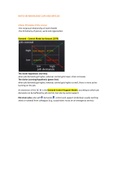
Demand – Control Model by Karasek (1979)
The Strain Hypothesis (red line):
when job demands get higher, whereas control gets lower, strain increases.
The Active Learning Hypothesis (green line):
when job demands get higher, whereas control gets higher as well, there is more active
learning on the job.
An extension of the DC-M is the Demand-Control-Support Model, according to which job
demands can be buffered by job control, but also by social support.
ISO-strain jobs: jobs with demands, control and support (individual usually working
alone or isolated from colleagues (e.g. a psychiatric nurse on an emergency service)
,The Job Demand- Resources Model by Demerouti (2001)
The original JD-R model:
High jobs demands lead to exhaustion (the overtaxing process)
Low job resources lead to withdrawal and disengagement (the withdrawal process)
Exhaustion + Disengagement = aspects of burnout
Revised Job Demands – Resources model by Schaufeli & Bakker (2004)
In the article of Schaufeli & Taris (2014), burnout is treated as one construct instead of two
(exhaustion and disengagement). Moreover, the positive counterpart of work engagement is
included. In this new version of the model, burnout and work engagement are used as
mediators. Burnout is a mediator between JD and health problems (energetic / health
impairment process), whereas work engagement is a mediator between JR and turnover
intention (motivational process).
NOTES:
-job demands may act either positively (‘’challenges’’) or negatively (‘’hindrances’’). Both
challenges and hindrances tend to be demanding, but challenges (such as workload, time
pressure, responsibility) have the potential to promote mastery, personal growth, and future
, gain, whereas hindrances (among others, role conflict, role ambiguity, and “red tape”) could
thwart personal growth, learning, and goal attainment.
-job demands and job resources may interact, as JR may buffer for the negative effects of JD
or JD may buffer the positive effects of JR
-after some time, personal resources were also included in the JD-R model
Personal Resources are important as human behaviour results from the interaction of both
personal and environmental factors. PR are defined as the psychological characteristics or
aspects of the self that are generally associated with resiliency and that refer to the ability to
control and impact one’s environment successfully. Similar to job resources, personal
resources are functional in accomplishing work goals, and they stimulate personal growth
and development. (Examples: self-efficacy, optimism, organisation-based self-esteem)
PR can be added to the model in five different ways:
A: PR may influence burnout and work engagement independently and directly
B: PR may moderate the relationship between job characteristics and well-being
C: PR may mediate in the relationship between job characteristics and well-being
D: PR may influence JD and JR directly or affect the perception of these
E: PR may be a confounder
Confounder (or “third variable”)means that PR affects both Job Demands and Job Resources
and their outcomes (burnout and well-being) and this basically means that if someone
controls for personal resources, then the effects of JD and JR on burnout and well-being are
likely to disappear.
NOTE: Personal resources (e.g., self-efficacy, optimism, extraversion etc.) are more stable
traits of one’s personality and can not be depleted (whereas internal resources such as
concentration, mood, energy can be depleted).
In case of exhaustion or lack of energy, the JD-R model could contribute in an intervention.
How? A good intervention would be to low hindrances and increase challenges or resources,
2 Basic Principles of the course:
-the reciprocal relationship of work+health
-the trichotomy of person, work and organisation
Demand – Control Model by Karasek (1979)
The Strain Hypothesis (red line):
when job demands get higher, whereas control gets lower, strain increases.
The Active Learning Hypothesis (green line):
when job demands get higher, whereas control gets higher as well, there is more active
learning on the job.
An extension of the DC-M is the Demand-Control-Support Model, according to which job
demands can be buffered by job control, but also by social support.
ISO-strain jobs: jobs with demands, control and support (individual usually working
alone or isolated from colleagues (e.g. a psychiatric nurse on an emergency service)
,The Job Demand- Resources Model by Demerouti (2001)
The original JD-R model:
High jobs demands lead to exhaustion (the overtaxing process)
Low job resources lead to withdrawal and disengagement (the withdrawal process)
Exhaustion + Disengagement = aspects of burnout
Revised Job Demands – Resources model by Schaufeli & Bakker (2004)
In the article of Schaufeli & Taris (2014), burnout is treated as one construct instead of two
(exhaustion and disengagement). Moreover, the positive counterpart of work engagement is
included. In this new version of the model, burnout and work engagement are used as
mediators. Burnout is a mediator between JD and health problems (energetic / health
impairment process), whereas work engagement is a mediator between JR and turnover
intention (motivational process).
NOTES:
-job demands may act either positively (‘’challenges’’) or negatively (‘’hindrances’’). Both
challenges and hindrances tend to be demanding, but challenges (such as workload, time
pressure, responsibility) have the potential to promote mastery, personal growth, and future
, gain, whereas hindrances (among others, role conflict, role ambiguity, and “red tape”) could
thwart personal growth, learning, and goal attainment.
-job demands and job resources may interact, as JR may buffer for the negative effects of JD
or JD may buffer the positive effects of JR
-after some time, personal resources were also included in the JD-R model
Personal Resources are important as human behaviour results from the interaction of both
personal and environmental factors. PR are defined as the psychological characteristics or
aspects of the self that are generally associated with resiliency and that refer to the ability to
control and impact one’s environment successfully. Similar to job resources, personal
resources are functional in accomplishing work goals, and they stimulate personal growth
and development. (Examples: self-efficacy, optimism, organisation-based self-esteem)
PR can be added to the model in five different ways:
A: PR may influence burnout and work engagement independently and directly
B: PR may moderate the relationship between job characteristics and well-being
C: PR may mediate in the relationship between job characteristics and well-being
D: PR may influence JD and JR directly or affect the perception of these
E: PR may be a confounder
Confounder (or “third variable”)means that PR affects both Job Demands and Job Resources
and their outcomes (burnout and well-being) and this basically means that if someone
controls for personal resources, then the effects of JD and JR on burnout and well-being are
likely to disappear.
NOTE: Personal resources (e.g., self-efficacy, optimism, extraversion etc.) are more stable
traits of one’s personality and can not be depleted (whereas internal resources such as
concentration, mood, energy can be depleted).
In case of exhaustion or lack of energy, the JD-R model could contribute in an intervention.
How? A good intervention would be to low hindrances and increase challenges or resources,


