Topic 1: Cell biology
Topic 1.1: Introduction to cells
7 Characteristics of living things:
1. Reaction to stimuli
- Movement
- Changes in the environment
2. Reproduce
- Asexual and sexual (bacteria)
- Parthenogenesis (reproduction without fertilization)
3. Respiration / gaseous exchange
- The diffusion of gases across membranes
4. Excretion
- Giving off waste products
5. Nutrition
- Autotrophic – plants
- Heterotrophic – animals
- Saprotrophic – fungi
6. Growth
- Increase in cell number and mass
- Development
7. Metabolism
- All reactions in the body
- Homeostasis – maintaining a regular metabolism
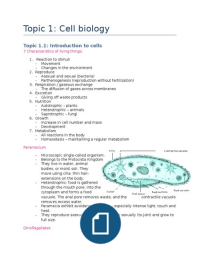
Paramecium
- Microscopic single-celled organism.
- Belongs to the Protocista Kingdom
- They live in water, animal
bodies, or moist soil. They
move using cilia; thin hair-
extensions on the body.
- Heterotrophic: food is gathered
through the mouth pore: into the
cytoplasm and forms a food
vacuole. The anal pore removes waste, and the contractile vacuole
removes excess water.
- Paramecia exhibit avoidance behavior – especially intense light, touch and
heat.
- They reproduce asexually (binary fission) or sexually (to join) and grow to
full size.
Dinoflagellates
, - Single-celled algae (fresh/salt water)
- Two flagella, which causes limited mobility.
Some species are allowed to migrate
vertically through the water column,
seeking nutrients, prey and protection from
harmful UV rays
- Half of the species can do photosynthesis,
and contain autotrophs.
- When conditions are favorable, a
population explosion or bloom may occur:
sometimes resulting in contamination of
fish, which poses a threat to human and
animal health (eutrophication).
Cell theory
The cell was first discovered by Robert Hooke in 1665.
1. All living organisms carry out the 7 basic functions of life. Evidence:
- If you were to remove or nullify one of the functions, the cell usually dies.
2. All living organisms are made up from cells. Evidence:
- Light microscope: 400 x
- Electron microscope: 70 – 100000
3. All cells arise from pre-existing cells
- No cells just appear
- Through cell division:
Mitosis: growth + repair
Meiosis: egg + sperm cells
Exceptions to the cell theory
1. Viruses: Some people consider viruses to be alive, but they are not made out
of cells. They have all 7 chracateristics, but are an exception to the cell
theory
2. Mitochondria: Breaks down glucose
3. Chloroplasts: builds up glucose
2&3 both have their own genetic material, and as they can reproduce
independently from the rest of the cells from the cell theory, is thus an
exception of the cell theory
4. Red Blood corpuscle: no nucleus
Relative sizes and scale bars (See booklet)
1 nanometer (nm) = 1/1000000000
1 micrometer (um) = 1/1000000
1 millimeter (mm) = 1/1000
Topic 1.1: Introduction to cells
7 Characteristics of living things:
1. Reaction to stimuli
- Movement
- Changes in the environment
2. Reproduce
- Asexual and sexual (bacteria)
- Parthenogenesis (reproduction without fertilization)
3. Respiration / gaseous exchange
- The diffusion of gases across membranes
4. Excretion
- Giving off waste products
5. Nutrition
- Autotrophic – plants
- Heterotrophic – animals
- Saprotrophic – fungi
6. Growth
- Increase in cell number and mass
- Development
7. Metabolism
- All reactions in the body
- Homeostasis – maintaining a regular metabolism
Paramecium
- Microscopic single-celled organism.
- Belongs to the Protocista Kingdom
- They live in water, animal
bodies, or moist soil. They
move using cilia; thin hair-
extensions on the body.
- Heterotrophic: food is gathered
through the mouth pore: into the
cytoplasm and forms a food
vacuole. The anal pore removes waste, and the contractile vacuole
removes excess water.
- Paramecia exhibit avoidance behavior – especially intense light, touch and
heat.
- They reproduce asexually (binary fission) or sexually (to join) and grow to
full size.
Dinoflagellates
, - Single-celled algae (fresh/salt water)
- Two flagella, which causes limited mobility.
Some species are allowed to migrate
vertically through the water column,
seeking nutrients, prey and protection from
harmful UV rays
- Half of the species can do photosynthesis,
and contain autotrophs.
- When conditions are favorable, a
population explosion or bloom may occur:
sometimes resulting in contamination of
fish, which poses a threat to human and
animal health (eutrophication).
Cell theory
The cell was first discovered by Robert Hooke in 1665.
1. All living organisms carry out the 7 basic functions of life. Evidence:
- If you were to remove or nullify one of the functions, the cell usually dies.
2. All living organisms are made up from cells. Evidence:
- Light microscope: 400 x
- Electron microscope: 70 – 100000
3. All cells arise from pre-existing cells
- No cells just appear
- Through cell division:
Mitosis: growth + repair
Meiosis: egg + sperm cells
Exceptions to the cell theory
1. Viruses: Some people consider viruses to be alive, but they are not made out
of cells. They have all 7 chracateristics, but are an exception to the cell
theory
2. Mitochondria: Breaks down glucose
3. Chloroplasts: builds up glucose
2&3 both have their own genetic material, and as they can reproduce
independently from the rest of the cells from the cell theory, is thus an
exception of the cell theory
4. Red Blood corpuscle: no nucleus
Relative sizes and scale bars (See booklet)
1 nanometer (nm) = 1/1000000000
1 micrometer (um) = 1/1000000
1 millimeter (mm) = 1/1000