Enzyme Catalysis
Acid Base Catalysis
- General Acid Base catalysis / Specific Acid Base + Concerted General Acid and Base
- Keto-Enol tautomerisation
- pKa and pH
- Amino Acids w/acidic, basic side chain (K, R, D, E, H)
- RNase
- Mutarotation - glucose
- alpha-Pyridone
1. General acid catalysis : process in which partial proton transfer from a Bronsted acid lowers the free energy of a reaction's TS
2. General base catalysis : rate increased by partial proton abstraction by a Bronsted base
3. Concerted general acid-base catalysed reaction : both reactions simultaneously occurring
- acid/base revert back to their original forms after catalysis
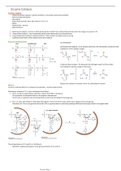
Keto-enol tautomerisation
(a) Uncatalysed
(b) General acid catalysis : in the enzyme active site, the acid donates a proton to help
stabilisation of the negative oxygen
(c) General base catalysis : the base pulls the hydrogen away from the carbon,
neutralising the positive charge of the proton
Reduces the carbanion character of the TS, catalysing the reaction
RNase A
Function: hydrolyse RNA to its component nucleotides - reaction peaks at pH 6
Mechanism: isolation of 2',3'-cyclic nucleotides from RNase
1. His 12, acting as a general base, abstracts a proton from RNA 2'-OH group.
This promotes a nucleophilic attack on the adjacent Phosphorous.
His 119 acts as a general acid, promoting bond scission by protonating the leaving group.
2. The 2',3'-cyclic intermediate is hydrolysed through the reverse of the first step, where water replaces the leaving group.
Therefore, His 12 acts as a general acid and His 119 as a general base to yield they hydrolysed RNA and have enzyme back to its original state.
The pH dependence of V'max/K'm in the RNase A
- ANALYSIS: catalytic participation of AA groups with pK'a of 5.4 and 6.4
Enzymes Page 1
, Mutarotation : mutarotation of α-D-glucose (by acid-base catalysis)
- Glucose molecule can be in 2 anomeric cyclic forms through the intermediacy of its linear form
Mechanism:
- Acid/Base catalysing mutarotation: α-Pyridone Mechanism of catalysis:
Acid/Base
Involves acidic & basic side chains of AAs
- Asp, Glu, His, Lys, Cys, Tyr
Acid/Base reactions are governed by sidechain pKa
- so catalysis is often sensitive to pH changes
Acid: pKa ~4
Base: pKa ~11
Histidine can be both acid & base b/c of its broad pKa value
Ka = Equilibrium constant for ionisation
pKa (of an acid) = pH at which the acid is half dissociated, when [A-] = [HA]
- lower the pKa, stronger the acid
Efficiency of an acid/base catalyst depends on the pH of the reaction
- For an acid to act as an acid-catalyst, it must be protonated
- For a base to act as a base-catalyst, it must be deprotonated
AAs by their local environment
Enzymes Page 2
Acid Base Catalysis
- General Acid Base catalysis / Specific Acid Base + Concerted General Acid and Base
- Keto-Enol tautomerisation
- pKa and pH
- Amino Acids w/acidic, basic side chain (K, R, D, E, H)
- RNase
- Mutarotation - glucose
- alpha-Pyridone
1. General acid catalysis : process in which partial proton transfer from a Bronsted acid lowers the free energy of a reaction's TS
2. General base catalysis : rate increased by partial proton abstraction by a Bronsted base
3. Concerted general acid-base catalysed reaction : both reactions simultaneously occurring
- acid/base revert back to their original forms after catalysis
Keto-enol tautomerisation
(a) Uncatalysed
(b) General acid catalysis : in the enzyme active site, the acid donates a proton to help
stabilisation of the negative oxygen
(c) General base catalysis : the base pulls the hydrogen away from the carbon,
neutralising the positive charge of the proton
Reduces the carbanion character of the TS, catalysing the reaction
RNase A
Function: hydrolyse RNA to its component nucleotides - reaction peaks at pH 6
Mechanism: isolation of 2',3'-cyclic nucleotides from RNase
1. His 12, acting as a general base, abstracts a proton from RNA 2'-OH group.
This promotes a nucleophilic attack on the adjacent Phosphorous.
His 119 acts as a general acid, promoting bond scission by protonating the leaving group.
2. The 2',3'-cyclic intermediate is hydrolysed through the reverse of the first step, where water replaces the leaving group.
Therefore, His 12 acts as a general acid and His 119 as a general base to yield they hydrolysed RNA and have enzyme back to its original state.
The pH dependence of V'max/K'm in the RNase A
- ANALYSIS: catalytic participation of AA groups with pK'a of 5.4 and 6.4
Enzymes Page 1
, Mutarotation : mutarotation of α-D-glucose (by acid-base catalysis)
- Glucose molecule can be in 2 anomeric cyclic forms through the intermediacy of its linear form
Mechanism:
- Acid/Base catalysing mutarotation: α-Pyridone Mechanism of catalysis:
Acid/Base
Involves acidic & basic side chains of AAs
- Asp, Glu, His, Lys, Cys, Tyr
Acid/Base reactions are governed by sidechain pKa
- so catalysis is often sensitive to pH changes
Acid: pKa ~4
Base: pKa ~11
Histidine can be both acid & base b/c of its broad pKa value
Ka = Equilibrium constant for ionisation
pKa (of an acid) = pH at which the acid is half dissociated, when [A-] = [HA]
- lower the pKa, stronger the acid
Efficiency of an acid/base catalyst depends on the pH of the reaction
- For an acid to act as an acid-catalyst, it must be protonated
- For a base to act as a base-catalyst, it must be deprotonated
AAs by their local environment
Enzymes Page 2