Enzyme Kinetics
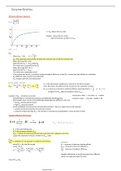
Michaelis-Menteen Equation
0- Obeys the 1st order
Plateau : obeys the zero order
- add more [S] but no effect on V Max
-
- the substrate concentration at which the reaction rate is half the maximal rate
- When [S] is low ([S] <
Approximates
The initial rate is proportional to [S]
- When [S] is high ([S] >
Approximates
The initial rate s dependent of [S]
- If an enzyme has low it achieves maximal catalytic efficiency at low [S] : enzyme has high affinity for substrates
- different btwn enzymes and substrates
- changes upon pH and temperature
is the dissociation equilibrium constant for the M-M complex
As decreases, the affinity of the enzyme for the substrate increase
is a measure of enzyme's substrate affinity, assuming that
- so higher the , high [S] needed to reach
Example of : sensitivity to alcohol CH3CH2OH + NAD+ = CH3CHO + H + + NADH
- Acetaldehyde is normally processed by acetaldehyde dehydrogenase CH3CHO + NAD + = CH3COO- + NADH + 2H +
- Most people have 2 forms of acetaldehyde dehydrogenase (different isoforms)
→ low mitochondrial enzyme
→ high cytosolic enzyme
- Some individuals have less active mitochondrial enzyme = due to a single amino acid mutation
→ alcohol mostly processed by the cytosolic enzyme
→ cytosolic enzyme has high = less alcohol is converted to acetaldehyde = more alcohol in blood
Catalytic Efficiency of Enzymes
- is the rate limiting step
- is the turnover number:
- : number of reaction processes that each active site catalyses/ unit time
- Larger the substrate molecule, smaller the value
Summary
- when [S] << low ES formed measure of substrate binding affinity
- so [E] = [ : measure of turnover efficiency
- measure of catalytic efficiency
Catalytic efficiencies of similar enzymes from different
species are approximately the same
Uses of
1. Know enzyme's substrate preference (substrate specificity)
Enzymes Page 1
, 1. Know enzyme's substrate preference (substrate specificity)
- Higher the the better the enzyme works on that substrate (high efficiency)
- Eg) Chymotrypsin: protease that prefers to cleave (hydrolyse) bulky hydrophobic/aromatic side chains
→ its active site best accommodates such AA side chains
→ also catalyse hydrolysis of ester bond with hydrophobic/aromatic R-group on carboxylic acid component
→ more hydrophobic, higher the enzyme's efficiency
2. Enzyme's catalytic efficiency
Catalytic Perfection : when enzyme encounters a substrate, product always formed
- The ratio is maximal (btwn enzyme and substrate) when = when formation of [P] from [ES] is faster than [ES] breakdown into [E] + [S]
- ,
- , but cannot be faster than the rate of collision of reactants = diffusion-controlled limit (108-109 M-1s1)
- With this value, the enzyme must catalyse a reaction almost every time they encounter a substrate
Kinetic Data Analysis
1. Lineweaver-Burke Plot
Disadvantages
Plot of 1/ vs 1/S is linear 1. Most measurements of [S] are high values, so most of the 1/[S]
values are crowded on the left side of the graph, so drawing a
straight line is difficult and inaccurate
- Slope =
2. For small [S], small errors in leads to large errors in 1/ and
- y-axis intercept = 1/ hence large errors in
- x-axis intercept = -1/ - 1/ approaches infinity as [S] decreases
- gives inaccurate measurements at low [S]
- insufficient measurements at high [S]
2. Hofstee-Eadie Plot
Slope = -Km
Y-axis intercept = Vmax
Assumption: Vmax is reached = limitation
Limitation: subject to large error since both coordinates contain dependent variable Vo
3. Hanes - Woolf Plot
Enzymes Page 2
Michaelis-Menteen Equation
0- Obeys the 1st order
Plateau : obeys the zero order
- add more [S] but no effect on V Max
-
- the substrate concentration at which the reaction rate is half the maximal rate
- When [S] is low ([S] <
Approximates
The initial rate is proportional to [S]
- When [S] is high ([S] >
Approximates
The initial rate s dependent of [S]
- If an enzyme has low it achieves maximal catalytic efficiency at low [S] : enzyme has high affinity for substrates
- different btwn enzymes and substrates
- changes upon pH and temperature
is the dissociation equilibrium constant for the M-M complex
As decreases, the affinity of the enzyme for the substrate increase
is a measure of enzyme's substrate affinity, assuming that
- so higher the , high [S] needed to reach
Example of : sensitivity to alcohol CH3CH2OH + NAD+ = CH3CHO + H + + NADH
- Acetaldehyde is normally processed by acetaldehyde dehydrogenase CH3CHO + NAD + = CH3COO- + NADH + 2H +
- Most people have 2 forms of acetaldehyde dehydrogenase (different isoforms)
→ low mitochondrial enzyme
→ high cytosolic enzyme
- Some individuals have less active mitochondrial enzyme = due to a single amino acid mutation
→ alcohol mostly processed by the cytosolic enzyme
→ cytosolic enzyme has high = less alcohol is converted to acetaldehyde = more alcohol in blood
Catalytic Efficiency of Enzymes
- is the rate limiting step
- is the turnover number:
- : number of reaction processes that each active site catalyses/ unit time
- Larger the substrate molecule, smaller the value
Summary
- when [S] << low ES formed measure of substrate binding affinity
- so [E] = [ : measure of turnover efficiency
- measure of catalytic efficiency
Catalytic efficiencies of similar enzymes from different
species are approximately the same
Uses of
1. Know enzyme's substrate preference (substrate specificity)
Enzymes Page 1
, 1. Know enzyme's substrate preference (substrate specificity)
- Higher the the better the enzyme works on that substrate (high efficiency)
- Eg) Chymotrypsin: protease that prefers to cleave (hydrolyse) bulky hydrophobic/aromatic side chains
→ its active site best accommodates such AA side chains
→ also catalyse hydrolysis of ester bond with hydrophobic/aromatic R-group on carboxylic acid component
→ more hydrophobic, higher the enzyme's efficiency
2. Enzyme's catalytic efficiency
Catalytic Perfection : when enzyme encounters a substrate, product always formed
- The ratio is maximal (btwn enzyme and substrate) when = when formation of [P] from [ES] is faster than [ES] breakdown into [E] + [S]
- ,
- , but cannot be faster than the rate of collision of reactants = diffusion-controlled limit (108-109 M-1s1)
- With this value, the enzyme must catalyse a reaction almost every time they encounter a substrate
Kinetic Data Analysis
1. Lineweaver-Burke Plot
Disadvantages
Plot of 1/ vs 1/S is linear 1. Most measurements of [S] are high values, so most of the 1/[S]
values are crowded on the left side of the graph, so drawing a
straight line is difficult and inaccurate
- Slope =
2. For small [S], small errors in leads to large errors in 1/ and
- y-axis intercept = 1/ hence large errors in
- x-axis intercept = -1/ - 1/ approaches infinity as [S] decreases
- gives inaccurate measurements at low [S]
- insufficient measurements at high [S]
2. Hofstee-Eadie Plot
Slope = -Km
Y-axis intercept = Vmax
Assumption: Vmax is reached = limitation
Limitation: subject to large error since both coordinates contain dependent variable Vo
3. Hanes - Woolf Plot
Enzymes Page 2