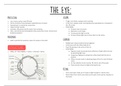
o Lies in bony cavity in skull → orbit − Tough, non-elastic, opaque outer covering
o Fat & connective tissue between eyeball & bone of socket − In the front, opaque outer covering becomes specialised as a transparent
o Exposed part is covered by conjunctiva disc → cornea
o Upper & lower eyelids − FUNCTIONS:
o eyelashes → prevent dust & insects from entering Protects inner structures
o tears, secreted by lachrymal glands, keep conjunctiva moist, remove dust Maintains round shape
& destroy bacteria. Cornea permits light to enter
Cornea refracts light rays to focus them on the retina
o Held in position & moved by 3 pairs of muscles in the orbit.
− Middle layer: blood vessels & brown pigment
− Continuous with the cilliary body & iris
STRUCTURE: −
−
Pupil → opening in the centre of the iris
FUNCTIONS:
o WALL OF THE EYEBALL = sclera + choroid + retina Pigment inside choroid prevents reflection of light within the eye
by absorbing light rays.
Suspensory ligaments arising from cilliary body hold the lens in
position.
Cilliary muscles assist in adjusting shape of lens for near & distant
vision.
Iris has radial & circular muscles → control size of the pupil.
Pupil controls amount of light entering the eye.
− Inner-most layer made up of 2 types of light receptors: rods & cones
− Nerve fibres from rod & cones leave as the optic nerve (carries impulses to
the brain)
o Fat & connective tissue between eyeball & bone of socket − In the front, opaque outer covering becomes specialised as a transparent
o Exposed part is covered by conjunctiva disc → cornea
o Upper & lower eyelids − FUNCTIONS:
o eyelashes → prevent dust & insects from entering Protects inner structures
o tears, secreted by lachrymal glands, keep conjunctiva moist, remove dust Maintains round shape
& destroy bacteria. Cornea permits light to enter
Cornea refracts light rays to focus them on the retina
o Held in position & moved by 3 pairs of muscles in the orbit.
− Middle layer: blood vessels & brown pigment
− Continuous with the cilliary body & iris
STRUCTURE: −
−
Pupil → opening in the centre of the iris
FUNCTIONS:
o WALL OF THE EYEBALL = sclera + choroid + retina Pigment inside choroid prevents reflection of light within the eye
by absorbing light rays.
Suspensory ligaments arising from cilliary body hold the lens in
position.
Cilliary muscles assist in adjusting shape of lens for near & distant
vision.
Iris has radial & circular muscles → control size of the pupil.
Pupil controls amount of light entering the eye.
− Inner-most layer made up of 2 types of light receptors: rods & cones
− Nerve fibres from rod & cones leave as the optic nerve (carries impulses to
the brain)