HESI BIOLOGY FINAL EXAM 2022 GRADED A
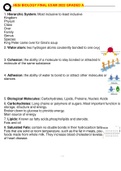
HESI BIOLOGY FINAL EXAM 2022 GRADED A 1. Hierarchic System: Most inclusive to least inclusive Kingdom Phylum Class Over Family Genus Species King Peter came over for Gina's soup 2. Water atom: two hydrogen atoms covalently bonded to one oxy 3. Cohesion: the ability of a molecule to stay bonded or attracted t molecule of the same substance 4. Adhesion: the ability of water to bond to or attract other molecules or stances 5. Biological Molecules: Carbohydrates, Lipids, Proteins, Nucleic Acids 6. Carbohydrates: Long chains or polymers of sugars. Most important function is storage, structure and energy. Broken down to glucose to provide energy. Main source of energy 7. Lipids: Known as fatty acids,phospholipids and steroids. Fats and oil 8. Saturated Fats: contain no double bonds in their hydrocarbon tail Fats that are solid at room temperature, such as the fat in meats, po foods made from whole milk. They increase blood cholesterol levels of heart disease. 10. Phospholipid: consist of two fatty acids of varying length bond phate group A molecule that is a constituent of the inner bilayer of biological memb a polar, hydrophilic head and a nonpolar, hydrophobic tail. 11. Hydrocarbon tail of fatty acids: non polar 12. Specific Heat: the amount of heat necessary to raise the temperature of 1 gram of that molecule by 1 celsius 13. Lattice: when freezes it forms this, it actually causes the molecules to spread apart resulting in floating 14. Polarity of water: it acts as a versatile solvent. The polar nature of water favors ionization of substances in solution 15. Steroids: Precursors to significant hormones and are a compo branes 16. Proteins: most significant contributor to cellular function. 17. Polymers: Molecules that are chains of repeating units; proteins and DNA are examples. 18. Amino acids: Building blocks of protein 19. Largest Biological Molecule: Proteins 20. Enzymes: particular types of proteins that act to catalyze different reactions or processes Biological catalyst Proteins that speed up chemical reactions Functional proteins; their names usually end in - ase Act as catalysts for special chemical reactions within the human bod Protein that speeds up chemical reactions by lowering activation energy 21. Nucleic Acids: components of the molecules of inheritance DNA and RNA 22. DNA: Deoxyribonucleic Acid is a unique molecule specific to a par organism and contains the code that is necessary for replication A double-stranded, helical nucleic acid molecule capable of replicating mining the inherited structure of a cell's proteins. 23. RNA: Ribonucleic Acid is used in transfer and as a messenger in most of the genetic code Protein synthesis 24. Metabolism: the sum of all chemical reactions that occur in an organism 25. Metabolic pathways: Chemical reactions with a cell. Always pro a standpoint of high energy to low energy 26. Cell: fundamental unit of biology Basic unit of life 27. Organelles: Structures specialized to perform distinct processes within a cell. 28. Prokaryotic Cell: Lack a defined nucleus and do not contain m brane-bound organelles A type of cell lacking a membrane-enclosed nucleus and membran organelles; found only in the domains Bacteria and Archaea. 29. Eukaryotic Cell: A type of cell with a membrane-enclosed nucleus and mem- brane-enclosed organelles. Examples of organisms with these cells are protists, plants, fungi, and animals. 30. Nucleus: Contains DNA of the cell 31. Chromosomes: contain all of the material for the regeneration of well as all of the instructions for the function of the cell. Every organis characteristic number of chromosomes specific to the particular spec 32. Ribosomes: read the RNA produced in the nucleus and translate the genetic instructions to produce proteins. Cells with a high rate of protein synthesis generally have a large number of ribosomes. 33. Endoplasmic Reticulum: Bound ribosomes are attached to h 34. Free ribosomes: found in the cytoplasm 35. Endoplasmic Reticulum: a membranous organelle found attached to the nuclear membrane and consists of two continuous parts. 36. Rough ER: membranous
Written for
- Institution
- Hesi biology
- Course
- Hesi biology
Document information
- Uploaded on
- October 24, 2022
- Number of pages
- 9
- Written in
- 2022/2023
- Type
- Exam (elaborations)
- Contains
- Questions & answers
Subjects
- hesi biology final exam
- hesi biology final
- hesi biology
- biology
- water atom
-
hesi biology final exam 2022 graded a
-
hesi biology final exam 2022
-
hierarchic system

Also available in package deal