Multidimensional Care Exam 1 CORRECTLY ANSWERED
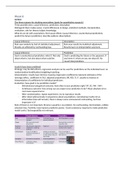
1. Phases of communication: Pre-interaction: The student nurse gathers infor- mation about the client Orientation: The student nurse introduces themself, explains their role in the relationship Working: Active part of the relationship. The student nurse communicates caring and compassion to the client Termination: This marks the end of the relationship, whether at the end of the shift or at discharge. 2. PASS: Pull, Aim, Squeeze, Sweep 3. When there is a fire you would call a: code red or yellow depending on facility 4. Components of therapeutic communication: Active Listening Establishing trust Being assertive Validating messages Exploring issues Using silence 5. Non-pharmacological interventions if a patient has a sprain: Physical ther- apy, exercise, hot and cold therapy, relaxation, ankle immobility 6. Normal vital signs: HR: 60 - 100 bpm RR: 12 - 20 Temp: 96.4 - 99.5 BP: 120/80 O2: 94-100% Pain 7. Pain: assessment—"PQRST": P = Provocation and Palliative factors - CAUSE Q= Quality R= Region of the body or Radiation S= Severity - scale T= Timing - when did it start and how long did it last Pain is the fifth vital sign 9. supine: lying on the back 10. lithotomy: Dorsal recumbent position at end of table with feet in flexed, and widely open 11. Sims': body position in which a person is lying on his left side w knee flexed and raised toward the chest 12. Prone: lying face down 13. lateral recumbent: lying on the side 14. knee-chest position: patient is lying face down with the hips b knees and chest rest on the table 15. unlicensed assistive personnel (UAP): -Includes CNAs, CMAs, and non-nursing personnel -Work under direct supervision of an RN or LPN -Specific tasks usually outlined in position description -Tasks may including feeding clients, preparing meals, lifting, basic care, measur- ing & recording vital signs, and ambulating clients 16. complementary medicine: health care practices and products u with conventional medicine 17. priority nursing assessment: -Continuous telemetry monitoring -Frequent vitals -Ongoing head-to-toe -Serial 12-Lead EKG -Pain: Intensity, location, quality, radiation, aggravating and alleviating factors Nursing Focus: -Perfusion -Respiratory Psychosocial Support: -Anxiety -Educational Needs: Patient and Family Monitor for Complications: -Progressive ACS -Heart Failure -Cardiogenic Shock -Cardiac Arrest 18. open-ended questions: questions that allow respondents to answer however they want 19. Maslow's Hierarchy of Needs: physiological, safety, love/belonging, esteem, self-actualization 20. visceral pain: pain originating in the internal organs in the thorax, cranium, or abdomen 21. deep somatic pain: ligaments, tendons, bones, blood vessels, nerves 22. Types of nutrition: mouth/oral, enteral, parenteral 23. mobiity: ability of an individual to perform purposeful physical movement of the body. 24. Consequences of Immobility: Osteoporosis, contractures Pressure ulcers Constipation Anorexia Urinary stasis > renal calculi, infection Psychological effects 25. Mobility interventions: passive ROM repositioning skin assessment nutrition breathing exercises mobility aids if needed 26. characteristics of therapeutic communication: 1. Empathy 2. Respect 3. Genuineness 4. Correctness 5. Confrontation 27. restating: using your own words to summarize the message you received from the client 28. clarifying: ensure you have decoded the message correctly "when you say that, what do you mean?" 29. validating: confirm you have made the correct interpretation 30. Barriers to communication: asking too many questions changing the subject expressing approval or disapproval offering advice false reassurance stereotyping patronizing language 31. culture: Socially transmitted behaviors, arts, beliefs, values, customs, lifeways and other characteristics that guide decision making 32. open ended questions: allows a narrative answer can use probing
Written for
- Institution
- Multidimensional
- Course
- Multidimensional
Document information
- Uploaded on
- October 22, 2022
- Number of pages
- 4
- Written in
- 2022/2023
- Type
- Exam (elaborations)
- Contains
- Questions & answers
Subjects
- multidimensional care
- pass
-
multidimensional care exam 1 correctly answered
-
multidimensional care exam 1
-
phases of communication