
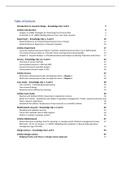
Table of Contents
Introduction to research design - Knowledge clip 1 and 2 2
Articles Introduction 3
Langley, A. (1999). Strategies for Theorizing from Process Data. 3
Eisenhardt, K. M. (1989). Building theories from case study research 2
Experiment – Knowledge clip 1, 2 and 3 10
Stated Preference (or Conjoint) Experiments (must in thesis) 12
Stated Preference Experiment: a Research Example 16
Articles Experiment 17
Consumer preferences parcel delivery methods: potential of parcel locker use in Netherlands 17
The Impact of Green Labels on Time Slot Choice and Operational Sustainability 19
Chapter 6 - Conjoint Analysis. In The Measurement and Analysis of Housing Preference and Choice 21
Survey - knowledge clip 1,2, 3 and 4 22
Overview of survey methods 22
Survey-based research in OM and SCM 23
Survey instruments and data analysis 24
Survey-based research paper in OM 26
Articles Survey 27
Multi-item measurement scales and objective items - Chapter 1 27
Multi-item measurement scales and objective items - Chapter 3 28
Case study – knowledge clip 1, 2 and 3 29
Care research - methodological approaches 29
Case research design 31
Necessity versus sufficiency reasoning 33
Articles Case-study 34
Mantere and Ketokivi (2013)- Reasoning in organization science 34
Baratt et al. (2011) - Qualitative case studies in operations management: Trends, research outcomes, and
future research implications 36
Ketokivi & Choi (2014) - Renaissance of case research as a scientific method 39
Model-based research - Knowledge clip 1, 2 and 3 42
Modeling and validation process 42
Three main methods used in SCM program 44
Within or outside a company context 46
Articles Model-based 47
System dynamics modeling: tools for learning in a complex world. California management review 47
Bertrand, J. W. M., & Fransoo, J. C. (2010). Modelling and simulation. In Researching operations
management (pp. 279-320) 52
Design science – knowledge clip 1 and 2 54
Articles Design science 57
Bridging Practice and Theory: A Design Science Approach 57
,Introduction to research design - Knowledge clip 1 and 2
Different approaches to scientific inquiries (asking questions to get information)
- Concerns of inappropriate forms of reasoning
- Concerns of inappropriate approach (qual, quant, etc.)
- Concerns of lack of transparency (including fraud)
Why does it matter?
- Unreliable knowledge claims
- Inappropriate advice for managers and organizations
- No theoretical contribution
Quantitative = research approach that examines concepts in terms of amount, intensity, or
frequency
- For example, employs modeling, HD methodology
- Idea of falsification; prediction as cornerstone of HD
Qualitative = research approach that examines concepts in terms of their meaning and
interpretation in specific contexts of inquiry
- Typically, case studies
- Variance approach or process approach
Mixed methods
- Mix of qualitative and quantitative work
Forms of reasoning
- Abduction: inference to a cause/ case → also used to frame problems and generate
solutions/ theories
o Example: might be a flat tire/ other problem requiring repair
- Deduction: inference to a result → used for testing solutions/ theories
o Example: the bicyclist is fixing the problem/ repairing his bike
- Induction: inference to a rule → involves generalizing from a sample to a population
o Example: on average, bicyclist doing similar actions by the side of a road are
likely repairing their bicycles
- All infereneces are fallible (able to make mistakes)
,Process of inquires
- Theorize through abduction
- Predict, confirm, and disconfirm through deduction
- Generalize through induction
Application to MSc thesis (mental framework)
- Begin with formulating a problem (e.g., company problem, research gap) using a
theory
- Identify the type of data (e.g., large N, small n) (observation is guided by theory)
- Identify the research design (correlation vs. process)
- Abduce your theory/ conjectures/ hypotheses
- Test your theory/ conjectures/ hypotheses
- Consider the implications of your theory/ conjectures/ hypotheses
- Identify the boundary conditions
- Construct theoretical contribution
Articles Introduction
Langley, A. (1999). Strategies for Theorizing from Process Data.
PROCESS DATA AND PROCESS THEORIZATION: THE CHALLENGE
Several difficult to analyze and manipulated characteristics in process data:
- Dealing with sequences of events
- Unclear boundaries within levels/ units of analysis
- Variety in:
● Precision
● Duration
● Relevance
, - Drawing phenomena such as:
● Changing relationships
● Thought
● Feelings
● Interpretations
Data composed of events
Variance theory
- Multiple case studies
● Key factor/ several factors that lead to one outcome and not the other
● 6 to 10 cases
● What are the factors that lead to different outcomes
- Explanations of relationships dependent and independent variables
- More of X and more of Y produce more of Z
Process theory
- Typically, single case study
- Explanations of sequence of events leading to outcome
- Do A and then B to get C
- Understanding patterns in events is key
● Easier to do something to change the outcomes
Data on Multiple Units and Levels of Analysis with Ambiguous Boundaries
Main reason using qualitative research:
- Take context into account
Leads to
- Levels of analysis difficult to separate. Complicates the sensemaking process
Data of Variable Temporal Embeddedness
Collecting process data important to
- Document as completely as possible sequence of events
Data That Are Eclectic
Process data
- Composed (samengesteld) of descriptions of discrete events
- Incorporate variety of quantitative and qualitative information
● Makes analysis and interpretation more complex
Introduction to research design - Knowledge clip 1 and 2 2
Articles Introduction 3
Langley, A. (1999). Strategies for Theorizing from Process Data. 3
Eisenhardt, K. M. (1989). Building theories from case study research 2
Experiment – Knowledge clip 1, 2 and 3 10
Stated Preference (or Conjoint) Experiments (must in thesis) 12
Stated Preference Experiment: a Research Example 16
Articles Experiment 17
Consumer preferences parcel delivery methods: potential of parcel locker use in Netherlands 17
The Impact of Green Labels on Time Slot Choice and Operational Sustainability 19
Chapter 6 - Conjoint Analysis. In The Measurement and Analysis of Housing Preference and Choice 21
Survey - knowledge clip 1,2, 3 and 4 22
Overview of survey methods 22
Survey-based research in OM and SCM 23
Survey instruments and data analysis 24
Survey-based research paper in OM 26
Articles Survey 27
Multi-item measurement scales and objective items - Chapter 1 27
Multi-item measurement scales and objective items - Chapter 3 28
Case study – knowledge clip 1, 2 and 3 29
Care research - methodological approaches 29
Case research design 31
Necessity versus sufficiency reasoning 33
Articles Case-study 34
Mantere and Ketokivi (2013)- Reasoning in organization science 34
Baratt et al. (2011) - Qualitative case studies in operations management: Trends, research outcomes, and
future research implications 36
Ketokivi & Choi (2014) - Renaissance of case research as a scientific method 39
Model-based research - Knowledge clip 1, 2 and 3 42
Modeling and validation process 42
Three main methods used in SCM program 44
Within or outside a company context 46
Articles Model-based 47
System dynamics modeling: tools for learning in a complex world. California management review 47
Bertrand, J. W. M., & Fransoo, J. C. (2010). Modelling and simulation. In Researching operations
management (pp. 279-320) 52
Design science – knowledge clip 1 and 2 54
Articles Design science 57
Bridging Practice and Theory: A Design Science Approach 57
,Introduction to research design - Knowledge clip 1 and 2
Different approaches to scientific inquiries (asking questions to get information)
- Concerns of inappropriate forms of reasoning
- Concerns of inappropriate approach (qual, quant, etc.)
- Concerns of lack of transparency (including fraud)
Why does it matter?
- Unreliable knowledge claims
- Inappropriate advice for managers and organizations
- No theoretical contribution
Quantitative = research approach that examines concepts in terms of amount, intensity, or
frequency
- For example, employs modeling, HD methodology
- Idea of falsification; prediction as cornerstone of HD
Qualitative = research approach that examines concepts in terms of their meaning and
interpretation in specific contexts of inquiry
- Typically, case studies
- Variance approach or process approach
Mixed methods
- Mix of qualitative and quantitative work
Forms of reasoning
- Abduction: inference to a cause/ case → also used to frame problems and generate
solutions/ theories
o Example: might be a flat tire/ other problem requiring repair
- Deduction: inference to a result → used for testing solutions/ theories
o Example: the bicyclist is fixing the problem/ repairing his bike
- Induction: inference to a rule → involves generalizing from a sample to a population
o Example: on average, bicyclist doing similar actions by the side of a road are
likely repairing their bicycles
- All infereneces are fallible (able to make mistakes)
,Process of inquires
- Theorize through abduction
- Predict, confirm, and disconfirm through deduction
- Generalize through induction
Application to MSc thesis (mental framework)
- Begin with formulating a problem (e.g., company problem, research gap) using a
theory
- Identify the type of data (e.g., large N, small n) (observation is guided by theory)
- Identify the research design (correlation vs. process)
- Abduce your theory/ conjectures/ hypotheses
- Test your theory/ conjectures/ hypotheses
- Consider the implications of your theory/ conjectures/ hypotheses
- Identify the boundary conditions
- Construct theoretical contribution
Articles Introduction
Langley, A. (1999). Strategies for Theorizing from Process Data.
PROCESS DATA AND PROCESS THEORIZATION: THE CHALLENGE
Several difficult to analyze and manipulated characteristics in process data:
- Dealing with sequences of events
- Unclear boundaries within levels/ units of analysis
- Variety in:
● Precision
● Duration
● Relevance
, - Drawing phenomena such as:
● Changing relationships
● Thought
● Feelings
● Interpretations
Data composed of events
Variance theory
- Multiple case studies
● Key factor/ several factors that lead to one outcome and not the other
● 6 to 10 cases
● What are the factors that lead to different outcomes
- Explanations of relationships dependent and independent variables
- More of X and more of Y produce more of Z
Process theory
- Typically, single case study
- Explanations of sequence of events leading to outcome
- Do A and then B to get C
- Understanding patterns in events is key
● Easier to do something to change the outcomes
Data on Multiple Units and Levels of Analysis with Ambiguous Boundaries
Main reason using qualitative research:
- Take context into account
Leads to
- Levels of analysis difficult to separate. Complicates the sensemaking process
Data of Variable Temporal Embeddedness
Collecting process data important to
- Document as completely as possible sequence of events
Data That Are Eclectic
Process data
- Composed (samengesteld) of descriptions of discrete events
- Incorporate variety of quantitative and qualitative information
● Makes analysis and interpretation more complex


