5.1.5: Animal responses
The organisation of the mammalian nervous system
Structural organisation of the nervous system:
- Structurally organised into 2 systems:
1) Central nervous system (CNS) - consists of brain and spinal cord
- Neurones -- relay
- Brain
- Grey matter - non-myelinated nerve cells
- White matter - longer myelinated axons and dendrons (made white by fatty myelin)
Spinal cord
- A column of nervous tissues running up the back. Surrounded by the spine for
protections
- Carries information about the body to the brain, and from the brain to the body, through
its connection switch spinal nerves (part of the PNS)
- Controls motor reflexes
- Damage to the spinal cord can lead to paralysis. Extent of paralysis depends on location
of the injury along the spinal cord and whether the spinal cord was completely severed.
Spinal cord injuries are notoriously difficult to treat because spinal nerves do not
regenerate (although ongoing research suggests that stem cell transplants may be bale
to act as a bridge to reconnect severed nerves)
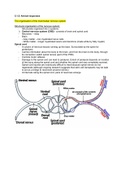
- At intervals along the spinal cord, pairs of neurones emerge
, 2) Peripheral nervous system (PNS) - consists of all the neurones that connect the CNS
to the rest of the body (nerves running to and from the CNS)
- Neurones -- sensory + motor
Function of the nervous system: to coordinate between sensors and effectors so that an
organism can respond to changes in its environment. This is essential for survival
Functional organisation of the nervous system:
, - The PNS is functionally organised into 2 systems:
1) Somatic nervous system: under conscious control - used when you voluntarily decide
to do something
- Carries impulses to skeletal muscle
- Axon terminals release acetylcholine
- Always excitatory/stimulatory
- Controlled by the cerebrum/cerebral
- Single efferent neurone (one neurone synapses directly w/ the effector)
- Most neurones are myelinated
- The somatic nervous system consists of 3 type of nerve:
1) Sensory nerves - consist entirely of sensory neurones. Transmit impulses from
sense organs → CNS
2) Motor nerves - consist entirely of motor neurones. Transmit impulses from the
CNS → effectors
3) Mixed nerves - these are the spinal nerves from the spinal cord. Consists of both
sensory and motor neurones
2) Autonomic nervous system: under subconscious control - used when the body does
something involuntary
- Carries impulses to smooth muscle (eg. in intestine walls), cardiac muscle, glands
- Axon terminals release acetylcholine (P) or noradrenaline (S)
- Can be excitatory/stimulatory or inhibitory (depends on neurotransmitter released at
effector and the receptors on the effector organs)
- Controlled by homeostatic centres in the brain (eg. hypothalamus, pons, medulla
oblongata)
- Although primarily under SUBconscious control, many aspects of the ANS can come
under conscious control (eg. can choose to hold your breath)
- Multiple efferent neurones (pathway of several neurones on route to the effector)
- Most neurones are unmyelinated
- The ANS is further functionally (structurally the neurones of the 2 systems are same and
run alongside one another) divided into the:
1) Sympathetic nervous system
- Generally increases activity - excitatory
- Exercise, excitement, emergency, embarrassment - ‘fight or flight’
responses
- Neurotransmitter at effector = noradrenaline
2) Parasympathetic nervous system
- Generally decreases activity - inhibitory
- Digestion, defecation, diuresis - ‘rest and digest’ / relaxing responses
- Neurotransmitter at effector = acetylcholine
- The sympathetic NS and parasympathetic NS exhibit antagonistic control - the action on
one system opposes the action of another -- increase in sympathetic stimulation results
in that which an increases in parasympathetic stimulation counterbalances/opposes
(although perhaps better described as ‘complementary’, as the two systems should be
seen as vital functions permanently modulating, usually in an antagonistic way, to
achieve homeostasis). Eg:
The organisation of the mammalian nervous system
Structural organisation of the nervous system:
- Structurally organised into 2 systems:
1) Central nervous system (CNS) - consists of brain and spinal cord
- Neurones -- relay
- Brain
- Grey matter - non-myelinated nerve cells
- White matter - longer myelinated axons and dendrons (made white by fatty myelin)
Spinal cord
- A column of nervous tissues running up the back. Surrounded by the spine for
protections
- Carries information about the body to the brain, and from the brain to the body, through
its connection switch spinal nerves (part of the PNS)
- Controls motor reflexes
- Damage to the spinal cord can lead to paralysis. Extent of paralysis depends on location
of the injury along the spinal cord and whether the spinal cord was completely severed.
Spinal cord injuries are notoriously difficult to treat because spinal nerves do not
regenerate (although ongoing research suggests that stem cell transplants may be bale
to act as a bridge to reconnect severed nerves)
- At intervals along the spinal cord, pairs of neurones emerge
, 2) Peripheral nervous system (PNS) - consists of all the neurones that connect the CNS
to the rest of the body (nerves running to and from the CNS)
- Neurones -- sensory + motor
Function of the nervous system: to coordinate between sensors and effectors so that an
organism can respond to changes in its environment. This is essential for survival
Functional organisation of the nervous system:
, - The PNS is functionally organised into 2 systems:
1) Somatic nervous system: under conscious control - used when you voluntarily decide
to do something
- Carries impulses to skeletal muscle
- Axon terminals release acetylcholine
- Always excitatory/stimulatory
- Controlled by the cerebrum/cerebral
- Single efferent neurone (one neurone synapses directly w/ the effector)
- Most neurones are myelinated
- The somatic nervous system consists of 3 type of nerve:
1) Sensory nerves - consist entirely of sensory neurones. Transmit impulses from
sense organs → CNS
2) Motor nerves - consist entirely of motor neurones. Transmit impulses from the
CNS → effectors
3) Mixed nerves - these are the spinal nerves from the spinal cord. Consists of both
sensory and motor neurones
2) Autonomic nervous system: under subconscious control - used when the body does
something involuntary
- Carries impulses to smooth muscle (eg. in intestine walls), cardiac muscle, glands
- Axon terminals release acetylcholine (P) or noradrenaline (S)
- Can be excitatory/stimulatory or inhibitory (depends on neurotransmitter released at
effector and the receptors on the effector organs)
- Controlled by homeostatic centres in the brain (eg. hypothalamus, pons, medulla
oblongata)
- Although primarily under SUBconscious control, many aspects of the ANS can come
under conscious control (eg. can choose to hold your breath)
- Multiple efferent neurones (pathway of several neurones on route to the effector)
- Most neurones are unmyelinated
- The ANS is further functionally (structurally the neurones of the 2 systems are same and
run alongside one another) divided into the:
1) Sympathetic nervous system
- Generally increases activity - excitatory
- Exercise, excitement, emergency, embarrassment - ‘fight or flight’
responses
- Neurotransmitter at effector = noradrenaline
2) Parasympathetic nervous system
- Generally decreases activity - inhibitory
- Digestion, defecation, diuresis - ‘rest and digest’ / relaxing responses
- Neurotransmitter at effector = acetylcholine
- The sympathetic NS and parasympathetic NS exhibit antagonistic control - the action on
one system opposes the action of another -- increase in sympathetic stimulation results
in that which an increases in parasympathetic stimulation counterbalances/opposes
(although perhaps better described as ‘complementary’, as the two systems should be
seen as vital functions permanently modulating, usually in an antagonistic way, to
achieve homeostasis). Eg: