BIOCHEMISTRY – LECTURE 8 PART 1
krebs cycle
At the end of glycolysis, we ended with 2 molecules of pyruvate. One of the fates
of pyruvate is to be imported into the mitochondria, be converted to a molecule
called acetyl CoA an enter the Krebs cycle. Acetyl CoA is also the starting point
for fatty acid synthesis. The reactions catalysed by PDH (pyruvate
dehydrogenase) is the link between pyruvate and its aerobic fate. CO 2 is
produced and a molecule of NADH, leaving a molecule of acetyl (linked to Co
enzyme A). This reaction is irreversible and marks a committed step to the
complete oxidation of glucose. Because of this commitment, activity of the PDH
complex is an important point of metabolic control.
As PDH catalyses a committed step to complete the oxidation of glucose, the
control over its activity is vital. When phosphorylated, PDH is inactive, this is
catalysed by PDH kinase. The removal of the phosphate group is catalysed by
PDH phosphatase. High energy signals activate PDH kinase, while low energy
signals inhibit it. The purpose of the Krebs cycle is to produce high energy
molecules, however molecules formed in the process are also used for synthesis
of other important biomolecules such as amino acids and porphyrins.
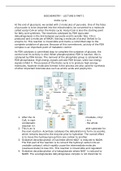
1. After the initial enzyme catalysed step, the unstable intermediate, citryl
CoA, is rapidly hydrolysed to release the CoA molecule. It is a
condensation reaction. This second, rapid reaction drives the whole
reaction in the forward direction. It is irreversible.
2. This is an isomerisation reaction to form isocitrate, a suitable substrate for
the next reaction. Aconitase catalyses the dehydration to form cis-aconite,
which remains bound to the enzyme prior to hydration. The overall effect
is to move the hydroxyl group from one carbon to another.
3. Oxidative decarboxylation of isocitrate where NAD+ is reduced to NADH.
The first part of the reaction is to convert the hydroxyl carbon into an
unstable carbonyl, which rapidly cause the intermediate molecule
(oxalosuccinate) to lose CO2. This reaction is irreversible and regulated.
4. Oxidative decarboxylation of a-ketoglutarate where NAD + is reduced to
NADH. The a-ketoglutarate dehydrogenase complex is not dissimilar to
krebs cycle
At the end of glycolysis, we ended with 2 molecules of pyruvate. One of the fates
of pyruvate is to be imported into the mitochondria, be converted to a molecule
called acetyl CoA an enter the Krebs cycle. Acetyl CoA is also the starting point
for fatty acid synthesis. The reactions catalysed by PDH (pyruvate
dehydrogenase) is the link between pyruvate and its aerobic fate. CO 2 is
produced and a molecule of NADH, leaving a molecule of acetyl (linked to Co
enzyme A). This reaction is irreversible and marks a committed step to the
complete oxidation of glucose. Because of this commitment, activity of the PDH
complex is an important point of metabolic control.
As PDH catalyses a committed step to complete the oxidation of glucose, the
control over its activity is vital. When phosphorylated, PDH is inactive, this is
catalysed by PDH kinase. The removal of the phosphate group is catalysed by
PDH phosphatase. High energy signals activate PDH kinase, while low energy
signals inhibit it. The purpose of the Krebs cycle is to produce high energy
molecules, however molecules formed in the process are also used for synthesis
of other important biomolecules such as amino acids and porphyrins.
1. After the initial enzyme catalysed step, the unstable intermediate, citryl
CoA, is rapidly hydrolysed to release the CoA molecule. It is a
condensation reaction. This second, rapid reaction drives the whole
reaction in the forward direction. It is irreversible.
2. This is an isomerisation reaction to form isocitrate, a suitable substrate for
the next reaction. Aconitase catalyses the dehydration to form cis-aconite,
which remains bound to the enzyme prior to hydration. The overall effect
is to move the hydroxyl group from one carbon to another.
3. Oxidative decarboxylation of isocitrate where NAD+ is reduced to NADH.
The first part of the reaction is to convert the hydroxyl carbon into an
unstable carbonyl, which rapidly cause the intermediate molecule
(oxalosuccinate) to lose CO2. This reaction is irreversible and regulated.
4. Oxidative decarboxylation of a-ketoglutarate where NAD + is reduced to
NADH. The a-ketoglutarate dehydrogenase complex is not dissimilar to