FLUX OF MATTER THROUGH ECOSYSTEMS
Global, geological, water and nutrient cycles and how humans impact those
cycles.
Open energy system vs. Closed matter system:
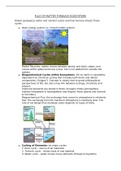
Matter Recycles: matter moves between abiotic and biotic states, and
moves within global and local cycles, but is not added from outside the
system.
Biogeochemical Cycles within Ecosystems: life on earth is completely
dependent on chemical cycling that includes both biotic and abiotic
components (“biogeo”). Concept is closely tied to grand philosophical
perspectives of life, but also a key link between ecology, chemistry and
physics.
Chemical elements are stored in Pools: Inorganic Pools (atmosphere,
mantle/ lithosphere & hydrosphere) and Organic Pools (plants and animals
& microbes).
Biogeochemical Flux: the exchange from ocean to atmosphere is relatively
fast. The exchange from the mantle to lithosphere is relatively slow. The
rate of exchange (flux) between pools depends on types of biota.
Cycling of Elements: six major cycles:
1. Rock cycle – source of all materials
2. Tectonic cycle – drives input of raw material
3. Water cycle – water moves many elements through ecosystems
, 4. Carbon cycle – closely tied to energy movement
5. Nitrogen cycle – transitions through multiple molecular forms with key
microbial processes, making it biologically available
Phosphorous cycle – relatively simpler and moves between land and water
1. Rock Cycle:
Igneous – formed from molten material.
Sedimentary – formed from accumulation of weathered material in depositional
basins.
Metamorphic – formed from sedimentary rocks exposed to heat, pressure or
chemical forces.
Origin of all material used to generate biological compounds.
2. Tectonic Cycle:
Lithosphere (crust) ‘floats’ on lower rock material.
Plate movement either divergent or convergent.
Plate boundaries are geologically active (volcanoes, earth movements through
‘quakes’).
Consequences: inputs new material, alters atmospheric composition &
absorption, alters oceanic composition & circulation.
3. Water (hydrologic) Cycle:
Describes the storage and movement of water between the biosphere,
atmosphere, lithosphere and the hydrosphere. Remarkably little of total water is
‘available’ for biota.
How do humans modify the water cycle?
- Over-abstraction from lakes and rivers
- Vegetation loss
- Soil erosion
- Pollution of surface water and ground aquifers
- Drainage of wetlands
- Climate impacts
Impacts of climate change: the water cycle:
- Amount and frequency of precipitation
- Evaporation rates
- Transpiration rates
- Physiological limits (e.g. water temperature)
Global, geological, water and nutrient cycles and how humans impact those
cycles.
Open energy system vs. Closed matter system:
Matter Recycles: matter moves between abiotic and biotic states, and
moves within global and local cycles, but is not added from outside the
system.
Biogeochemical Cycles within Ecosystems: life on earth is completely
dependent on chemical cycling that includes both biotic and abiotic
components (“biogeo”). Concept is closely tied to grand philosophical
perspectives of life, but also a key link between ecology, chemistry and
physics.
Chemical elements are stored in Pools: Inorganic Pools (atmosphere,
mantle/ lithosphere & hydrosphere) and Organic Pools (plants and animals
& microbes).
Biogeochemical Flux: the exchange from ocean to atmosphere is relatively
fast. The exchange from the mantle to lithosphere is relatively slow. The
rate of exchange (flux) between pools depends on types of biota.
Cycling of Elements: six major cycles:
1. Rock cycle – source of all materials
2. Tectonic cycle – drives input of raw material
3. Water cycle – water moves many elements through ecosystems
, 4. Carbon cycle – closely tied to energy movement
5. Nitrogen cycle – transitions through multiple molecular forms with key
microbial processes, making it biologically available
Phosphorous cycle – relatively simpler and moves between land and water
1. Rock Cycle:
Igneous – formed from molten material.
Sedimentary – formed from accumulation of weathered material in depositional
basins.
Metamorphic – formed from sedimentary rocks exposed to heat, pressure or
chemical forces.
Origin of all material used to generate biological compounds.
2. Tectonic Cycle:
Lithosphere (crust) ‘floats’ on lower rock material.
Plate movement either divergent or convergent.
Plate boundaries are geologically active (volcanoes, earth movements through
‘quakes’).
Consequences: inputs new material, alters atmospheric composition &
absorption, alters oceanic composition & circulation.
3. Water (hydrologic) Cycle:
Describes the storage and movement of water between the biosphere,
atmosphere, lithosphere and the hydrosphere. Remarkably little of total water is
‘available’ for biota.
How do humans modify the water cycle?
- Over-abstraction from lakes and rivers
- Vegetation loss
- Soil erosion
- Pollution of surface water and ground aquifers
- Drainage of wetlands
- Climate impacts
Impacts of climate change: the water cycle:
- Amount and frequency of precipitation
- Evaporation rates
- Transpiration rates
- Physiological limits (e.g. water temperature)