Marketing
Product life cycle
Marketing – is the management process involved in identifying, anticipating and satisfying
needs and wants of customers.
Product life cycle – represents the different stages in the life of a product and the sales that
are achieved at each stage.
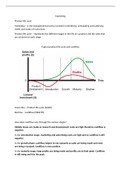
Typical product life cycle and cashflow
Green line – Product life cycle (SALES)
Red line – Cashflow (PROFITS)
How does cashflow vary through the various stages?
Initially losses are made as research and development costs are high therefore cashflow is
negative.
In the introduction stage, marketing and advertising costs are high and so cashflow is still
negative.
In the growth phase, cashflow begins to rise upwards as sales are being made and costs
are being recouped. Cashflow is now positive.
In the maturity stage, large profits are being made and profits are at their peak. Cashflow
is still rising and hits the peak.
, In the saturation phase, profits begin to decrease but cashflow is still positive.
In the decline phase, sales begin to fall and profits also begin to fall. But cashflow is still
positive but is decreasing slowly.
‘Straw on fire’ product life cycle – the product quickly moves through all the stages of the
product life cycle. E.g., loom bands and fidget spinners.
Extended product life cycle - demonstrates that some products remain in the market place
for a long time. These products stay in the maturity phase.
Why R&D is important:
Allows businesses to improve existing products
Allows businesses to find alternative methods of producing goods which can reduce
costs
Increases efficiency
Learn from mistakes made to improve lifespan of product (make it more durable)
Extended product life cycle
Extension strategies
Repositioning the product in the marketplace – make it more appealing to target
market
Improve the product
Product life cycle
Marketing – is the management process involved in identifying, anticipating and satisfying
needs and wants of customers.
Product life cycle – represents the different stages in the life of a product and the sales that
are achieved at each stage.
Typical product life cycle and cashflow
Green line – Product life cycle (SALES)
Red line – Cashflow (PROFITS)
How does cashflow vary through the various stages?
Initially losses are made as research and development costs are high therefore cashflow is
negative.
In the introduction stage, marketing and advertising costs are high and so cashflow is still
negative.
In the growth phase, cashflow begins to rise upwards as sales are being made and costs
are being recouped. Cashflow is now positive.
In the maturity stage, large profits are being made and profits are at their peak. Cashflow
is still rising and hits the peak.
, In the saturation phase, profits begin to decrease but cashflow is still positive.
In the decline phase, sales begin to fall and profits also begin to fall. But cashflow is still
positive but is decreasing slowly.
‘Straw on fire’ product life cycle – the product quickly moves through all the stages of the
product life cycle. E.g., loom bands and fidget spinners.
Extended product life cycle - demonstrates that some products remain in the market place
for a long time. These products stay in the maturity phase.
Why R&D is important:
Allows businesses to improve existing products
Allows businesses to find alternative methods of producing goods which can reduce
costs
Increases efficiency
Learn from mistakes made to improve lifespan of product (make it more durable)
Extended product life cycle
Extension strategies
Repositioning the product in the marketplace – make it more appealing to target
market
Improve the product