BIOCHEMISTRY BLUE-PACOP QUESTIONS AND ANSWERS
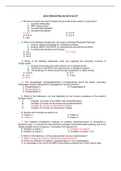
BIOCHEMISTRY BLUE-PACOP __ 1. What two enzymes are used to bypass the pyruvate kinase reaction of glycolysis? I. pyruvate carboxylase II. PEP carboxykinase III. Fructose biphosphatase IV. Glucose-6-phosphate A. I & II D. II & IV B. III & IV E. II & III C. I &III __ 2. Which of the following includes the main goals of Pentose Phosphate Pathway? I. produce ribose-5-phosphate for nucleotide synthesis II. produce NADPH and NADP for oxidoreductive biochemical synthesis III. to interconvert pentoses and hexoses A. I & II D. I, II & III B. II & III C. I & III __ 3. Which of the following statements is/are true regarding the secondary structure of nucleic acids? I. Guanine forms base pairs with cytosine via 2 hydrogen bonds II. The B form of the DNA is the most common in biological systems III. The breaking of H-bonds caused by high temperature is called melting A. I,II & III D. I & II B. I & II E. II only C. II & III __ 4. The phospholipid, phosphatidylinositol 4,5-biphosphate forms the potent secondary messengers inositol triphosphate & diacylglycerol via what enzyme? A. Phospholipase A D. Phospholipase B B. Phospholipase C C. Phospholipase D __ 5. Which of the following is not true regarding the four enzyme complexes of the electron transport chain? A. Complex I is known as the NADH-CoQ Oxidoreductases B. Complex II is known as Succinate-CoQ Oxidoreductases C. Complex III is known as Cytochrome Oxidase D. Complex IV is known as Cytochrome Oxidase __ 6. Glucose and mannose are epimers at: A. Carbon 4 C. Carbon 3 B. Carbon 2 D. Carbon 5 __ 7. One important endogenous molecule for synthetic biotransformation of xenobiotics is glucoronic acid. It is actually the most dominant conjugative biotransformation pathway due to the readily available source of glucose. It is produce from glucose via: A. Oxidation at carbon 1 C. Oxidation at carbon 6 B. Oxidation at carbon 2 D. Oxidation at carbon 1 & 6 __ 8. Which of the following is not true about protein structure determination? A. NMR is the primary means of determining protein structure B. Protein are difficult to crystallize, a disadvantage of x-ray crystallography C. An advantage of the use of the NMR is that proteins analyzed are in their natural state D. Large and very complex proteins can only be analyzed by x-ray crystallography __ 9. Tertiary structures of proteins are primarily stabilized by I. H-bonds II. Hydrophobic interactions III. Ionic bonds IV. Disulfide bonds A. I & III D. I, II& IV B. II & IV E. II, III & IV C. I,III & IV __ 10. In an uncompetitive inhibition of enzymatic action : A. Inhibitor binds either to the free enzyme or the enzyme substrate complex B. Lineweaver-Burk plots of the enzyme alone (control) & the enzyme + inhibitor are parallel to each other C. The apparent Km is raised D. The Vmax is unaffected
Document information
- Uploaded on
- August 12, 2022
- Number of pages
- 104
- Written in
- 2022/2023
- Type
- Exam (elaborations)
- Contains
- Questions & answers