
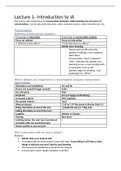
Lecture 1- Introduction to IA
The course will mostly focus on Conversation Analysis= Understanding the structure of
conversations. Can be about job interview, sales, customer service, news interview etc. etc.
Transcription
Different transcription systems
Transcripts in interviews Transcripts in conversation analysis
Focus on content Focus on interaction
“I told that to the officer” “I told that thuh-uh- officer”
Details have meaning
- Pauses and cut-offs show the
speaker is editing, error avoidance
takes place
- Pronunciation “thuh” instead of
“thee” indicates the speaker was
planning to use a noun starting with
a consonant, such as cop
- Speaker might be avoiding “cop”,
replacing it by “officer”
Which details are important in conversation analysis transcripts?
Types of details:
Inhalations and exhalations .hh and hh
Drawn out sounds (longer sounds) Yeah::
Cut-off words That-
Emphasis Are you happy (underlining)
Increased volume YOU (capitals)
Decreased volume °you°
Silences/pauses (1.4) or (.) if the pause is shorter than 0.3
Rising intonation at end of the turn , (moderate rise) or ? (big rise)
Falling intonation at end of the turn .
Laughter Hehehe or hahaha
Overlap [but then]
Latching (when the next turn is produced =
smoothly after the second turned)
Words spelled as pronounced
Why transcribe with so much detail?
Reasons:
Details help us to analyze talk
To analyze talk we need to get to know the data. Transcribing it will help us hear
things in talk that you don’t find by just listening
The transcript is published as proof for the analysis
A transcript is never totally complete or perfect
,Understanding ethnomethodology
Social structure and implicit social norms
Imagine you are walking on the street and someone starts to walk right next to you
the whole time. Most people will feel weird about this. There are social rules for
things like walking on the street
What is ordinary between people? How can we know that? Ethnomethodology.
Ethnomethodology
Ethnomethodology tries to understand what normal behaviour is. Studies social
structures as produced by members of a culture themselves
Ethnomethodology is qualitative research with attention to detail. It is the point of
departure for CA.
Indexicality= The meaning of utterances comes not from the words alone, but from
their use in a specific context.
What is normal or ordinary?
Normal or ordinary is not who we are, but how we construct our actions
We do work to present ourselves as ordinary
Instead of us being normal, it is an achievement which we achieve by abiding by
implicit procedures and assumptions Doing being normal.
People can choose to play by the norms/procedures or not
People can negotiate the norms and change the context.
Social situations are flexible
How do we know what ordinary procedures are?
1. Violating the rules Breaching experiment
1. You suspect an implicit norm/procedure
2. You deliberately violate that suspected norm/procedure
3. You observe how you feel and how others respond to your behaviour
Other people’s responses will probably display it if you indeed have violated an
implicit norm (avoiding you, irritation display, correction).
Example: You go into an empty bus and sit right between the only other person and
see they act very busy to not talk to you.
Indexicality has been found by breaching experiments as well
Indexicality= Meaning of words depends on the context of use + range of norms.
How do we open jars, we should take jelly out of the jar before putting it on the
sandwich, how do we grab sandwiches etc.
2. Documentary method of interpretation
Every action that you observe is taken as a piece of evidence for the existence of a
particular underlying pattern. The pattern is then used to understand the action.
Usually the pattern is implicit (how we stand in a queue)
Sometimes the pattern can become more explicit such as when:
- Doing a breaching experiment
- When adapting to a new culture (handing over payments with two hands in
shops in Asia).
,Why does it matter what is ordinary?
Procedures and assumptions of ‘doing being ordinary’ are a resource:
To produce our own behaviour, to come across as ordinary
To recognize other’s behaviour as normal as long as they stick to the procedures
The procedures make human interaction and social life possible
Doing being ordinary when telling a story
How to do be ordinary when telling a story:
Use an appropriate level of detail depending on context
Construct an accountable (logical, following the normal procedures) story
Construct a story that reflect the teller’s relationship to the events and to the
addressee
Tell the story at an appropriate time
Accountability
Meanings:
1. Logical, following the normal procedures
2. An utterance that needs explanation
The second meaning becomes relevant when actions fail to make immediate sense.
Similarities and differences between conversation analysis and
ethnomethodology
Similarities:
Methods members of a community use to organize social life
Looking for patterns and norms in everyday human life
Interested in social actions as produced by the members
Differences:
Ethnomethodology Conversation Analysis
Interested in social actions in general Focus on talk
Uses breaching experiments Are there natural departures of norms and
responses. Looking for deviant cases from
the pattern
Works with field notes Works with transcription and turn by turn
analysis
Conversation Analysis as a Methodological Approach
Meaning and local context
A baby is born and a health visitor visits the parents, the baby is thumb-sucking.
Health visitor: He is enjoying that, isn’t he?
There are different options as to what the health visitor actually meant
The meaning of the utterance is dependent on the interpretation of the co-
interactant in the local context. Conversation analysis looks at this.
The term Conversation Analysis
Conversation analysis:
Concerns everyday talk
, And all sorts of institutional interaction (legal, medical, business, government)
And multimodality (speech, posture, head, arms, props)
And text-based interaction (chat, WhatsApp, email)
Talk as social action
Which actions do speakers accomplish towards each other?
Example:
- Why didn’t you wash the dishes?
- Grammatical format: Question
- Social action: Complaint
Example:
- A: You look like you’re not really in the mood for this party
- B: No, not really
- Response of B: Denial
- Social action: Confirmation
How to determine which social action is happening?
Context can be used to determine social actions. In Conversation Analysis, we look at
sequential context: What happens in the turns before and the turns after the utterance?
How the turn before influences the social action:
- A: ‘You look like you’re not really in the mood for this party’
- B: ‘No, not really’
- Social action: Confirmation
However, if A would say:
- A: ‘Are you in the mood for tonight’s party?’
- B: ‘No, not really’
- Social action: Denial
This change in social action is caused by the turn before ‘not really’.
How the turn after influences the social action:
- A: ‘Shall I clean your windows for you?’
- B: ‘That would be great, thank you’
- Social action: Treat A’s turn as an offer
However, if B would say:
- A: ‘Shall I clean your windows for you?’
- B: ‘I actually cleaned the windows last week. It was really bad weather here
yesterday.’
- Social action: Response of B treats A’s turn as criticism
Next turn proof procedure= As analyst you look at the next turn. How does the turn
function in this particular interaction?
Empirical approach
Conversation analysis is an empirical approach. What can we see and hear in the
data?
Conversation analysts study the resources that speakers also make available to each
other: Words, hesitations, reformulations, inhales and exhales, volume and
intonation, laughter, posture etc.
The course will mostly focus on Conversation Analysis= Understanding the structure of
conversations. Can be about job interview, sales, customer service, news interview etc. etc.
Transcription
Different transcription systems
Transcripts in interviews Transcripts in conversation analysis
Focus on content Focus on interaction
“I told that to the officer” “I told that thuh-uh- officer”
Details have meaning
- Pauses and cut-offs show the
speaker is editing, error avoidance
takes place
- Pronunciation “thuh” instead of
“thee” indicates the speaker was
planning to use a noun starting with
a consonant, such as cop
- Speaker might be avoiding “cop”,
replacing it by “officer”
Which details are important in conversation analysis transcripts?
Types of details:
Inhalations and exhalations .hh and hh
Drawn out sounds (longer sounds) Yeah::
Cut-off words That-
Emphasis Are you happy (underlining)
Increased volume YOU (capitals)
Decreased volume °you°
Silences/pauses (1.4) or (.) if the pause is shorter than 0.3
Rising intonation at end of the turn , (moderate rise) or ? (big rise)
Falling intonation at end of the turn .
Laughter Hehehe or hahaha
Overlap [but then]
Latching (when the next turn is produced =
smoothly after the second turned)
Words spelled as pronounced
Why transcribe with so much detail?
Reasons:
Details help us to analyze talk
To analyze talk we need to get to know the data. Transcribing it will help us hear
things in talk that you don’t find by just listening
The transcript is published as proof for the analysis
A transcript is never totally complete or perfect
,Understanding ethnomethodology
Social structure and implicit social norms
Imagine you are walking on the street and someone starts to walk right next to you
the whole time. Most people will feel weird about this. There are social rules for
things like walking on the street
What is ordinary between people? How can we know that? Ethnomethodology.
Ethnomethodology
Ethnomethodology tries to understand what normal behaviour is. Studies social
structures as produced by members of a culture themselves
Ethnomethodology is qualitative research with attention to detail. It is the point of
departure for CA.
Indexicality= The meaning of utterances comes not from the words alone, but from
their use in a specific context.
What is normal or ordinary?
Normal or ordinary is not who we are, but how we construct our actions
We do work to present ourselves as ordinary
Instead of us being normal, it is an achievement which we achieve by abiding by
implicit procedures and assumptions Doing being normal.
People can choose to play by the norms/procedures or not
People can negotiate the norms and change the context.
Social situations are flexible
How do we know what ordinary procedures are?
1. Violating the rules Breaching experiment
1. You suspect an implicit norm/procedure
2. You deliberately violate that suspected norm/procedure
3. You observe how you feel and how others respond to your behaviour
Other people’s responses will probably display it if you indeed have violated an
implicit norm (avoiding you, irritation display, correction).
Example: You go into an empty bus and sit right between the only other person and
see they act very busy to not talk to you.
Indexicality has been found by breaching experiments as well
Indexicality= Meaning of words depends on the context of use + range of norms.
How do we open jars, we should take jelly out of the jar before putting it on the
sandwich, how do we grab sandwiches etc.
2. Documentary method of interpretation
Every action that you observe is taken as a piece of evidence for the existence of a
particular underlying pattern. The pattern is then used to understand the action.
Usually the pattern is implicit (how we stand in a queue)
Sometimes the pattern can become more explicit such as when:
- Doing a breaching experiment
- When adapting to a new culture (handing over payments with two hands in
shops in Asia).
,Why does it matter what is ordinary?
Procedures and assumptions of ‘doing being ordinary’ are a resource:
To produce our own behaviour, to come across as ordinary
To recognize other’s behaviour as normal as long as they stick to the procedures
The procedures make human interaction and social life possible
Doing being ordinary when telling a story
How to do be ordinary when telling a story:
Use an appropriate level of detail depending on context
Construct an accountable (logical, following the normal procedures) story
Construct a story that reflect the teller’s relationship to the events and to the
addressee
Tell the story at an appropriate time
Accountability
Meanings:
1. Logical, following the normal procedures
2. An utterance that needs explanation
The second meaning becomes relevant when actions fail to make immediate sense.
Similarities and differences between conversation analysis and
ethnomethodology
Similarities:
Methods members of a community use to organize social life
Looking for patterns and norms in everyday human life
Interested in social actions as produced by the members
Differences:
Ethnomethodology Conversation Analysis
Interested in social actions in general Focus on talk
Uses breaching experiments Are there natural departures of norms and
responses. Looking for deviant cases from
the pattern
Works with field notes Works with transcription and turn by turn
analysis
Conversation Analysis as a Methodological Approach
Meaning and local context
A baby is born and a health visitor visits the parents, the baby is thumb-sucking.
Health visitor: He is enjoying that, isn’t he?
There are different options as to what the health visitor actually meant
The meaning of the utterance is dependent on the interpretation of the co-
interactant in the local context. Conversation analysis looks at this.
The term Conversation Analysis
Conversation analysis:
Concerns everyday talk
, And all sorts of institutional interaction (legal, medical, business, government)
And multimodality (speech, posture, head, arms, props)
And text-based interaction (chat, WhatsApp, email)
Talk as social action
Which actions do speakers accomplish towards each other?
Example:
- Why didn’t you wash the dishes?
- Grammatical format: Question
- Social action: Complaint
Example:
- A: You look like you’re not really in the mood for this party
- B: No, not really
- Response of B: Denial
- Social action: Confirmation
How to determine which social action is happening?
Context can be used to determine social actions. In Conversation Analysis, we look at
sequential context: What happens in the turns before and the turns after the utterance?
How the turn before influences the social action:
- A: ‘You look like you’re not really in the mood for this party’
- B: ‘No, not really’
- Social action: Confirmation
However, if A would say:
- A: ‘Are you in the mood for tonight’s party?’
- B: ‘No, not really’
- Social action: Denial
This change in social action is caused by the turn before ‘not really’.
How the turn after influences the social action:
- A: ‘Shall I clean your windows for you?’
- B: ‘That would be great, thank you’
- Social action: Treat A’s turn as an offer
However, if B would say:
- A: ‘Shall I clean your windows for you?’
- B: ‘I actually cleaned the windows last week. It was really bad weather here
yesterday.’
- Social action: Response of B treats A’s turn as criticism
Next turn proof procedure= As analyst you look at the next turn. How does the turn
function in this particular interaction?
Empirical approach
Conversation analysis is an empirical approach. What can we see and hear in the
data?
Conversation analysts study the resources that speakers also make available to each
other: Words, hesitations, reformulations, inhales and exhales, volume and
intonation, laughter, posture etc.


